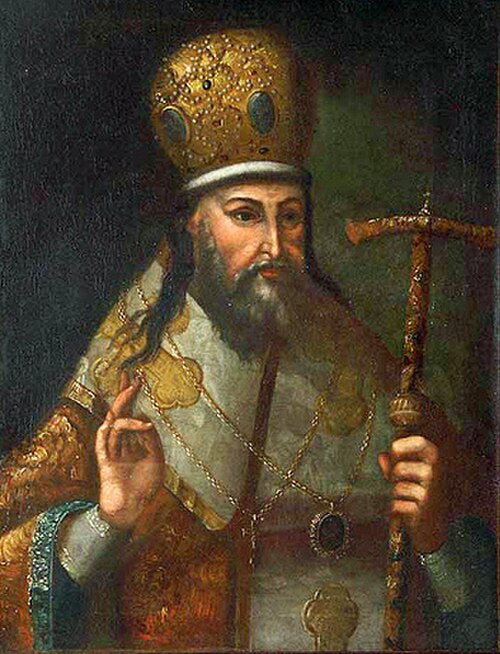
Hieromartyr
Arsenius Matsievich
Metropolitan of Rostov
Metropolitan of Rostov and Yaroslavl who died at Reval in 1772 after opposing the seizure of church property.
Life
Saint Arsenius Matsievich, Metropolitan of Rostov and Yaroslavl, was a hierarch of the Russian Church in the eighteenth century, a native of Volhynia. He was the only bishop to stand up openly against the seizure of monastic property by Empress Catherine II, and for this he was deposed, stripped of his monastic status, and imprisoned for life. He died in the prison of the fortress of Reval, now Tallinn, in 1772, and the Russian Church numbered him among the saints in 2000.
Origins and education
Alexander Ivanovich Matsievich was born in 1697 at Vladimir-Volynsky, the son of a priest. His family descended from the minor Polish nobility or, according to other sources, from the Orthodox gentry of western Rus. His father, John, served at the Church of the Saviour in the town. Some Ukrainian sources say that his grandfather was a Pole and his father a Uniate priest.
He received a fine education, studying at the church school of his native town, at the school of rhetoric in Lviv, and then at the Kiev Theological Academy.
Monk and preacher
In 1716 he was sent as a preacher to the Saviour Monastery at Novgorod-Seversky in the diocese of Chernigov. There Archimandrite Gennadius (Stefanovich) tonsured him a monk with the name Arsenius. In the monastery he sang in the choir, preached, and taught the children Latin.
In 1717 he was sent to Chernigov to Archbishop Anthony (Stakhovsky), a friend of Metropolitan Stephen Yavorsky, who ordained him hierodeacon. Under his influence he decided to continue his studies. In 1718 he returned to the Kiev Academy for philosophy and theology, and in 1723 he was ordained hieromonk in the Cathedral of Saint Sophia in Kiev. He completed his studies in 1726.
After the academy he preached in Kiev, lived for a time at the Kiev Caves Lavra, and late in 1729 came to the Saint Elias Monastery at Chernigov. In 1730 he was sent to Tobolsk, where he spent three years as preacher and teacher.
Siberia, the North, and Bering's expedition
In 1733, returning from Siberia, he travelled through Ustyug, Kholmogory, and the Solovetsky Monastery, where he disputed with the Old Believers imprisoned there. From 1734 to 1736 he took part in the Second Kamchatka Expedition led by Vitus Bering. In 1736 he was arrested and brought from Pustozersk to the Admiralty College in a secret case, but was found innocent.
Ill with scurvy, he was released from naval service in 1737 through the intercession of Archbishop Ambrose (Yushkevich) of Vologda, with whom he remained for a time. From 1738 he was a hieromonk at the Synod's house in Saint Petersburg and teacher of religion at the gymnasium of the Academy of Sciences and the Cadet Corps.
The years as examiner
From 1738 he was charged with examining candidates for the priesthood and clergy and with admonishing those who had strayed from Orthodoxy. The sources show that these inquiries, after the harsh custom of the time, went as far as torture. Hieromonk Arsenius had a Yaroslavl hegumen named Tryphon, an old man of eighty-five, tortured until he died, and the Synod, on the complaint of the local bishop, ruled that thereafter clergy should be interrogated with more restraint. Some Ukrainian sources also ascribe to him a role in the condemnation to death of the naval officer Voznitsyn, who had converted to Judaism.
Metropolitan of Siberia
In March 1741, during the regency of Anna Leopoldovna, he was consecrated Metropolitan of Tobolsk and all Siberia. He was chosen for his knowledge of Siberia, but also because shortly before he had refused to swear allegiance to Duke Biron, regent for the infant Emperor Ivan Antonovich.
Later he refused to swear the oath to Empress Elizabeth as well, because its wording called the monarch the "supreme judge" of the Synod. Instead he proposed that the Lord Jesus Christ Himself, Head of the Church and Great High Priest, be confessed as the judge and lawgiver of church government. He held that giving this title to a human being was flattery that diminished Christ, the true Judge. Elizabeth allowed him to omit the phrase, but he still did not take the oath.
Metropolitan of Rostov
His refusal did not harm his career. In 1742 he preached several times during the coronation, and in May 1742 he was transferred to Rostov and made a member of the Holy Synod. He governed the diocese of Rostov and Yaroslavl from 1742 to 1763. Between 1742 and 1761 he often preached at court, and his sermons survive in twelve manuscript volumes at the Trinity Lavra.
In his diocese he found many Old Believers, a people left ignorant for lack of schools, and a poorly prepared clergy. On his initiative a Slavonic-Latin seminary was opened at the Saviour Monastery in Yaroslavl. Some historians, such as P. V. Znamensky, nevertheless saw him as an opponent of church schools and blamed him for closing the Latin school in Rostov. In 1759 he clashed with the rector of the Yaroslavl seminary, whose teaching he considered Judaising and Calvinist.
In 1752 he led the uncovering of the relics of Saint Dimitry of Rostov. He wrote works against the Old Believers and a rebuttal of a Lutheran pamphlet called "The Hammer". Toward the Old Believers he was very harsh, as a man of his time, often relying on the power of the state and keeping wealthy and prominent Old Believers in prison.
With Archbishop Ambrose (Yushkevich) he wrote a memorandum in 1742 protesting against synodal government and the College of Economy and proposing the restoration of the patriarchate.
Against secularisation
When Catherine II decided to transfer monastic lands to the state, Metropolitan Arsenius was the only hierarch to oppose it openly. From March 1763 he sent the Synod one protest after another against the seizure of monastic estates and against the interference of laymen in church affairs. He sharply criticised the president of the College of Economy, Count Musin-Pushkin, whom he called "a Turk".
On the Sunday of Orthodoxy, at the service, he added to the usual anathemas against heretics one against those who oppress churches and monasteries. The empress called him a hypocrite, a schemer, and a raving liar. The Synod, which since its foundation had the monarch at its head, supported the secularisation and sent the empress a report on his actions.
The trial
Catherine ordered the Synod itself to try him. In March 1763 a guards officer came to Rostov with orders to bring him to Moscow with only three attendants and to seal all his papers. In Moscow he was held under strict guard in the Simonov Monastery. He was brought to the palace at night and questioned before the empress, and the sources say he spoke so boldly that the empress covered her ears and he was gagged.
On 14 April 1763 the Synod sentenced him to be deposed from the episcopate and from monasticism and handed over to the civil court, which for insulting the empress would have condemned him to death. The empress left him only the monastic habit and sent him under supervision to a remote monastery, first to Ferapontov and then to the Monastery of Saint Nicholas at Korela in the diocese of Arkhangelsk.
The final sentence
In exile he continued to criticise the empress's policies sharply. He condemned the imprisonment of the former Emperor Ivan Antonovich, killed in the Schlüsselburg fortress when Lieutenant Mirovich tried to free him, and he defended Mirovich. In 1767, on the denunciation of an officer, a new investigation was opened, which the empress examined in person.
He was stripped of his monastic status as well, reduced to the rank of a peasant, and confined in a cell of the Reval fortress at the Smiths' Gate under the name "Andrei Vral", that is, Andrew the Liar. His guards were to be soldiers who knew no Russian, and he was forbidden to write, though he could read books in Russian. According to one tradition, the empress ordered his portrait in full metropolitan's vestments to be hung in his cell to increase his suffering.
Repose
The aged hierarch died in the Reval prison on 28 February 1772, Old Style, according to some sources from cold and hunger. He was buried at Reval in the Dormition chapel of the Church of Saint Nicholas.
Rehabilitation and veneration
On 28 June 1918 the Local Council of the Russian Church restored him to episcopal dignity, judging that he had been deprived of it for political reasons. In August 2000 the Jubilee Council of Bishops of the Russian Orthodox Church glorified him for veneration throughout the Church as a hieromartyr. In 2004 he was also canonised by the Kiev Patriarchate.
Saint Arsenius of Rostov is commemorated on 28 February (12 March in leap years and 13 March in other years, New Style) and on 23 May, in the Synaxis of the Saints of Rostov and Yaroslavl.
Commemorated the same day May 23
 Mary of ClopasSaint · MyrrhbearerMay 23
 Euphrosyne of PolotskVenerable · Abbess of PolotskMay 23
 Demetrius I of GeorgiaRight-Believing · King of GeorgiaMay 23
 Michael of SynnadaSaint · Metropolitan of SynnadaMay 23
 Nicetas the Stylite of PereslavlStylite · Founder of Saint Nicetas MonasteryMay 23
 Epiphanius the WiseVenerable · Monk and hagiographerMay 23
 Desiderius of LangresHieromartyr · Bishop of LangresMay 23
 Euphebius of NaplesSaint · Bishop of NaplesMay 23
 Leontius of RostovSaint · Bishop of RostovMay 23
 Cyril II of RostovSaint · Bishop of RostovMay 23
 Dimitry of UglichRight-Believing · Prince of UglichMay 23
 Simeon of VladimirSaint · Bishop of VladimirMay 23