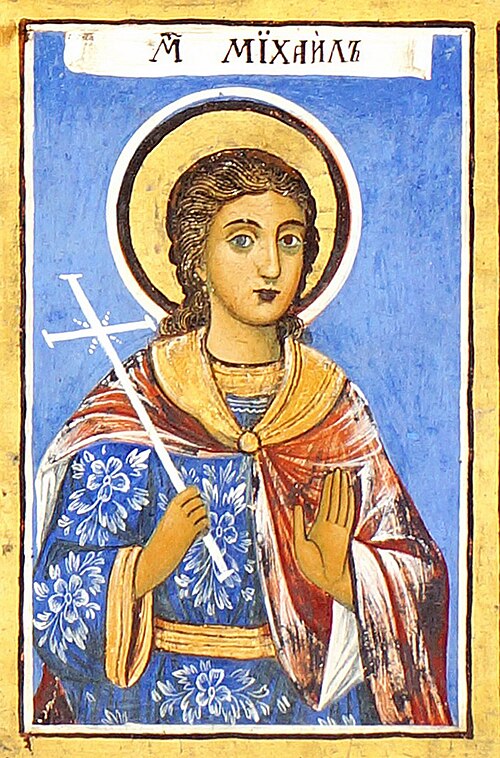
Saint
Michael of Synnada
Metropolitan of Synnada
Metropolitan of Synnada from 784 to 815, sent on missions to Harun al-Rashid and Charlemagne; died in 826.
Life
Saint Michael the Confessor, metropolitan of Synnada, was metropolitan of Synnada, in Phrygia, from 784 or 787 to 815, sent as envoy to Harun al-Rashid and to Charlemagne, then exiled by the emperor Leo V the Armenian for defending the holy icons. He fell asleep on 23 May 826 (in other sources, around 818 or 821). His feast is on 23 May.
No details of his beginnings are known. From youth he desired monastic life and was sent by Patriarch Tarasius, who also tonsured him, to a monastery on the shore of the Bosporus or the Black Sea, founded by him; with him entered the monastery Saint Theophylact, the future bishop of Nicomedia. Both struggled zealously and were glorified by gifts from the Lord: once, at harvest, when the people languished with thirst, at the prayer of the two monks an empty bronze vessel began to pour out water (in the Serbian account, a rain in time of drought). Tarasius ordained him bishop of the city of Synnada. In 787 he took part in the Seventh Ecumenical Council at Nicaea, being recorded in all its sessions. For his life and wisdom he had the love of the people and the attention of the emperors Nikephoros I and Michael Rangabe.
Michael of Synnada is commonly identified with the bishop Michahel who, with the abbot Peter, led the embassy sent by Nikephoros I to Charlemagne in 802-803, to ratify the peace between them. In 806, when the caliph Harun al-Rashid launched a great invasion of Asia Minor, Nikephoros sent them again, with Gregory, the steward of Amastris, as peace envoys. In 811-812 he led another embassy to Charlemagne, with the protospatharioi Arsaphios and Theognostos, on behalf of Michael I Rangabe, to renew the peace and negotiate a marriage between Michael's son Theophylact and a daughter of Charlemagne. Although he was warmly received at Aachen and a peace treaty was ratified, Charlemagne hesitated to agree to the match. On the way, the embassy passed through Rome, where Michael handed Pope Leo III the synodical letter of Nikephoros I, Tarasius's successor.
When, in 815, Leo V the Armenian returned to iconoclasm and began to remove Orthodox bishops from their sees, Michael steadfastly defended Orthodoxy and rebuked the errors of the heretics. The emperor condemned him; the saint answered fearlessly: I honour the holy icons of my Saviour Jesus Christ and of the Most Pure One, his Mother, and of all the saints and bow to them. Your order to remove the icons from the churches I will not carry out. He was exiled to Eudokias, where he died. His head is kept at the Great Lavra on Athos, and part of his relics at the Iviron monastery. He is praised in the Synodikon of Orthodoxy of 843 and is invoked for protecting crops from pests.
Commemorated the same day May 23
 Mary of ClopasSaint · MyrrhbearerMay 23
 Euphrosyne of PolotskVenerable · Abbess of PolotskMay 23
 Demetrius I of GeorgiaRight-Believing · King of GeorgiaMay 23
 Nicetas the Stylite of PereslavlStylite · Founder of Saint Nicetas MonasteryMay 23
 Epiphanius the WiseVenerable · Monk and hagiographerMay 23
 Desiderius of LangresHieromartyr · Bishop of LangresMay 23
 Euphebius of NaplesSaint · Bishop of NaplesMay 23
 Arsenius MatsievichHieromartyr · Metropolitan of RostovMay 23
 Leontius of RostovSaint · Bishop of RostovMay 23
 Cyril II of RostovSaint · Bishop of RostovMay 23
 Dimitry of UglichRight-Believing · Prince of UglichMay 23
 Simeon of VladimirSaint · Bishop of VladimirMay 23