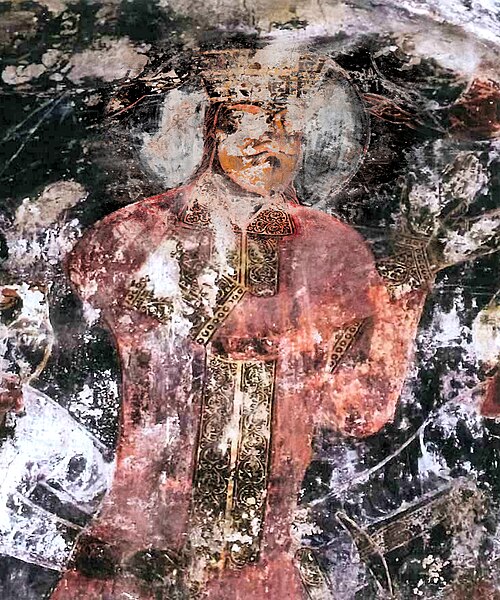
Right-Believing
Demetrius I of Georgia
King of Georgia
King of Georgia from 1125 to 1156, of the Bagrationi dynasty, also known as a poet.
- Feast
- May 23old style June 5
- Reposed
- 115612th century
- Place
- Mtskheta
Life
Demetrius I was King of Georgia of the Bagrationi dynasty from 1125 to 1156, the eldest son of David IV the Builder. The Georgian Orthodox Church honours him as a saint, and after he was forced to leave the throne he became a monk with the name Damian and left church hymns, among them the well-known "Thou art a vineyard".
Youth and arms
Demetrius was the eldest son of David IV by his first wife, Rusudan, an Armenian, and he was raised at Kutaisi. In 1117 his father sent him on a punitive expedition to Shirvan, where the young commander took the fortress of Kaladzori, later called Alberd, and returned with captives and great wealth, which strengthened his fame. On 12 August 1121, at the Battle of Didgori against the Seljuks, David IV divided his army in two, and Demetrius led a hidden reserve. The Georgians feigned a desertion and sowed confusion in the enemy camp, and when the Seljuk leadership faltered, Demetrius struck from the flank and broke the enemy forces. He then pursued them for three days. In 1125, according to the Life of King Demetre, David declared him co-ruler and crowned him with his own hands, saying that through wisdom, chastity and bravery he would govern Georgia well. David departed to the Lord that year, on 24 January, and Demetrius remained king.
Reign
Demetrius received from his father a large and flourishing state, from the Black Sea to the Caspian, and he strove to keep it within its borders. Already in 1125 he had to drive the Seljuks from the fortress of Dmanisi, which guarded one of the approaches to Tbilisi from the south. In 1129 and 1130, with the help of his sister, he reached a settlement in Shirvan, which was divided in two, the Christian part joining Georgia, and the eastern part remaining to the emir Manuchihr, a vassal of Georgia. In 1130 he had to give up Ani to the Shaddadids, on the condition that the great church of the city remain Christian and that Georgia might intervene to protect Christians. In the same year his half-brother Vakhtang rebelled with the support of the great lord Ivane Abuletisdze, but the king seized the plotters, and Vakhtang was blinded and cast into prison.
In 1139 Demetrius raided Ganja and brought its iron gate to Georgia, giving it to Gelati Monastery at Kutaisi, where it is kept to this day. Ganja could not be held for long and fell again in 1143. In 1154, in agreement with the emir Shaddad of Ani, he won a victory over the emir Saltuk of Erzurum, whom he captured and released for a ransom. According to the sources, his time was a good one for the Muslims of Tbilisi, and the king went to the mosque on Fridays and listened to the prayer. He gave his daughter Rusudan in marriage to Seljuk rulers, and another daughter, in 1154, to Iziaslav II of Kiev.
Abdication
Demetrius had two sons, David, the eldest, and George, the youngest, whom he loved more and for whom he fixed the inheritance, setting David aside. The families that had earlier backed his brother Vakhtang now rose against this setting aside. A first attempt at a coup failed in 1150, but in 1154 or 1155 David succeeded, and the king was forced into a monastery and became a monk with the name Damian. In the monastery he composed church hymns, among them the hymn "Shen khar venakhi" (Thou art a vineyard), dedicated to the Mother of God, which is attributed to him. After six months of rule David died, and Demetrius returned to the throne. The sources differ about his end: according to some he died soon afterward, in the fortress of Bebristsikhe, while according to others he handed power in 1156 to his son George III, the father of Queen Tamar the Great, and lived after 1158 as the monk Damian. He was buried at Gelati Monastery.
The Georgian Church commemorates him as a saint on 23 May. The poet and hymnographer king is honoured not only for his defence of the country but also for his songs.
Commemorated the same day May 23
 Mary of ClopasSaint · MyrrhbearerMay 23
 Euphrosyne of PolotskVenerable · Abbess of PolotskMay 23
 Michael of SynnadaSaint · Metropolitan of SynnadaMay 23
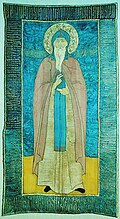 Nicetas the Stylite of PereslavlStylite · Founder of Saint Nicetas MonasteryMay 23
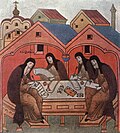 Epiphanius the WiseVenerable · Monk and hagiographerMay 23
 Desiderius of LangresHieromartyr · Bishop of LangresMay 23
 Euphebius of NaplesSaint · Bishop of NaplesMay 23
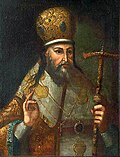 Arsenius MatsievichHieromartyr · Metropolitan of RostovMay 23
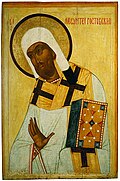 Leontius of RostovSaint · Bishop of RostovMay 23
 Cyril II of RostovSaint · Bishop of RostovMay 23
 Dimitry of UglichRight-Believing · Prince of UglichMay 23
 Simeon of VladimirSaint · Bishop of VladimirMay 23