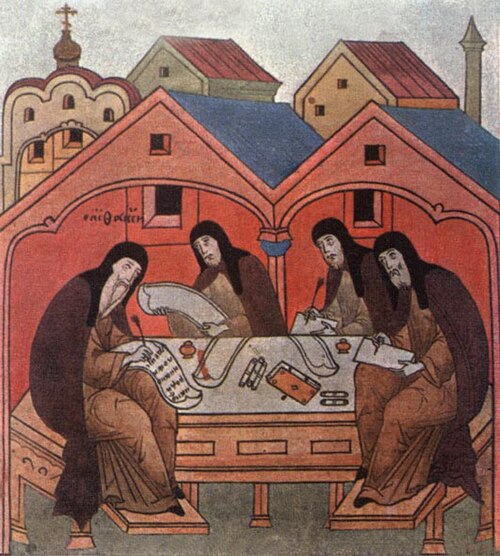
Venerable
Epiphanius the Wise
Monk and hagiographer
Russian monk and hagiographer, disciple of Sergius of Radonezh; died around 1420.
- Feast
- May 23old style June 5
- Reposed
- 142015th century
- Place
- Rostov Veliky
- Order
- Venerables
Life
The Venerable Epiphanius the Wise (Premudry) was a Russian monk and hagiographer, disciple of Saint Sergius of Radonezh. He was born at Rostov in the first half of the fourteenth century and died around 1420 (no later than 1422), as a hieromonk, at the Trinity Monastery. He is commemorated on 23 May (5 June) in the Synaxis of the Saints of Rostov and Yaroslavl. The historian Serge Zenkovsky said that he, with Stephen of Perm, Sergius of Radonezh and the painter Andrei Rublev, embodied "the Russian spiritual and cultural revival of the late fourteenth and early fifteenth century".
Youth and travels Judging by the Life of Stephen of Perm that he wrote, he studied, like Stephen, at the monastery of Saint Gregory the Theologian at Rostov, called the Zatvor, famous for its library. As a young man he learned to copy manuscripts and paint icons. He also learned Greek and the Greek hagiographic traditions. He often "quarrelled" with Stephen about the meaning of texts and sometimes reproached him, which shows that if Stephen was older, it was not by much. He was well educated: the many quotations and literary reminiscences made from memory and interwoven in his writings show that he knew the Psalter, the New Testament, several books of the Old Testament, and was well read in patristic and hagiographic literature. Some facts suggest he travelled widely, to Constantinople, Athos and Jerusalem. Later he came to the Monastery of the Holy Trinity, founded by Sergius in 1337. In the title of the Encomium of Sergius of Radonezh he is called his disciple, and Pachomius the Logothete (the Serb) says he lived many years, from youth, "together with the abbot of the Trinity". In 1380 he was at the Trinity-Sergius Lavra, a mature man, learned, an experienced copyist and draftsman, and an observant man inclined to chronicle notes. After Sergius's death, in 1392, he began to make notes about him, then probably went to Moscow, into the service of Metropolitan Cyprian, and became a friend of Theophanes the Greek. In 1408, at the time of Khan Edigu's attack on Moscow, he fled to Tver, where he made friends with the archimandrite of the Spaso-Athanasiev monastery, Cornelius, in the schema Cyril, with whom he later corresponded. In one of his letters he spoke with praise of the skill and works of Theophanes the Greek, of his mind and learning (the letter of 1413 is the principal source on the great painter) and called himself an "icon painter". In the 1410s he settled again at the Trinity Monastery, holding a place of honour among the brethren: "he was confessor in the great lavra to the whole brotherhood".
Writings He wrote at least three works: the Life of Saint Stephen of Perm ("Discourse on the life and teaching of our father Stephen, bishop of Perm", finished soon after Stephen's death, in 1396, preserved in about fifty copies of the fifteenth to seventeenth centuries), the Life of Saint Sergius of Radonezh and the Encomium of Sergius. Boris Kloss argues that he is also the author of the Trinity Chronicle. He began gathering the materials for the Life of Sergius a year after the saint's death, from his own memories and the accounts of other contemporaries, and finished it twenty-six years after his death, around 1417 to 1418. The work was reworked by Pachomius the Serb, a version more often found, and in fifteenth-century copies the life appears rarely. To him are also attributed the "Tale of the monk Epiphanius about the road to the holy city of Jerusalem", the introduction to the Tver Chronicle and a letter to Abbot Cyril of Tver.
The Life of Sergius follows well established hagiographical conventions and has many parallels to passages of Scripture. Epiphanius dwells on the saint's spiritual qualities, and so does not stress his close ties to Prince Dmitry Donskoy. He wished to portray an idealized sanctity and did so through lengthy praises. His literary style was named "pletenie sloves", the weaving of words, and is recognized by the abundance of new words, formed from nouns or noun-adjective pairs. In his view the ordinary words of a common man "are incapable of expressing the greatness of the deeds done by holy men to the glory of Christ." Zenkovsky hails his writings as "a new page in Russian literary history". It is often thought that the new style was influenced by the contemporary surge in Russian painting, and Epiphanius was a great admirer of Theophanes the Greek. According to Tvorogov, he shows better than other Russian authors the style of the second South Slavic influence, which brought the literary language closer to the Balkan tradition and a spirit of pre-renaissance, attention to the inner life of the human being. The lives he wrote give no concrete details of real life.
Commemorated the same day May 23
 Mary of ClopasSaint · MyrrhbearerMay 23
 Euphrosyne of PolotskVenerable · Abbess of PolotskMay 23
 Demetrius I of GeorgiaRight-Believing · King of GeorgiaMay 23
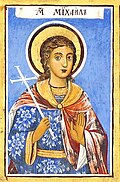 Michael of SynnadaSaint · Metropolitan of SynnadaMay 23
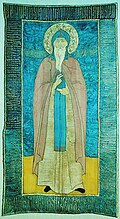 Nicetas the Stylite of PereslavlStylite · Founder of Saint Nicetas MonasteryMay 23
 Desiderius of LangresHieromartyr · Bishop of LangresMay 23
 Euphebius of NaplesSaint · Bishop of NaplesMay 23
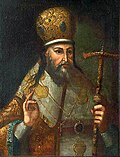 Arsenius MatsievichHieromartyr · Metropolitan of RostovMay 23
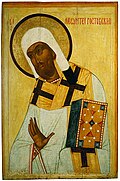 Leontius of RostovSaint · Bishop of RostovMay 23
 Cyril II of RostovSaint · Bishop of RostovMay 23
 Dimitry of UglichRight-Believing · Prince of UglichMay 23
 Simeon of VladimirSaint · Bishop of VladimirMay 23