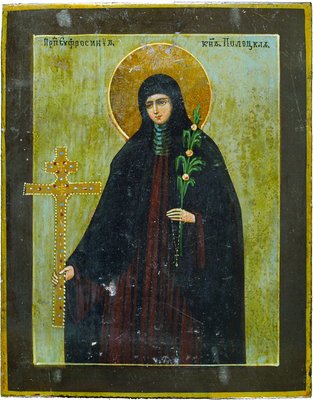
Venerable
Euphrosyne of Polotsk
Abbess of Polotsk
Princess of Polotsk who became an abbess and founded monasteries, who reposed in Jerusalem in 1167.
- Feast
- May 23old style June 5
- Reposed
- 116712th century
- Place
- Jerusalem
- Order
- Venerables
Life
Saint Euphrosyne of Polotsk (Predslava) was a princess of Polotsk, daughter of Prince Svyatoslav (George) Vseslavich, a nun, abbess, founder of monasteries and enlightener. She died in the Holy Land, around 1167 (according to other sources, in 1173). She is commemorated on 23 May and is one of the fifteen patron saints of Belarus, celebrated on the first Sunday after Pentecost; she is the only virgin saint of East Slavic origin.
Youth and monasticism
Predslava was born between 1101 and 1105 in the family of Rurik, whose members were the princes of Polotsk, today in Belarus, a granddaughter of Prince Vseslav. From childhood she learned to read the Psalter and other books, and her love of learning was joined with prayer. When she reached twelve, her parents wished to marry her; she rejected all proposals and, without her parents’ knowledge, fled to the convent where her aunt, Romania, was abbess, and took the name Euphrosyne (“joy”). With the blessing of Bishop Elias of Polotsk, she began to live beside the Cathedral of Saint Sophia, where she copied books and, perhaps, translated; the money she earned she gave to the poor. It is said that an angel showed her in a dream the place where she should found a convent, near Polotsk, at Seltse, and appeared to her three times; the same angel also appeared to the bishop.
Foundations and work
Around 1128 the bishop entrusted her with the task of setting up a convent, the Savior-Transfiguration convent at Seltse, where she taught young women to copy books, sing, sew and other crafts, and through her efforts a cathedral was built in 1161 which survives today. She drew into monasticism her sister Evdokia and many maidens of noble families, among them a relative, Zvenislava, who brought her wealth and jewels, and Euphrosyne tonsured her with the name Evpraxia. She also founded a monastery of monks, dedicated to the Mother of God, and two churches; the church of the Holy Saviour, still standing, is the most precious monument of early Belarusian architecture. Her monasteries were centres of learning, with schools, libraries, scriptoria and an almshouse. At her order the master Lazar Bohsha made a six-armed golden cross, decorated with enamel and precious stones, given to the church of the Holy Saviour in 1161; it disappeared in 1941, during the evacuation of the museum, and has not been found.
Pilgrimage and death
Toward the end of her life she went on pilgrimage to Constantinople and the Holy Land. Patriarch Michael II gave her an icon of the Mother of God, called the “Virgin of Korsun”, and the Crusader king Amalric I of Jerusalem received her. She died at Jerusalem and was buried in the monastery of Saint Theodosius. After Saladin’s conquest of Jerusalem, in 1187, monks took her body to Kyiv, to the Caves Lavra, and in 1910 the relics were brought to her city, Polotsk. She was canonized in 1984. In Belarus there is the convent of Saint Euphrosyne in Polotsk and a church of Saint Euphrosyne in Minsk; churches bear her name also at London, Toronto, Vilnius and in New Jersey.
Commemorated the same day May 23
 Mary of ClopasSaint · MyrrhbearerMay 23
 Demetrius I of GeorgiaRight-Believing · King of GeorgiaMay 23
 Michael of SynnadaSaint · Metropolitan of SynnadaMay 23
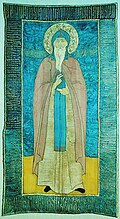 Nicetas the Stylite of PereslavlStylite · Founder of Saint Nicetas MonasteryMay 23
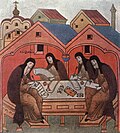 Epiphanius the WiseVenerable · Monk and hagiographerMay 23
 Desiderius of LangresHieromartyr · Bishop of LangresMay 23
 Euphebius of NaplesSaint · Bishop of NaplesMay 23
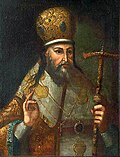 Arsenius MatsievichHieromartyr · Metropolitan of RostovMay 23
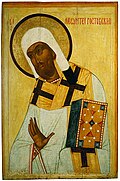 Leontius of RostovSaint · Bishop of RostovMay 23
 Cyril II of RostovSaint · Bishop of RostovMay 23
 Dimitry of UglichRight-Believing · Prince of UglichMay 23
 Simeon of VladimirSaint · Bishop of VladimirMay 23