Hieromartyr
Michael Lektorsky
A hieromartyr of the Russian Church, commemorated in the Orthodox calendar.
- Feast
- October 14old style October 27
- Reposed
- 192120th century
- Order
- Martyrs
Life
Holy Hieromartyr Michael Lektorsky, an archpriest, was born on 9 November 1872 into the family of a Kuban priest. He graduated from the Stavropol theological seminary in 1892 with the title of student. He was ordained a deacon and appointed to a deacon-teacher's place in the stanitsa of Dinskaya, where he was teacher at the one-class church school. In August 1893 he was ordained a priest and sent to the village of Blagodatnoe, where he was head and religion teacher of the one-class parish school until February 1896. Then, at his request, he was moved to the stanitsa of Voronezhskaya, to the two-class boys' and one-class girls' schools. From 13 May 1906 he was moved, at his request, to the church of Saint Andrew in the stanitsa of Novotitarovskaya. He was rector of the local parish church and from 5 April 1913 confessor of the clergy of the second district.
Father Michael was a fine family man. His wife, Ekaterina Vladimirovna (born 24 November 1872), bore him four children: Alexander (1895), Nadezhda (1898), Olga (1905) and Vladimir (1910). For his pastoral zeal he was marked with the epigonation (1900), the skufia (1905) and the kamilavka (6 May 1910); he received the archpastoral blessing and a certificate for his labour in founding a library and reading room at the church school (1908); and in 1897 he took part in the first general census of the Russian Empire as head of a census district, for which he received the thanks of the emperor and a bronze medal.
In the night of 25 to 26 September 1921, in the stanitsa of Novotitarovskaya, Archpriest Michael Lektorsky was arrested by the first cavalry brigade of Budyonny's Chongar division, on a charge of counter-revolutionary agitation, and brought with many arrested Cossacks to the stanitsa of Bryukhovetskaya, to the special department of the Bolshevik Ninth Army. For a month and a half the prisoners lived in wretched conditions, slept on straw and were eaten by fleas and lice, so that someone who chanced to see Father Michael, then forty-nine, found a very thin old man, barely able to walk. The sentence of the troika of the special department was short: death.
When a group of forty hostages had been stripped to their shirts, the Cossacks began to beg him, "Father, hear our confession." The priest heard their confession and absolved their sins, saying, "With your own blood you will be made partakers, and now forgive me for what I have done wrong." When he began to serve a moleben, they began to strike them with rifle butts, and Father Michael hardest of all. Then they tied their hands, threw them into carts and drove them outside the stanitsa to a clay pit. The Cossack lying beside Father Michael managed to free his own hands and freed those of the priest too. "Now let us run," he whispered. But the priest answered, "I bless you to run, I no longer have the strength." The Cossack ran. When the Bolsheviks found that of all the condemned only the priest had his hands untied, they put him to terrible torments.
On 27 October 1921, at ten in the evening, all the hostages were shot, and among the heap of bodies the mutilated body of Father Michael stood out. There were people who saw all this. He is commemorated on 27 October, the day of his death, in the new style, with the Synaxis of the New Martyrs and Confessors of the Russian Church (a movable day) and, on 3 October, with the Synaxis of the Saints of the Kuban Metropolis (a movable day).
Commemorated the same day October 14
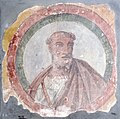 Callixtus IHieromartyr · Bishop of RomeOct 14
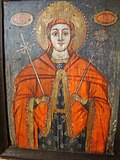 Paraskeva of the BalkansVenerable · of EpivatesOct 14
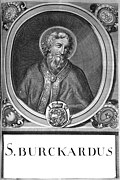 Burchard of WürzburgSaint · First Bishop of WürzburgOct 14
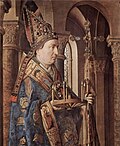 Donatian of ReimsSaint · Bishop of ReimsOct 14
 Gaudentius of RiminiHieromartyr · Bishop of RiminiOct 14
 Domninus of ThessalonikiMartyr · Martyr of ThessalonikiOct 14
 NazariusMartyr · Martyr of MilanOct 14
 Fortunata of CaesareaMartyrOct 14
 Ambrose PolyanskySaint · Bishop of Kamianets-PodilskyiOct 14
- 40 Martyrs of Egypt and PalestineHoly MartyrsOct 14
 AngadrismaVenerableOct 14
- Bernard of ArceConfessorOct 14