Hieromartyr
Michael Tikhonitsky
Cleric martyred for the faith of Christ in 1918, during the Soviet persecution.
- Feast
- September 7old style September 20
- Reposed
- 191820th century
- Order
- Martyrs
Life
Holy Hieromartyr Michael Tikhonitsky (Mikhail Petrovich Tikhonitsky), an archpriest, was born in 1846 in the village of Oshet, Nolinsk district of Vyatka province, to the psalm-reader Pyotr Tikhonitsky and his wife Anfisa Ivanovna. The child grew up obedient and curious, and from early on heard the holy Gospel read in church by his grandfather, the deacon John Yankevsky, and often helped his father to read and sing on the choir. He was sent to the clerical school at Vyatka and then to the seminary, which he finished in 1868, resolving to devote his life to the holy Church and to continue the old priestly dynasty of the Tikhonitskys.
Ministry
He was ordained a deacon and, in 1870, a priest. His service was appointed at the little church of Saint Elijah in the Izhevsk works, in the Sarapul district, which had recently been given to the Edinoverie. The young priest, hardly twenty-four, laboured at preaching the Word of God and at bringing parishioners back from schism, and kept many from error. He was then moved with his family to the village of Bystritsa, where he had four children. His wife, Apollinaria Vladimirovna, and his mother, Anfisa Ivanovna, helped him with all their strength. Two of his children, Veniamin and Vladimir, became priests, the third son, Elpidifor, a teacher, like the daughters Maria, Julia and Vera. After two years he was moved to the village of Podrelye, where he taught at the zemstvo school. The dean wrote of him, "Zealous in preaching the Word of God and in explaining the teaching of the Holy Church; he inclines to it the parishioners infected with schism." He was marked by compassion; he joined the Red Cross and received the badge of the second class. At the request of his parishioners he headed the parish trusteeship, which began to build a stone wall around the church.
In 1881 he was moved to the Holy Trinity church in the town of Orlov, Vyatka province. On 11 December 1881 his wife, Apollinaria Vladimirovna, died, his best friend, who had shared with him all the hardships of parish life. A special place in his life was held by his service at the little church of the Ascension in Orlov, where he was moved in 1898 and which stood in the middle of the old town cemetery. His son told how on the night of Pascha, after the procession, Father Michael turned to the graves scattered in the darkness and said in a deeply moving voice, "And you in the graves, Christ is risen."
In 1913 he was appointed to the Kazan-Theotokos cathedral in Orlov, though he was sixty-seven, and became confessor of the clergy of the town and dean of the churches of Orlov, still teaching at the girls' gymnasium.
Martyrdom
Patriarch Tikhon issued an epistle in which he anathematized those who took part in the slaughter of innocent people. On 15 February 1918 Father Michael read the epistle of His Holiness Patriarch Tikhon at the Divine Liturgy in the Kazan cathedral in Orlov. The same evening he was placed under house arrest. After two days the investigating commission resolved to hand the case to the Revolutionary Tribunal. The bill of indictment was full of hatred for the Church, but did not say a word against Father Michael; his only fault was the reading of the "counter-revolutionary" epistle. At interrogation he said that he did not admit guilt. The defenders drew the tribunal's attention to his moral qualities and to the fact that he was not a political man, and that his act was directed not against Soviet power, but in defence of the Church and the faith. The prosecution's hope in witnesses was not fulfilled either: they began to defend him, telling of his generosity to the poor and his lack of self-interest. On 28 February 1918 the tribunal of the Orlov soviet found him guilty of counter-revolutionary action but, taking account of his advanced age and the two weeks of house arrest, resolved on a public reprimand, with a warning that for further agitation he would be punished more severely.
Half a year passed. All this time Father Michael went on serving God, the Church and people. His health had been shaken, and, in his daughter's words, "the arrest, the stuffy air and the lack of movement had a deadly effect on his exhausted old strength". But his wish to help his neighbour remained the same: he visited the sick, helped the poor and cared for prisoners. On 5 September 1918 the Extraordinary Commission ordered a search at the Tikhonitskys' lodging, without result. After the search Father Michael seems to have been urged to leave the town, which he did, not suspecting a provocation. The day after his departure, on 7 September 1918, the commissar Vorobiev received a warrant for search and arrest of the priest Tikhonitsky "living in the village of Rusanovo of the Levinsk volost". The arrest took place on 8 September 1918 in the village of Nizhnyaya Edoma, in the house of Prokopy Semyonovich Fokin. In the search record it was noted, "search without result". Nevertheless three people were arrested: "the priest Father Michael, the kulak of the village of Edoma Prokopy Semyonovich Fokin and Ekaterina Khalturina of the village of Ryabinichi". The accusation, counter-revolutionary, was more than abstract. The absence of any offence gave him hope that the commission would release him.
From all this the Extraordinary Commission ordered, "for spreading counter-revolutionary appeals, the priest Michael Tikhonitsky to be shot." The sentence was carried out on 20 September 1918. Three sons of Father Michael bound their fate to the Russian Orthodox Church: Vladimir took monastic vows early and then, in exile, became a metropolitan, Exarch of Western Europe; Veniamin served many years as a priest in Vyatka, and in 1942 took monastic vows and, as Archbishop of Kirov and Slobodskoy, laboured much for the revival of the Vyatka diocese; Elpidifor, a talented teacher and deeply believing Christian, perished in Stalin's camps. The daughters worked long as educators at Orlov and humbly tended their father's grave.
The grave of Father Michael became a place of reverent veneration by the Orthodox. The citizens who knew him in life and those who had heard of him from their parents are certain of his holiness. On 8 September 2008 the holy relics of Archpriest Michael Tikhonitsky were found at the cemetery of Orlov, in a place kept by church tradition, and now rest in the parish church of the Nativity of the Mother of God. By decision of the Holy Synod of the Russian Orthodox Church, Father Michael has been numbered among the New Martyrs and Confessors of Russia; the glorification took place in 2003. He is commemorated on 20 September, the day of his death, in the new style, with the Synaxis of the New Martyrs and Confessors of the Russian Church (a movable day), on 11 July with the Synaxis of the Saints of the Udmurt Land (a movable day) and on 21 October with the Synaxis of the Saints of Vyatka.
Commemorated the same day September 7
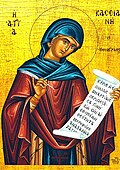 KassiaVenerable · Abbess and HymnographerSep 7
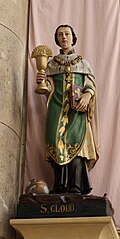 ClodoaldVenerable · Merovingian prince and hermitSep 7
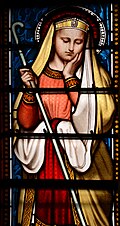 Regina of AutunMartyrSep 7
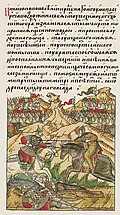 Alexander PeresvetVenerable · Warrior monk of the Trinity LavraSep 7
 Gratus of AostaSaint · Bishop of AostaSep 7
 Gauzelin of ToulSaint · Bishop of ToulSep 7
 John of NovgorodSaint · Archbishop of NovgorodSep 7
 ChiaffredoMartyr · Patron of SaluzzoSep 7
 SozonMartyr · Shepherd of CiliciaSep 7
 Alpinus of ChâlonsSaint · Bishop of ChâlonsSep 7
 Andrew OslyabyaVenerable · Monk of the Trinity LavraSep 7
- Macarius of OptinaVenerable · Hieroschemamonk of OptinaSep 7