Confessor
Mitrofan Vozdvizhensky
Confessor, who suffered for the faith of Christ and died in 1938, during the Soviet persecution.
- Feast
- November 19old style December 2
- Reposed
- 193820th century
- Order
- Confessors
Life
Holy Confessor Mitrofan Vozdvizhensky, a priest, was born on 4 June 1886 in the village of Velikoe, Volchansk district of Kharkov province. His father, Konstantin Mikhailovich, was then a teacher at the parish school, later a reader in the church there, and from 1904 a reader at the church of Saint Nicholas in Novo-Danilovka, in the Grigorievka deanery of the Taurida diocese, where his son Mitrofan was later to become rector. His mother was named Elisaveta Grigorievna. In 1904 Mitrofan entered the Taurida theological seminary. On 30 January 1906 Archbishop Demetrius (Abashidze) of Taurida closed the seminary and dismissed all the pupils; they were then offered to re-enter, giving a pledge to keep all the rules of seminary discipline. The student Vozdvizhensky was not distinguished by bad conduct and had not been seen in oppositional circles, but, like everyone else, he had to sign the common pledge of loyalty. After graduating he married Tatiana Onufrievna Glotova. He was a teacher in the village of Fyodorovka, Melitopol district, in 1907 reader at the church of the Conception of Saint Anna in the village of Annovka, in 1909 deacon at the church of the Three Hierarchs attached to the Taurida theological seminary, and in 1918 he was ordained a priest for the same church by Archbishop Demetrius. After the civil war he moved with his family to the village of Novodanilovka, Akimovka district, Zaporizhzhia region, and was rector of the village church, dedicated to Saint Nicholas.
The priest preached tirelessly, rebuked atheism, called to the old piety, but the parishioners grew fewer and fewer. In the terrible years of collectivization Father Mitrofan, with the best of his parishioners, tried to protest and to contest the lawlessness of the collective-farm authorities. People began to listen to his words, and even in the minds of the enthusiasts of collective-farm building doubts arose. In 1931 he was arrested by the Akimovka GPU, but was released after five days. The characterization drawn up by the village council for the NKVD described him as "anti-Soviet", a "priest socially dangerous", who "systematically gathers counter-revolutionary elements at his home", carries on persistent agitation against collectivization and the state loan, and "speaks in a terrorist way" of the leader Stalin.
After his release he went on with the same ardour from house to house, urging the peasants, weakened in spirit and bewildered by state terror, not to abandon the faith. After the service he preached fearlessly and was not silent beyond the church fence either. He called to prayer and repentance those who had not lost faith and rebuked the injustices of those in power. During the subscription to the state loan he did not stand by as a spectator, but said openly that it was the robbery of an already robbed people, that the money would probably go to the war in Spain and that the peasants would have no benefit from it. He spoke impartially of Stalin and the whole Central Committee. At the census of January 1937 he went tirelessly with prayer from house to house and persuaded the Orthodox and those who wavered to register as believers, not to renounce God and the Church under any pressure, disregarding illusory advantages and the real fear of being crushed by the heavy boot of state atheism. At Father Mitrofan's house like-minded people gathered, prayed, conversed, thought how to survive, deprived of the right to defend the church. After his companions were arrested and repressed, he did not cease to visit with prayer those who were afraid to go to church and openly called on people not to work on Sundays and great church feasts. He said, "The Russian people will yet find deliverance from the Communists. The Bolsheviks with Stalin have led Russia into a dead end." Father Mitrofan was full of love and at the same time strict; for instance, he would not agree to baptize the children of parents who had stopped going to church.
On 6 August 1937 he was arrested by the Akimovka office of the NKVD and held in the Akimovka prison. At the arrest he had a wife, Tatiana Onufrievna, forty-three years old, and four daughters: Olga, Lidia, Nadezhda and Nina. He was charged with "counter-revolutionary agitation of a terrorist direction", consisting in his having urged people at the census to register as believers, spreading the rumour that unbelievers would have the "seal of the Antichrist" put on their foreheads, that "antichrists sit in Soviet power", and that "it is no sin to kill Stalin and the whole Central Committee". At the single interrogation he rejected all the charges, saying that he always spoke only the truth and had never carried on agitation. On 10 October 1937 he was sentenced to ten years in a camp, under articles 54-8 and 54-10 of the Criminal Code of the Ukrainian SSR. In a letter home he said that in the camp he had "weakened beyond measure". He grew weaker every day, and in July 1938 he wrote that he would not live through the winter. He died on 2 October 1938 in Lokchimlag in the Komi ASSR and was buried in a common grave. By decision of the procurator's office of the Zaporizhzhia region of 27 September 1989 he was rehabilitated. He is commemorated with the Synaxis of the New Martyrs and Confessors of the Crimean Metropolis, on 2 December, and with the Synaxis of the Saints of the Crimea, on 28 December.
Commemorated the same day November 19
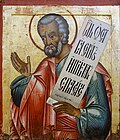 ObadiahProphet · The ProphetNov 19
 Eucherius of LyonSaint · Bishop of LyonNov 19
 Philaret of MoscowSaint · Metropolitan of MoscowNov 19
 Nerses the GreatSaint · Catholicos of ArmeniaNov 19
 Hilarion the GeorgianVenerable · Georgian monk and wonderworkerNov 19
 Barlaam of the Kyiv CavesVenerable · First Abbot of the Caves LavraNov 19
 Porphyrios the KavsokalyviteVenerable · Athonite hieromonkNov 19
 Adrian of PoshekhonyeVenerable Martyr · Abbot of the Dormition MonasteryNov 19
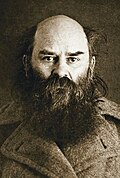 Joasaph UdalovHieromartyr · Bishop of ChistopolNov 19
 Porphyry GulevichHieromartyr · Bishop of SimferopolNov 19
 Alexis BelkovskyHieromartyr · Archbishop of Velikiy UstyugNov 19
 Macarius KarmazinHieromartyr · Bishop of YekaterinoslavNov 19