Hieromartyr
Nicholas Tsvetkov
Cleric martyred for the faith of Christ in 1937, during the Soviet persecution.
- Feast
- September 15old style September 28
- Reposed
- 193720th century
- Order
- Martyrs
Life
Holy Hieromartyr Nicholas Tsvetkov was a protodeacon at the cathedral of Volokolamsk and was shot at the Butovo range on 27 September 1937.
His life
He was born on 8 March 1879 in the village of Nikolskoye, in the Zvenigorod district, in the family of the deacon John Glebovich Tsvetkov. His father, gripped by the passion of drink, did not work his land, rented it out and spent the money, so the family of four children lived in poverty. Nicholas grew up devout and dreamed from childhood of serving the Church. He kept a diary in which he noted not only events but also his thoughts and his efforts to understand the services, and between the pages he even drew his first boots, bought late, when it was time to send him to school. He finished the theological school and the Bethany seminary, in 1900. In 1901 the cathedral of Volokolamsk looked for a deacon with a good voice, and the choice fell on him. He married the orphan Anna and was ordained deacon for that cathedral. He took his aged parents into his home; his father went on drinking and died in 1908 in a drunken state. The father's death shook the son: he changed his life entirely, moved into a cell in the bell tower, led a life of fasting and prayer, sometimes spending the whole night in prayer, and filled his little room with icons. He helped all the poor and suffering: he sent firewood, clothes, footwear, and whatever he received from the clergy's income he gave away on the road, until his wife asked that the money be given to her, for they already had two little girls. Among people he behaved as a fool for Christ, answered questions with riddles and proverbs, and often carried a flower in his hand, which he smelled, a living one in summer, an artificial one in winter; even in prison he came out to visits with a flower in his hand.
Each summer the clergy went in procession through the villages around Volokolamsk with the carved icon of Saint Nicholas, and Father Nicholas most often accompanied the icon. Thousands of people gathered, and the procession covered dozens of kilometres. For his blameless service he was raised to the rank of protodeacon. His ascetic life, deep humility and works of mercy at last gave him the gifts of foresight and of working miracles, and more and more people came to him for support in prayer.
Persecution
He was not arrested just once. In 1918 he suffered humiliations and forced labour. In 1923 he was sentenced to ten years in a camp in a fabricated case and was released early, in 1929. In 1931 he was arrested again and sentenced to three years. In the camp he humbly bore the offences of the others, saying, "I can endure, they cannot." On 18 June 1934 he was released from the Mariinsk camp and returned to Volokolamsk, where he lived with his spiritual children and with his brother, a deacon.
On 27 August 1937 he was arrested and, at the interrogation of 6 September, said that he did not serve in any church but had not renounced his rank, and that, speaking with believers who asked his advice and complained of the hard life, he told them to hope in God and to pray. He was taken to the Taganka in Moscow, where on 22 September he was asked whether he admitted guilt of anti-Soviet agitation, and answered no. On 26 September an NKVD troika sentenced him to death, and the next day he was shot and buried in an unknown common grave on the Butovo range.
He is remembered on 28 September, on 29 May (a movable day) in the Synaxis of the New Martyrs of Butovo, and on 5 September (a movable day) in the Synaxis of the Saints of Moscow, in the new style.
Commemorated the same day September 15
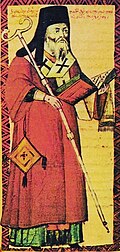 Symeon of ThessalonicaSaint · Archbishop of ThessalonicaSep 15
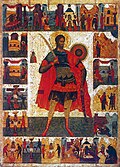 Nicetas the GothGreat MartyrSep 15
 Nicomedes of RomeMartyrSep 15
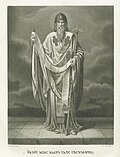 Joseph of AlaverdiVenerable · Abbot of Alaverdi MonasterySep 15
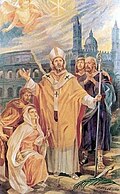 Mamilian of PalermoSaint · Bishop of PalermoSep 15
- Acacius of BeroeaSaint · Bishop of Beroea in SyriaSep 15
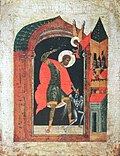 Nikita BesogonGreat Martyr · The Demon-BeaterSep 15
 Maximus, Asclepiodota and Theodotus of AdrianopleHoly MartyrsSep 15
 Porphyrius of EphesusMartyr · ActorSep 15
- Maximus of AdrianopleMartyrSep 15
- Nicholas SkvortsovHieromartyr · PriestSep 15
- Phileas of ThmuisHieromartyr · Bishop of ThmuisSep 15