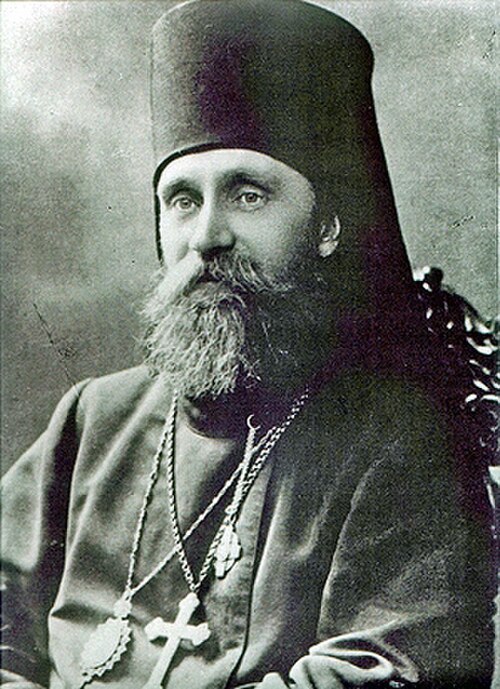
Hieromartyr
Platon Kulbusch
Bishop of Revel
First Orthodox saint of Estonian ethnicity, bishop of Revel, killed at Tartu in January 1919.
Life
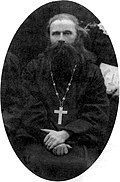
Saint Platon, in the world Paul Kulbusch, was bishop of Reval, now Tallinn, and the first Orthodox saint of Estonian ethnicity. He was killed at Tartu on 14 January 1919. The Russian Orthodox Church canonized him in 2000 and the Ecumenical Patriarchate on 15 September 2000. He is commemorated on 14 January (1 January by the old calendar). His relics are in the Transfiguration Cathedral in Tallinn.
He was born on 13 July 1869 at Pootsi in Pärnumaa, in southwestern Estonia today, then part of the Russian Empire, son of Peter Kulbusch, a psalm-reader and teacher at the parish school of the church of Arosaare. He graduated from the clerical school in Riga in 1884, the seminary in Riga in 1890, as the best student of his class, and the Saint Petersburg Theological Academy in 1894, with a degree in theology. On 5 December 1894 he was ordained a priest and named rector of the Estonian Orthodox parish in Saint Petersburg, set up by decree of the Synod on 31 December 1894. At first services were held in the basement of the Resurrection church. He founded an Estonian parish school, opened on 21 October 1898, where he and the clergy taught without pay, with a small boarding house and meals for the poorest pupils. On 29 November 1898 he opened the Brotherhood of the Hieromartyr Isidore of Yuriev, to help the spiritual growth of the Estonian flock, the printing of books in Estonian, libraries and aid to the needy. He built the Estonian church of Saint Isidore, consecrated on 23 September 1907 with the help of Saint John of Kronstadt, where services were held in Estonian. In the first twelve years of his ministry seven Estonian parishes were formed, in Saint Petersburg, Kronstadt, Gatchina, Luga, Narva and elsewhere.
In 1917 a plenary council in Riga elected him bishop of Reval, and he was consecrated under the name Platon on 31 December 1917. They were troubled times: the First World War, the overthrow of Tsar Nicholas II, and Estonia yearned for independence, which Platon supported. After the declaration of independence of 24 February 1918 came the German occupation, during which Platon travelled through Estonia on horseback, visiting parishes. In November 1918 Germany handed power to the Estonian government, and Bolshevik Russia invaded. Platon was then at Tartu, ill with pneumonia. The Bolsheviks took Tartu on 24 December, and on 2 January Platon was arrested and imprisoned in a cellar. On 14 January 1919, in the Tartu Credit Centre massacre, he was killed together with the priests Michael Bleive and Nikolai Bezhanitsky, just before the city was retaken by the Estonian army. The three were canonized as martyrs by the Russian Orthodox Church Outside Russia in 1982, by the Russian Orthodox Church on 12 August 2000 and by the Patriarchate of Constantinople on 15 September 2000.
Commemorated the same day January 1
 Basil the GreatSaint · Archbishop of Caesarea in CappadociaJan 1
 SarahRighteous · The MatriarchJan 1
 Fulgentius of RuspeSaint · Bishop of RuspeJan 1
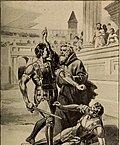 TelemachusVenerable MartyrJan 1
 Gregory of Nazianzus the ElderSaint · Bishop of NazianzusJan 1
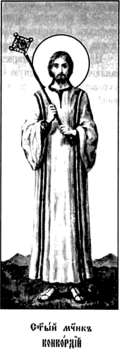 Concordius of SpoletoMartyr · Martyr of SpoletoJan 1
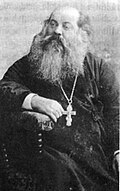 Nikolai BezhanitskyHieromartyr · Archpriest in EstoniaJan 1
 Basil of AncyraMartyr · Priest of GalatiaJan 1
 Alexander TrapitsynHieromartyr · Archbishop of PugachevJan 1
 Basil VitevskyHieromartyr · PriestJan 1
 Athanasius VolkhovskySaint · Bishop of Mogilev and PolotskJan 1
 Michael BleiveHieromartyr · Archpriest at TartuJan 1