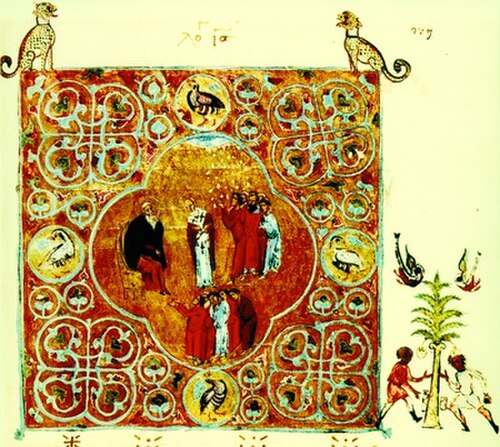
Saint
Gregory of Nazianzus the Elder
Bishop of Nazianzus
Bishop of Nazianzus in Cappadocia, father of Gregory the Theologian and patriarch of a family of clergy.
Life
Saint Gregory the Elder of Nazianzus was bishop of Nazianzus in Cappadocia, father of Saint Gregory the Theologian and patriarch of a family of saints. He fell asleep in the year 374, at an age near a hundred. The Church remembers him on 1 January.
Origins and turning to the faith
He was a rich aristocrat of Nazianzus, in south-west Cappadocia, a landowner with a house also at Karbala. In youth he belonged to the Hypsistarian sect, which combined pagan and Jewish elements: according to his son, those of this sect rejected idols and sacrifices, worshipped fire and lamps, honoured the Sabbath and kept carefully the rules about animals, but did not accept circumcision. Under the influence of his wife Nonna he embraced Christianity, and in the year 325, when the Council of Nicaea was meeting, he asked for Baptism. Tradition says that at his Baptism he was accompanied by an apparition. He was baptized by Archbishop Leontius of Cappadocia, in 328 or 329 was ordained priest and then chosen bishop of Nazianzus, a see he held all his life. He defended the faith of the Council of Nicaea and, from his own wealth, built in 335 a great cathedral in the form of an octagon, related in architecture to the Saint Sophia built later at Constantinople. Not many details of his pastoral work survive. His son describes him as a man of energy.
Trial and family
In 361 he ordained priest, against his will, his son Gregory, to have a helper in governing the diocese. At the end of 363 (in the Greek source, in 360), without grasping the subtleties of theology, he signed a creed of Arian leaning, which caused a division in the diocese: monks and clergy rose against him. The division lasted a short time, and his son had to defend his father and wrote the “Oration on the return of the monks into the bosom of the Church,” showing the old man's right faith. Gregory the Elder often acted as a peacemaker in the appointment of bishops and played an important part in the election of Saint Basil of Caesarea, in 370; he corresponded with Saint Basil, among other things about a certain Glycerius, surrounded by women whom Basil wanted sent back to their families. By about 370 he no longer had an active role as bishop.
By his marriage to Nonna he had three children: Gregory the Theologian (329-389), Caesarius (about 331 until after 368), physician at the court of Constantius II and of Julian the Apostate, and Gorgonia (died about 372), praised by her brother as a model Christian wife. After his death Saint Gregory the Theologian dedicated to him “Oration 18,” delivered in praise of his father and in consolation of his mother Nonna, the main source about his life. All the members of the family are venerated as saints.
Commemorated the same day January 1
 Basil the GreatSaint · Archbishop of Caesarea in CappadociaJan 1
 SarahRighteous · The MatriarchJan 1
 Fulgentius of RuspeSaint · Bishop of RuspeJan 1
 TelemachusVenerable MartyrJan 1
 Platon KulbuschHieromartyr · Bishop of RevelJan 1
 Concordius of SpoletoMartyr · Martyr of SpoletoJan 1
 Nikolai BezhanitskyHieromartyr · Archpriest in EstoniaJan 1
 Basil of AncyraMartyr · Priest of GalatiaJan 1
 Alexander TrapitsynHieromartyr · Archbishop of PugachevJan 1
 Basil VitevskyHieromartyr · PriestJan 1
 Athanasius VolkhovskySaint · Bishop of Mogilev and PolotskJan 1
 Michael BleiveHieromartyr · Archpriest at TartuJan 1