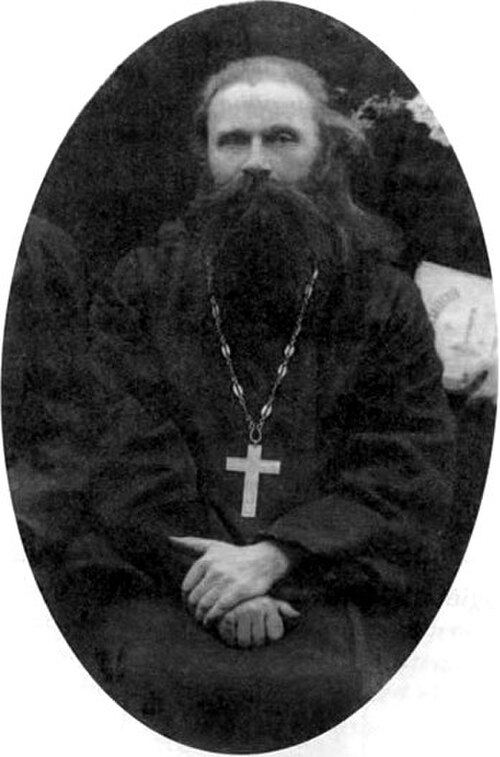
Hieromartyr
Michael Bleive
Archpriest at Tartu
Archpriest at Tartu, one of the first Estonian Orthodox saints, killed in January 1919.
Life
Holy Hieromartyr Michael Bleive, archpriest of the Dormition cathedral at Tartu, is one of the first Orthodox saints of Estonian descent. He was shot by the Bolsheviks in January 1919, together with Bishop Platon of Reval and Archpriest Nicholas Bezhanitsky. He was numbered among the new martyrs of Russia at the jubilee Council of Bishops of the Russian Orthodox Church in Moscow, in August 2000. He is commemorated on 1 January, by the old calendar (14 January New Style).
Youth and family
The sources do not agree on his year of birth: our record gives 1873, while the Romanian text says 29 October 1837, which does not fit the rest of his life (he finished seminary in 1894 and married in 1899), so 1837 looks like a slip of the pen for 1873. He was born at Olustvere (in Russian Ollustfere), in the Fellin (Viljandi) district of the Livonia governorate of the Russian Empire. His father, John Petrovich Bleive, was a psalm reader at the local church; his mother was Akilina Khristoforovna, born Leat. He had two sisters, Alexandra and Vera.
The family was poor, and so he studied at the state's expense at the religious school in Riga, then at the seminary in Riga, which he finished in 1894 in the second category. He stayed at Riga as a singer in the bishop's choir and psalm reader at the church of Saint John, at the bishop's estate. From 1896 he was a reader at the women's community of the Holy Trinity in Riga. In 1899 he married Lyubov Feodorovna Lugovskaya, a priest's daughter.
Priestly ministry
On 1 January 1900 Bishop Agathangel of Riga and Mitau ordained him priest. He served in the parish of Garielsk (Laanemetsa), in the Verro (Voru) deanery. He cared for church singing, gave heartfelt sermons, taught at school and helped the poor. In 1905, during the actions of a punitive detachment, he took under his protection innocent men condemned to death. From 20 February 1908 he was priest at the church of Niggen (Noo), where he gathered funds for the church and adorned it with new vessels. On 7 December 1910 he was appointed dean of the first Yuriev district. At the start of the First World War he held special evening services, so that intense prayer might be made for those gone to the front, and visited and comforted weeping mothers and wives.
Between 22 July 1915 and 6 October 1916 he was priest at the church of Ringen (Rongu), then was moved as third priest to the Dormition cathedral of Yuriev (Tartu) and later was second priest. Professor John Lappo, warden of the cathedral and professor at the university of Yuriev, described him as a quiet and modest man, with the gentle and pure look of those who live a deeply spiritual life; despite his modesty and even shyness he had a firm character and, where needed, gave himself in sacrifice without long hesitation. On 20 June 1918, at the request of the parish council, Bishop Platon (Kulbusch) appointed him rector of the cathedral and raised him to the rank of archpriest. Despite the difficulties (the stopping of pay to the clergy, the need for funds for the parish school of Saint Isidore), Professor Lappo testifies that he never heard from him one complaint or a harsh word about anyone. His service was simple and pure in prayer, his preaching full of inspiration, without a trace of weariness. Some sermons he gave in verse, full of Christian sorrow, and he urged people not to fear death or violent destruction, since Christ, victor over death, leads through the troubles of this age the Christian soul toward the age to come, which does not pass.
Arrest and martyrdom
After the Bolsheviks occupied Tartu, in December 1918, he was arrested on 5 January 1919 in the altar of the cathedral. He was accused of breaking the ban on serving (by an order of 29 December services were forbidden under pain of death, and a directive of 31 December required all "popes" to leave the city). He was shot together with Bishop Platon and the rector of the church of Saint George, Archpriest Nicholas Bezhanitsky. He was buried at Tartu, in the Dormition cathedral, where his relics are. In August 2000 he was numbered among the new martyrs of Russia.
Commemorated the same day January 1
 Basil the GreatSaint · Archbishop of Caesarea in CappadociaJan 1
 SarahRighteous · The MatriarchJan 1
 Fulgentius of RuspeSaint · Bishop of RuspeJan 1
 TelemachusVenerable MartyrJan 1
 Gregory of Nazianzus the ElderSaint · Bishop of NazianzusJan 1
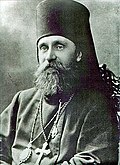 Platon KulbuschHieromartyr · Bishop of RevelJan 1
 Concordius of SpoletoMartyr · Martyr of SpoletoJan 1
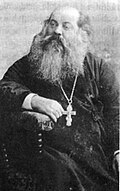 Nikolai BezhanitskyHieromartyr · Archpriest in EstoniaJan 1
 Basil of AncyraMartyr · Priest of GalatiaJan 1
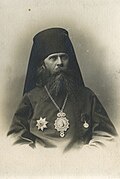 Alexander TrapitsynHieromartyr · Archbishop of PugachevJan 1
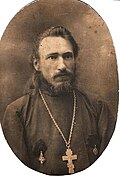 Basil VitevskyHieromartyr · PriestJan 1
 Athanasius VolkhovskySaint · Bishop of Mogilev and PolotskJan 1