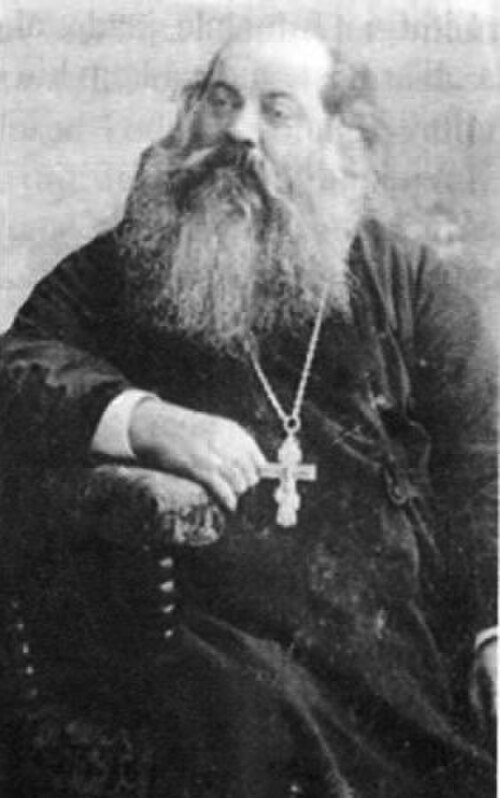
Hieromartyr
Nikolai Bezhanitsky
Archpriest in Estonia
Archpriest in Estonia, killed by the Bolsheviks at Tartu on January 14, 1919.
Life
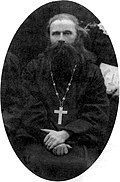
Saint Nikolai Stefanovich Bezhanitsky (14 December 1859 - 14 January 1919), hieromartyr, was an archpriest in the Livonia province of the Russian Empire, killed by the Bolsheviks at Tartu (Yuryev) in Estonia. He was numbered among the New Martyrs of Russia in August 2000, at the Jubilee Council of Bishops in Moscow, and is one of the three Holy Martyrs of Tartu (with Bishop Platon and Archpriest Mikhail Bleive). He is commemorated on 1 January by the old calendar (14 January by the new).
Family and studies
He was born on 14 December 1859, in the Soontaga parish of Livonia province, at Priipalu according to the Romanian source, in a hereditary priestly family: his father and all four of his brothers were priests of the Riga diocese. He graduated from the Riga seminary in 1883. He married the daughter of the priest M. I. Kazarinov.
Priest
He was ordained priest and appointed to the Voronei (Varnja) parish. After two years he was moved to Kergu in the Pernau district; in 1891-1904 he served at the church of Saint Catherine in Verro, in 1904-1908 at Fellin, and from 1908 he was rector of the Estonian Orthodox parish of Saint George in Yuryev. He was confessor of the deaneries of Verro and Yuryev. In 1908 he was elected chairman of the congress of diocesan clergy of the Riga diocese, which comprised three provinces: Courland, Livonia and Estonia. The main traits of his personality, according to contemporaries, were kindness, exceptional goodness and indulgence. One who knew him closely told that from the Verro district several families of farmhands, because of great need, decided to move somewhere into the depths of Russia; they had a wretched bit of property and some pennies. They left their homeland, naturally, with a heavy heart, but they had heard also of concessions for settlers; they knew that at Verro there was a very kind priest, Bezhanitsky, and went to him with confidence. He found them travel concessions, went with them to the offices and to the station. How close the bond was between them and his flock is shown by the fact that, even after he left a parish, he was invited to perform services at his former place of service. He often served free of charge. As dean of Verro, for twelve years he traveled twenty versts on trackless road to the village of Timmo, taking nothing for services or for the long journeys; thanks to these disinterested trips, an independent parish was later formed at Timmo. At Fellin, as director of the prison committee, he also served gratuitously, performed services and held pastoral talks with the prisoners. At Kergu, from the donations he collected, "poor pupils had free schooling and received hot food"; at Verro, through his care, "a good new two-storey building was built for the parish school"; at Fellin he sought to improve the material situation of needy village teachers. On his initiative courses were set up for teachers of auxiliary schools, which gave very good results. He obtained from the diocesan school council both free aid and payment of the dinner table for the course students.
Activity in 1905-1906
During the first Russian revolution he went to Riga, to the diocesan bishop Agathangel, and reported to him the numerous violations of human rights committed by the punitive detachments. As a result of this conversation, Bishop Agathangel issued an epistle in which priests were recommended to "raise their voice" when under the harsh punitive measures fell persons innocent or deserving of leniency. He interceded before the punitive forces for his parishioners. A participant in the events, M. Taevere, wrote in his memoirs: in the Oluste region four rebels were seized, three of them Lutherans. Since night had come, the shooting was postponed till morning. The adjutant of Colonel Markov, for some unknown reason, himself asked the priest N. Bezhanitsky and the pastor of the German parish, Mikwitz, to come to give communion to those condemned to death. It was already midnight. The old Fr. Bezhanitsky not only gave communion to the condemned but in the middle of the night went and woke Colonel Markov to intercede for the prisoners. The colonel was very surprised that a clergyman had been called to give communion to rebels, since by law such people are shot without this mercy. As a result the death sentence was cancelled and an investigation was promised. It was about four in the morning when the priest Bezhanitsky came to my apartment; he was dancing, weeping and laughing. I thought he had gone mad. He said it was the happiest day of his life: he had saved four innocent prisoners from death. I understood his state. Once, when it was impossible to intercede with anyone, he hid in his own home a man sought by the authorities.
Arrest and martyrdom
After Tartu was occupied by the Bolsheviks in December 1918, by order of 29 December the celebration of services was forbidden on pain of death. The order of 31 December required all "priests" to leave the city, which the Orthodox clergy did not obey. On 4 January 1919 the Council of the Workers' Commune of Estonia (the Estonian Soviet republic) published the order of confiscation of all the property of the Church. On the same day it was announced that the "Orthodox priest" Bezhanitsky was allowed, in view of his advanced age, to remain in the city until 20 January, but already on 5 January he was arrested in the church of Saint George. He was shot together with Bishop Platon and the rector of the Dormition cathedral, Archpriest Mikhail Bleive. He was buried in Tartu, in the Dormition cathedral. He was numbered among the New Martyrs of Russia in August 2000, at the Jubilee Council of Bishops of the Russian Orthodox Church in Moscow.
Commemorated the same day January 1
 Basil the GreatSaint · Archbishop of Caesarea in CappadociaJan 1
 SarahRighteous · The MatriarchJan 1
 Fulgentius of RuspeSaint · Bishop of RuspeJan 1
 TelemachusVenerable MartyrJan 1
 Gregory of Nazianzus the ElderSaint · Bishop of NazianzusJan 1
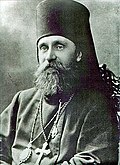 Platon KulbuschHieromartyr · Bishop of RevelJan 1
 Concordius of SpoletoMartyr · Martyr of SpoletoJan 1
 Basil of AncyraMartyr · Priest of GalatiaJan 1
 Alexander TrapitsynHieromartyr · Archbishop of PugachevJan 1
 Basil VitevskyHieromartyr · PriestJan 1
 Athanasius VolkhovskySaint · Bishop of Mogilev and PolotskJan 1
 Michael BleiveHieromartyr · Archpriest at TartuJan 1