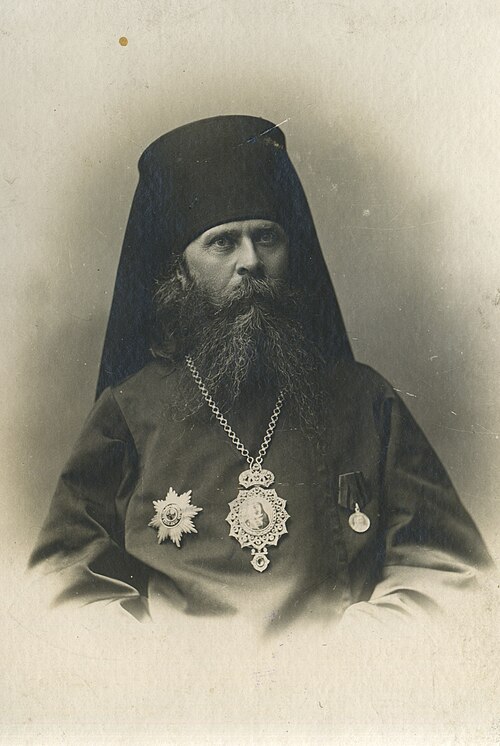
Hieromartyr
Alexander Trapitsyn
Archbishop of Pugachev
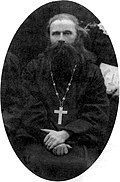
Archbishop of Pugachev, vicar of the Saratov diocese, born in 1862, who died a martyr in 1938; glorified in 2000.
Life
Saint Alexander (in the world Alexander Ivanovich Trapitsyn, 1862-1938), hieromartyr, was Archbishop of Pugachev, vicar of the Saratov diocese, formerly Bishop of Murom, Yuryev and Vologda, and Archbishop of Simbirsk and of Kuibyshev. Arrested in 1937, he was shot on 14 January 1938 (1 January by the old calendar). He was numbered among the New Martyrs and Confessors of Russia at the Jubilee Council of Bishops in August 2000, and among the saints of Simbirsk. He is commemorated on 14 January.
Youth and priestly ministry
He was born in 1862 in the village of Volma in the Vyatka district, Vyatka province (now the Kirov region), in the family of Deacon John Trapitsyn and his wife Claudia. The parents had eight sons: three of his brothers became priests, and Azarius became a painter. He graduated from the church school of Vyatka (1878), the Vyatka seminary (1884) and the Kazan Theological Academy, with the degree of candidate in theology, with the work "Decisions against simony in the Greek-Eastern and Russian Church" (1888).
From 1888 he was an overseer of pupils at the Vyatka church school. In the same year he married, and in 1892 he was widowed after the birth of a son. On 23 February 1889 he was ordained deacon, and on 26 February priest, for the All Saints cathedral of Vyatka. In 1892-1897 he was a deputy of the clerical department in the Vyatka city duma and a censor of sermons and writings of religious-moral content. He was catechist at the Vyatka diocesan school for girls (1889) and at the Alexandrovsk secondary school. In 1894 he made a pilgrimage to the Holy Land. From 27 May 1896 he was a member of the Vyatka diocesan school council. By decision of the Holy Synod of 3-12 September he was transferred as inspector to the Vyatka seminary, and from 1900 was its rector. On 26 February 1900 Bishop Alexis (Opotsky) of Vyatka and Slobodsk tonsured him a monk, keeping his name. In 1901 he was sent to Sarapul to inspect the church school. On 28 July 1901, by decree of the Holy Synod, he was appointed rector of the Kaluga seminary and raised to archimandrite, and was also a member of the council of the Kaluga branch of the Imperial Orthodox Palestine Society. He received the pectoral cross (1900), the Order of Saint Anne second class (1902), the Order of Saint Vladimir third class (1905) and second class (1912).
Bishop
On 12 December 1904 he was consecrated Bishop of Murom, vicar of the Vladimir diocese, by Metropolitan Anthony (Vadkovsky) of Saint Petersburg and Ladoga, Metropolitan Vladimir (Bogoyavlensky) of Moscow and Kolomna, Metropolitan Flavian (Gorodetsky) of Kiev and Galicia and others. From 1905 he was chairman of the Vladimir diocesan school council and vice-chairman of the Vladimir branch of the Imperial Orthodox Palestine Society. From 23 November 1907 he was Bishop of Yuryev, first vicar of the Vladimir diocese, and from 29 May 1912 Bishop of Vologda and Totma. From the start of the First World War he organized intense charitable activity in the diocese. In 1917 he took part in the all-Russian congresses of learned monasticism (chairman of the section "On learned monasticism in educational and non-educational service") and of representatives of monasteries, with a deciding vote, and was a member of the All-Russian Local Council, at all three sessions, in sections II, III, V, VIII, XI and XVII. In 1919 he was sentenced to half a year of forced labor. From 1920 he was Archbishop of Simbirsk and Syzran.
In January 1923 he officially recognized the Renovationist Supreme Church Administration, but in April 1923, unwilling to cooperate with them, he retired and lived at the All Saints church in Simbirsk; in autumn, after repentance, he returned to the administration of the diocese. He supported the so-called "Declaration" of Metropolitan Sergius (Stragorodsky) of 29 July 1927 and received an appointment to the see of Simferopol and Crimea.
Ministry at Samara
From August 1928 he was Archbishop of Kuibyshev. The diocese had had no ruling bishop since 1924, in the city the Orthodox had only one church, and the others belonged to the Renovationists. He traveled much in the diocese, preached to the peasants, held processions, and ordained priests from among deacons and literate peasants. As a result, in Samara province the Orthodox parishes became more numerous than the Renovationist ones. He supported the clergy returning from exile and prisons, helping them to register and receive permission to serve, helped the nuns of the closed Seraphim-Diveevo monastery and secretly performed monastic tonsures. He was simple, modest and merciful, often gave his clothes to needy priests returned from prison, and helped the families of the repressed.
In 1933 a criminal case was opened against him for anti-Soviet activity. The authorities accused him of being the "leader of a counter-revolutionary group of churchmen... He repeatedly led illegal gatherings in his house... at which he gave anti-Soviet directions. He carried on preaching work in an anti-Soviet spirit, worked on religious fanatics to take priestly rank. He carried on anti-Soviet agitation among the peasants who came to him from villages to find priests." On 29 October 1933 a special conference of the OGPU collegium sentenced him to three years of exile in the Urals. From 1936 he was Archbishop of Pugachev, vicar of the Kuibyshev diocese. Returned from exile, he settled at Ulyanovsk, and in 1936 moved to Samara, where he served, with the blessing of the ruling bishop, at the church of Saints Peter and Paul.
Last arrest and martyrdom
On 30 November 1937 he was arrested together with twenty-six clergy and laity. He was accused of having "united in Kuibyshev all the priests without place, mainly those who had arrived from exile. He created authority for these priests among believers... as 'sufferers for the faith', which was used for anti-Soviet insurgent and counter-revolutionary fascist agitation. He himself personally carried on pogrom and insurgent agitation..." He did not plead guilty. On 21 December 1937 he was sentenced to death, and on 14 January 1938 the sentence was carried out.
He was numbered among the New Martyrs and Confessors of Russia at the Jubilee Council of Bishops of the Russian Orthodox Church in August 2000, for veneration throughout the Church. With him were canonized the priests of his case who did not admit guilt: John Iosifovich Suldin (1880-1938), John Vasilievich Smirnov (1873-1938), Alexander Alexandrovich Organov (1873-1938), Trofim Grigorievich Myachin (1888-1938), Alexander Petrovich Ivanov (1866-1938), Vyacheslav Alexandrovich Infantov (1883-1938), Basil Ivanovich Vitevsky (1873-1938) and Jacob Ivanovich Alferov (1878-1938).
Commemorated the same day January 1
 Basil the GreatSaint · Archbishop of Caesarea in CappadociaJan 1
 SarahRighteous · The MatriarchJan 1
 Fulgentius of RuspeSaint · Bishop of RuspeJan 1
 TelemachusVenerable MartyrJan 1
 Gregory of Nazianzus the ElderSaint · Bishop of NazianzusJan 1
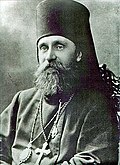 Platon KulbuschHieromartyr · Bishop of RevelJan 1
 Concordius of SpoletoMartyr · Martyr of SpoletoJan 1
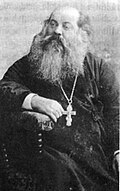 Nikolai BezhanitskyHieromartyr · Archpriest in EstoniaJan 1
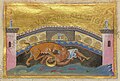 Basil of AncyraMartyr · Priest of GalatiaJan 1
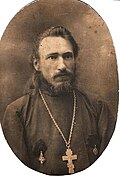 Basil VitevskyHieromartyr · PriestJan 1
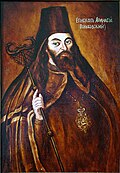 Athanasius VolkhovskySaint · Bishop of Mogilev and PolotskJan 1
 Michael BleiveHieromartyr · Archpriest at TartuJan 1