Saint
Fulgentius of Ruspe
Bishop of Ruspe
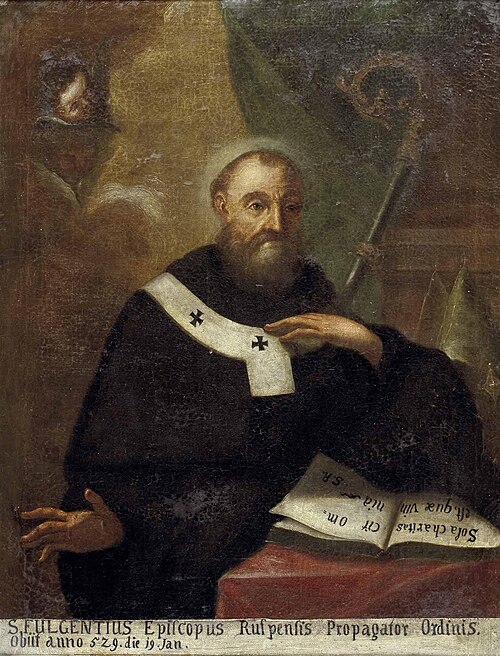
Bishop of Ruspe in North Africa, a theologian who defended the true faith against the Arians.
Life
Saint Fulgentius, hierarch, was bishop of Ruspe in North Africa, in the province that is now part of Tunisia. He lived in the fifth and sixth centuries, when the Arian Vandals persecuted the Orthodox faithful, and he defended the true faith in writing and in speech. He is commemorated on 1 January.
Beginnings
He was born around 462-468, at Telepte, into a distinguished family. His grandfather, the senator Gordian of Carthage, had been stripped of his goods by the Vandal king Genseric and banished to Italy. His father, Claudius, died while Fulgentius was still small, and his mother, Mariana, taught him Greek and Latin. It is said that as a child he learned all the works of Homer by heart. He soon earned the respect of people by the way he handled the family’s affairs and became procurator, that is, tax collector, of Byzacena. But he quickly grew weary of the life of the world, and a sermon of Saint Augustine on Psalm 36, which speaks of the passing of this life, decided him to become a monk.
The monk
When he wished to go to the hermits of the Thebaid in Egypt, he learned from Bishop Eulalius of Syracuse that Egyptian monasticism had been touched by monophysitism, and he changed his mind. He asked to be received by Bishop Faustus, driven from his see by the Vandal king Huneric and founder of a monastery in Byzacena. Faustus tried to hold him back, because his frail body did not seem able to bear the strict rule, but seeing him steadfast he admitted him on trial. Mariana, who had been told nothing beforehand, ran weeping to the monastery gates, asking how a church meant to protect widows could take her only son; Fulgentius nevertheless remained in his calling. When the Arians began persecuting again, he moved to another monastery nearby, where the abbot Felix entrusted him with the outward affairs while he himself looked after the spiritual. In 499, during a new persecution, the two fled to Sicca Veneria; there an Arian priest had them seized and beaten on learning that they preached the faith of Nicaea. In 500 he went to Rome, where he prayed at the tombs of the apostles. Then he returned to Byzacena, built a monastery and chose to live in a hermit’s cell. His fame spread far, and he was several times offered the see of an emptied diocese, but he refused, knowing that King Thrasamund had ordered that only Arians be placed in them.
Bishop of Ruspe
In 502 he let himself be persuaded to take the see of Ruspe. His virtues made a deep impression on the faithful, but soon he was banished to Sardinia, with some sixty other bishops who did not hold the Arian faith. Pope Symmachus, knowing of their hardship, sent them food and money year after year. In Sardinia Fulgentius turned a house in Cagliari into a monastery and wrote several works for the instruction of the Christians of Africa. In 515 Thrasamund summoned him back for a public debate with the Arian bishop who had taken his place. His book An Answer to Ten Objections is said to have been put together from the answers he gave then. Thrasamund, struck by his learning but fearing disorder if his arguments reached the Arians, ordered that from then on he speak only by word of mouth. Fulgentius answered with a further work against Arianism, called the Three Books to King Thrasamund. The king came to respect him and let him stay for a time at Carthage, but in 520, after complaints from the Arian priests, he sent him again to Sardinia. Fulgentius founded monastic communities not only in Africa but also in Sardinia.
His end
After Thrasamund’s death and the accession of his son Hilderic, in 523, Fulgentius was able to return to Ruspe and shepherded his flock there until his death. He fell asleep on 1 January 533, by some sources 527, and the Church remembers him as a shepherd who defended the faith without fearing the king.
Commemorated the same day January 1
 Basil the GreatSaint · Archbishop of Caesarea in CappadociaJan 1
 SarahRighteous · The MatriarchJan 1
 TelemachusVenerable MartyrJan 1
 Gregory of Nazianzus the ElderSaint · Bishop of NazianzusJan 1
 Platon KulbuschHieromartyr · Bishop of RevelJan 1
 Concordius of SpoletoMartyr · Martyr of SpoletoJan 1
 Nikolai BezhanitskyHieromartyr · Archpriest in EstoniaJan 1
 Basil of AncyraMartyr · Priest of GalatiaJan 1
 Alexander TrapitsynHieromartyr · Archbishop of PugachevJan 1
 Basil VitevskyHieromartyr · PriestJan 1
 Athanasius VolkhovskySaint · Bishop of Mogilev and PolotskJan 1
 Michael BleiveHieromartyr · Archpriest at TartuJan 1