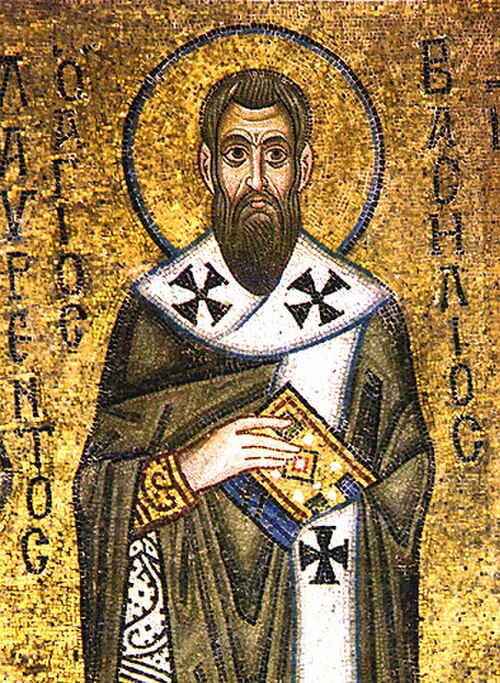
Saint
Basil the Great
Archbishop of Caesarea in Cappadocia
Great hierarch and theologian of Cappadocia, author of a Divine Liturgy and of monastic rules.
Life
Saint Basil the Great, archbishop of Caesarea in Cappadocia, is one of the Three Holy Hierarchs and one of the greatest teachers of the Church. He lived in the fourth century, defended the faith in the Holy Trinity and the divinity of the Holy Spirit, gave order to monastic life, and built a whole institution for the poor and the sick. The Divine Liturgy that bears his name is celebrated ten times a year. The Church commemorates him on 1 January.
A family of saints
He was born in 329 or 330 at Caesarea in Cappadocia, into a wealthy and devout family. His grandparents on his father's side had hidden for seven years in the forests of Pontus during Diocletian's persecution. His mother, Saint Emmelia, was the daughter of a martyr, and his father, Basil, was a lawyer and rhetorician. Of their ten children, five became saints: Basil; Macrina, a great ascetic who deeply influenced him; Gregory, bishop of Nyssa; Peter, bishop of Sebaste; and the deaconess Theosebia. He spent his earliest years on the family estate by the river Iris, raised by his mother and his grandmother Macrina, who remembered Saint Gregory the Wonderworker.
Education
He learned first from his father, then from the best teachers at Caesarea, where he met Gregory the Theologian. He went on to the school at Constantinople and finally to Athens, where he stayed four or five years and mastered all the learning of his day: philosophy, rhetoric, grammar, astronomy, mathematics, medicine. At Athens began the friendship of his life with Gregory the Theologian, the two thinking of themselves as one soul in two bodies.
The monk
About the year 357 he returned to Caesarea and taught rhetoric for a time, but soon chose the path of asceticism. He was baptized by Bishop Dianius of Caesarea and made a reader, to read and expound Scripture to the people. Then he travelled to Egypt, Syria and Palestine to meet the great ascetics. Back in Cappadocia he gave his wealth to the poor and settled on the far bank of the river Iris, near his mother and his sister Macrina, gathering monks around him in common life. By letters he called Gregory the Theologian to join him. They lived in a house with no roof and no hearth, ate very little, cleared stones, planted and watered trees and carried heavy loads. Basil had only a tunic and a mantle, and wore a hair shirt only at night, so that it would not be seen. They read Scripture in the light of the Fathers, above all Origen, and from these writings compiled a collection called the Philokalia. At the request of the monks Basil also wrote down rules for a virtuous life. Monasteries for men and women were organized on his example, joining common life with that of the hermit.
Ministry at Caesarea
In 362 he was ordained deacon by Meletius of Antioch, and in 364 priest by Bishop Eusebius of Caesarea. Eusebius, moved by jealousy, showed his displeasure, and Basil withdrew to his monastery so as not to trouble the Church. When the Emperor Valens, an Arian, began the troubles of Orthodoxy, Basil returned at Eusebius's request and in practice took over the governance of the Church. He preached daily, sometimes twice. On the famine of 368 he gave a famous homily. In these years he wrote the Hexaemeron, commentaries on Isaiah and on the Psalms, a second collection of monastic rules, and three books against Eunomius.
In 370, after Eusebius died, he was chosen archbishop of Caesarea and consecrated on 14 June. Saint Athanasius the Great rejoiced at his election. In his books against Eunomius Basil taught the divinity of the Holy Spirit, and at the request of Saint Amphilochius of Iconium he wrote the work "On the Holy Spirit". He wrote numerous letters to Churches, bishops and priests. His burdens grew from the splitting of Cappadocia in two, the schism at Antioch, the disdain of some Western bishops, and the defection to the Arians of his friend Eustathius of Sebaste.
Valens sent the prefect Modestus to Caesarea to frighten him with the seizure of his goods, exile and even death. Basil answered that nothing could be taken from the little he had, that exile means nothing to one bound to no place, and that death would only bring him sooner to God. "No one has ever spoken to me so boldly," the prefect confessed. "Perhaps because you have never spoken to a bishop," the saint replied. Modestus told the emperor that they had been defeated by a leader of the Church. Valens then entered the church at Theophany among the crowd, and stood amazed at the singing of the psalms and at Basil's bearing at the altar.
Basil served nearly every day, kept the canons strictly, and saw to it that only the worthy were ordained. Near Caesarea he built two monasteries, one for men and one for women, with a church of the Forty Martyrs, and he obtained exemption from taxes for the clergy. He spent his wealth and the Church's income on the needy, built a poorhouse in every centre of his diocese, and at Caesarea a house for strangers. The complex at Caesarea, called the Basiliad, included a poorhouse, an orphanage, a home for the aged, a hostel for travellers and a hospital, and thousands found food and care in it.
The Divine Liturgy
As an organizer of services, Basil composed a Liturgy that is celebrated ten times a year: on 1 January, on the first five Sundays of Great Lent, on the eves of the Nativity and of Theophany, on Great Thursday and on Great Saturday. Saint Gregory the Theologian recalls among his works the order of prayers, the care for the poor, for strangers and for virgins, and the arrangement of altars.
Repose and veneration
Sickly from youth and worn down by labours, fasting and the cares of pastoral service, Saint Basil reposed in the Lord on 1 January 379, aged forty-nine. Before his death he blessed Gregory the Theologian to take the see of Constantinople. Saint Amphilochius of Iconium, in his eulogy, observed that Basil did not depart to the Lord on the feast of the Circumcision of Christ by chance, and asked that his memory be kept each year on that day. Saint Basil is also called the "revealer of heavenly mysteries", and his honoured head is kept at the Great Lavra on Mount Athos.
In some countries a bread called vasilopita is blessed after the Liturgy on his day, with a coin baked into it, and whoever receives the slice with the coin is said to be blessed by Saint Basil for the coming year; it is also said that the saint visits the homes of the faithful. The Church also commemorates him on 30 January, with Saint Gregory the Theologian and Saint John Chrysostom, in the Synaxis of the Three Holy Hierarchs.
Commemorated the same day January 1
 SarahRighteous · The MatriarchJan 1
 Fulgentius of RuspeSaint · Bishop of RuspeJan 1
 TelemachusVenerable MartyrJan 1
 Gregory of Nazianzus the ElderSaint · Bishop of NazianzusJan 1
 Platon KulbuschHieromartyr · Bishop of RevelJan 1
 Concordius of SpoletoMartyr · Martyr of SpoletoJan 1
 Nikolai BezhanitskyHieromartyr · Archpriest in EstoniaJan 1
 Basil of AncyraMartyr · Priest of GalatiaJan 1
 Alexander TrapitsynHieromartyr · Archbishop of PugachevJan 1
 Basil VitevskyHieromartyr · PriestJan 1
 Athanasius VolkhovskySaint · Bishop of Mogilev and PolotskJan 1
 Michael BleiveHieromartyr · Archpriest at TartuJan 1