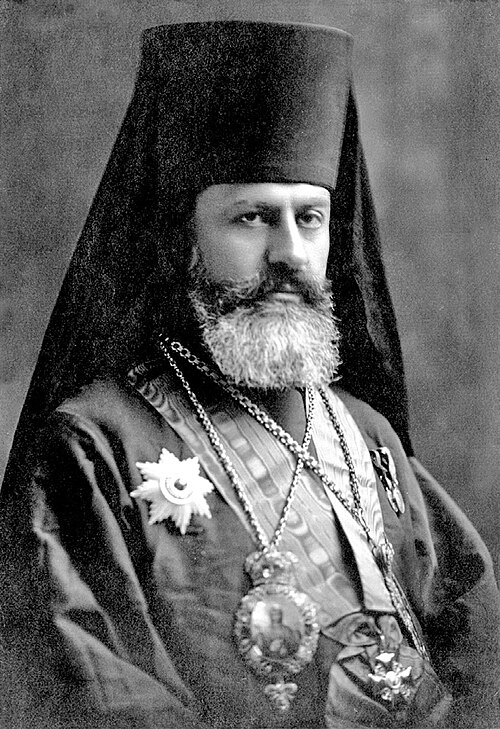
Saint
Raphael of Brooklyn
Bishop of Brooklyn
Syrian Orthodox bishop in North America, the first Orthodox bishop consecrated on American soil.
- Feast
- February 14old style February 27
- Reposed
- 191520th century
- Order
- Hierarchs
Life
Holy Hierarch Raphael of Brooklyn was an Arab Orthodox pastor from Syria, sent to America by the Russian Church, and in 1904 became the first Orthodox bishop consecrated on American soil. When he died, in 1915, the Syro-Arab Mission counted thirty parishes and twenty-five thousand faithful.
Youth and formation
He was born in 1860 in Syria, of pious parents, Michael Hawaweeny and his second wife Mary, daughter of a priest of Damascus. His date of birth is not known exactly; he himself believed that he had been born around the feast of the Synaxis of the Archangels Michael and Gabriel (8 November, in the old style). At that time there were fierce persecutions of Christians: their parish priest, St Joseph of Damascus, and many around him had been killed as martyrs, and the family fled to Beirut, where the future saint was born. In 1861, at Epiphany, he was baptized with the name Raphael, and soon the family returned to Damascus.
After primary school his father could no longer afford his son's studies, but the deacon Athanasius Attalah (later metropolitan of Homs) interceded with Patriarch Hierotheus of Antioch that Raphael be received at the preparatory courses of the patriarchate. He was such a good student that in 1877 he was chosen assistant teacher, and the next year he became a teacher of Arabic and Turkish. On 28 March 1879 Patriarch Hierotheus tonsured him a monk, and Raphael became the patriarch's subdeacon. The Patriarch of Constantinople, Joachim III, offered a scholarship for one student from Antioch at the theological school of Halki, and Raphael was the only one chosen. He was ordained deacon on 8 December 1885 and in June 1886 obtained his diploma in theology. He returned home, impressed Patriarch Gerasimus of Antioch and accompanied him on his pastoral visits. Wishing to know more, he asked for a blessing to pursue higher studies in Russia and was received at the Kyiv Theological Academy.
Patriarch Gerasimus then named him head of the representation of the Church of Antioch in Moscow; he was ordained priest by the rector of the Academy, Bishop Sylvester, and raised to archimandrite by Metropolitan Ioannikios of Moscow. In two years he reduced the representation's debt from 65,000 to 15,000 rubles and brought twenty-four Syrian students to Russia. When Gerasimus left the throne for Jerusalem, Raphael saw an opportunity to free the Church of Antioch from the rule of foreign hierarchs; he wrote to influential bishops and laymen and published articles in the Russian press. He did not succeed, and even paid for his frankness. In November 1891 Metropolitan Spyridon, a Greek from Cyprus, was elected patriarch, and many Arabs believed that he had bought the votes. Raphael refused to commemorate him in church and was suspended; he submitted, but went on writing in the Russian newspapers, until the patriarchs obtained from the tsar a ban on his articles. He then published books. At last he asked the patriarch's forgiveness, the suspension was lifted, he was allowed to pass under the jurisdiction of the Russian Church, and he taught Arabic at the Academy in Kazan until 1895, when the Syrian Orthodox Benevolent Society of New York called him to shepherd the Arab Orthodox community there.
In America
He arrived in New York on 2 November 1895 and was met by a delegation of Arab Christians. In less than two weeks he found a suitable place in lower Manhattan, raised a church and furnished it with objects brought from Russia; Bishop Nicholas consecrated it in honour of St Nicholas. Learning of the small communities of Arab Christians scattered through North America, left without a pastor, he set out on pastoral journeys: in the summer of 1896 he visited thirty cities between New York and San Francisco, performing weddings, baptisms, confessions and Liturgies, and where there was no church, in the homes of the faithful. He stood firm in Orthodoxy, requiring that any church unity rest on the teaching of the seven Ecumenical Councils. In 1898 he printed the first book of the New World, a service book in Arabic, The Book of True Consolation in the Divine Prayers. In 1898 and 1899 he made further journeys, the last through forty-three cities. At Johnstown, in Pennsylvania, he reconciled people whose enmity threatened to split the Arab community. There too he received the telegram announcing that Metropolitan Meletios had been elected patriarch of Antioch; he told his people that for the first time in a hundred and sixty-eight years a native Arab had been elected head of the Church of Antioch.
He was offered the see of Latakia, that of vicar bishop of Beirut, that of Zahle and that of Tripoli, but he always declined, saying that he could not leave his flock in America and that he wished to build a permanent church and a parish cemetery. In 1901 he bought part of the Olivet cemetery on Long Island, and in 1906 he bought and converted a church building on Pacific Street in Brooklyn, consecrated by Bishop Tikhon.
Bishop of Brooklyn
In 1903 the Holy Synod of the Russian Church unanimously elected him bishop of Brooklyn, keeping him at the same time at the head of the Syro-Arab Mission of North America. On the third Sunday of Great Lent in 1904 he was consecrated in the cathedral of St Nicholas in Brooklyn by Bishops Tikhon and Innocent, in vestments given by the tsar Nicholas II, being the first Orthodox bishop consecrated on American soil. At the end of 1904 he decided to publish the official journal of the mission, Al-Kalimat (The Word), whose first issue appeared in January 1905. In July 1905 he blessed the land for St Tikhon's Monastery and the orphanage at South Canaan, Pennsylvania, and three days later presided over the assembly of the diocesan clergy at Old Forge, at which were present three priests who would be canonized: Alexis Toth, Alexander Hotovitzky and John Kochurov. Seeing that the young no longer spoke Arabic, he supported the use of English in worship and teaching and recommended the service book translated by Isabel Hapgood. In 1911, on the fifteenth anniversary of his service in America, Archbishop Platon gave him an icon of the Saviour in a silver frame.
At the end of 1912 he fell ill with heart failure, which would be the cause of his death. He continued pastoral journeys in 1913-1914. In 1915 he fell ill again and stayed two months at home; on 14/27 February, at 12:40, he departed to the Lord. He was called and did not answer; they shook him, but he had already gone. He was a gentle and merciful pastor, strict with himself, learned and the author of books; he taught Greeks and Russians in their own language, spoke English well and wrote most of the articles in Al-Kalimat. He is commemorated on 27 February (14 February in the old style), in the new style; his name has not been entered in the calendar of the Russian Orthodox Church.
Commemorated the same day February 14
 CyrilEqual-to-the-Apostles · Apostle to the SlavsFeb 14
 MaronVenerable · Syriac HermitFeb 14
 Auxentius of BithyniaVenerable · Hermit of BithyniaFeb 14
- Abraham of HarranSaint · Bishop of HarranFeb 14
 Antoninus of SorrentoVenerable · Abbot and hermitFeb 14
 Isaac of the Kiev CavesVenerable · Recluse of the Kiev CavesFeb 14
 Ephraim of KatounakiaVenerable · Athonite elder of KatounakiaFeb 14
 Modestinus, Florentinus and FlavianusHoly Martyrs · Martyrs of CampaniaFeb 14
 Damian the NewVenerable MartyrFeb 14
 The Twelve Greek CraftsmenHoly VenerablesFeb 14
- Barbara of SkvorchikhaFool-for-Christ · Fool for Christ and recluseFeb 14
- Paul DernovHieromartyr · ArchpriestFeb 14