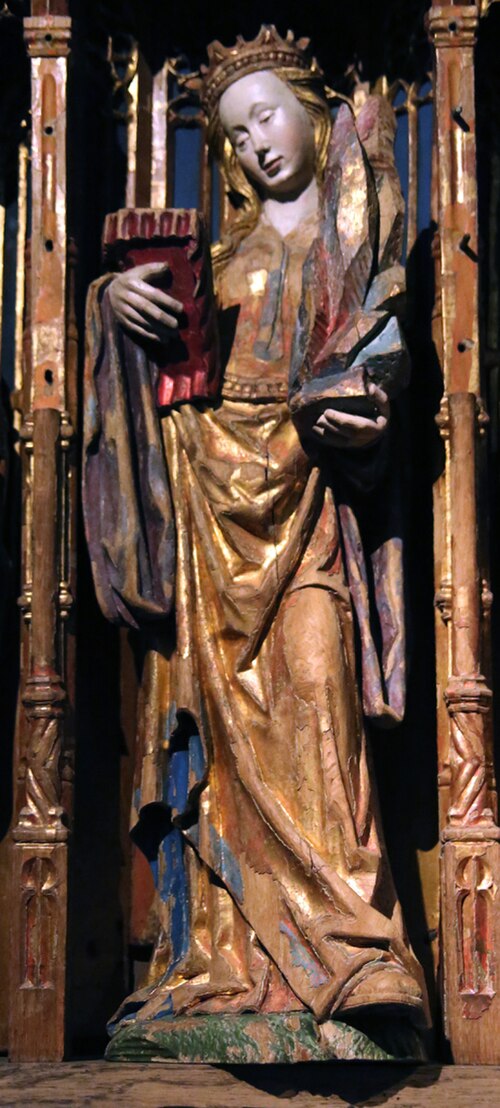
Holy Martyrs
Sunniva and Companions
An Irish virgin and her companions, honored as martyrs on the island of Selja in Norway.
Life
The Holy Martyrs Sunniva and Companions are honored as the Irish virgin Sunniva (Sunnifa) and her companions, slain on the island of Selja in Norway in the tenth century. She is patron of the diocese of Bjørgvin and of all western Norway.
According to the legend, put in writing in the twelfth century, Sunniva was the heir of an Irish kingdom and fled when an invading heathen king wanted to marry her. With her brother Alban, other believers and, in later accounts, two sisters, she set out to sea, was carried to Norway and settled on the uninhabited islands of Selja and Kinn during the time of the pagan Jarl Hákon Sigurdsson. The jarl came with armed men to kill them; the Christians hid in caves and prayed to God to bring the caves down upon them so that they would not be ravaged, and the caves collapsed.
Later, two farmers who had anchored at Selja for the night on the way to Trondheim saw a supernatural light over the island and found a bleached skull with a sweet smell. They told King Olaf Tryggvason and Bishop Sigurd, who came to Selja, found many sweet-smelling bones, dug out the cave and recovered Sunniva's body incorrupt, as though she were asleep. The bones were placed in a casket and her body in a timber shrine.
Around 1100 a Benedictine abbey dedicated to Saint Alban was built at Selja; the veneration of Sunniva, at first subordinate to that of her brother, can be traced from that time. In 1170 her relics, again found incorrupt, were moved to the new cathedral in Bergen, and her veneration spread throughout Norway. In the fires of Bergen in 1170/71 and 1198 the relics were carried out of the cathedral and set down at Sandbru, and the fire is said to have halted, which was hailed as a miracle. The shrine remained in Christ Church in Bergen until 1531. She is commemorated on 8 July as a saint of the undivided Church, by the New Calendar.
Commemorated the same day July 8
 Adrian III of RomeSaint · Bishop of RomeJul 8
 Edgar the PeacefulRight-Believing · King of EnglandJul 8
 Kilian of WürzburgHieromartyr · Bishop of WürzburgJul 8
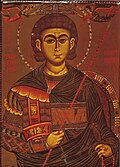 Procopius of ScythopolisGreat Martyr · Reader and exorcist at ScythopolisJul 8
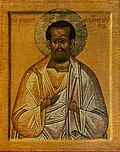 Procopius of UstyugFool-for-Christ · Fool for ChristJul 8
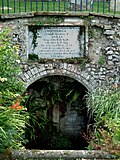 Withburga of DerehamVenerable · Abbess of DerehamJul 8
- Auspicius of ToulSaint · Bishop of ToulJul 8
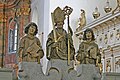 Colman of WürzburgHieromartyr · Irish missionary at WürzburgJul 8
 MorwennaVenerable · Saint of CornwallJul 8
 Procopius of UstiaRighteousJul 8
 Theophilus the Myrrh-streamerVenerable · AthoniteJul 8
- Epictetus and AstionHoly Venerable Martyrs · Martyrs of HalmyrisJul 8