Hieromartyr
Theodore Aleksinsky
A Russian priest put to death for his faith in Christ in 1918, during the communist persecution.
- Feast
- December 2old style December 15
- Reposed
- 193720th century
- Order
- Martyrs
Life
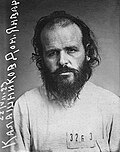
Holy Hieromartyr Theodore Aleksinsky, a priest, was born on 21 October 1875 in the village of Kamenki in the Myshkin district of the Yaroslavl province, in the family of the priest Nicholas Aleksinsky. He received the crown of martyrdom by shooting on 15 December 1937 at the Butovo firing range near Moscow.
Life
In 1890 Theodore entered the theological seminary at Yaroslavl, then the Moscow Theological Academy, which he finished in 1900 with the degree of candidate of theology, and was appointed teacher of Russian and Church Slavonic at the theological school in Krasny Kholm. In 1909 he was ordained priest at the Strastnoy Convent in Moscow, where he served until it was closed by the godless authorities in the 1920s. He was then assigned to the church of the Sign of the Mother of God on Karetnaya Street in Moscow.
First arrest
On 14 April 1931 he was arrested and held in the Butyrka prison. He and all the others arrested, more than thirty clergy and laity, were accused of anti-Soviet activity, of organizing illegal "sisterhoods" and "brotherhoods," and of helping exiled clergy. Interrogated, Father Theodore said he had not engaged in anti-Soviet conversations. On 30 April 1931 the Special Council of the OGPU Collegium sentenced him to three years of exile in Russia's North. He returned from exile to Moscow in 1934, where his family had remained, but the authorities would not allow him to live in the city and told him he could settle no nearer than a hundred kilometres from Moscow. He went to Tula but could not find a priest's post, so he went to the Patriarchate, which sent him as priest to the church in the village of Ivakino in the Uvarovo district of the Moscow region.
Second arrest
He was arrested on 1 December 1937 and imprisoned in Taganka prison in Moscow. On 2 December NKVD officers questioned him and false witnesses. The first questioned was the son of a priest shot in 1918, who in the 1930s had become a primary school teacher, and who declared that the landlady of Father Theodore's house had told him the priest said to the faithful after the service, "Orthodox, hard times have come. Life is getting worse and worse. Everything goes according to Holy Scripture. Soon the time of bloodshed will come." Then the chairman of the collective farm in the village of Potapkovo, where Father Theodore had lived since August 1937, was questioned. He declared that since the priest moved to the village discipline on the farm had declined, the farm workers had begun to go to church, and the priest's counter-revolutionary activity showed in his visits to the farm workers' homes. The priest told them it was a sin to work on feast days, that their fate depended on God, and that without God one does not get even to the threshold. The chairman said that in September 1937 the priest came to the office and asked him not to oppress the farm workers and to let them go to church, saying that hard times had come, that people had forgotten God and God had begun to forget them, and that a time would come when people would come to their senses but it would be too late.
Then Father Theodore was questioned. The investigator told him that in August 1937 he had expressed dissatisfaction with Soviet power and spread provocative rumours about war. He answered that it was slander and that he had never said anything against Soviet power. Asked whether he urged the farm workers not to work on feast days, he answered that he had conducted no such agitation and had told no one that one may not work on feast days. That was all the inquiry. On 5 December the NKVD troika sentenced him to death by shooting. Father Theodore Aleksinsky was shot on 15 December 1937 and buried in an unknown common grave at the Butovo firing range.
Veneration
He is commemorated on 15 December (new style), in the Synaxis of the New Martyrs of Butovo on 29 May on a movable day, in the Synaxis of the Saints of Moscow on 5 September, and in the Synaxis of the New Martyrs and Confessors of Radonezh on 10 December.
Commemorated the same day December 2
 HabakkukProphet · The ProphetDec 2
 Stefan Uroš VRight-Believing · Tsar of the SerbsDec 2
 Chromatius of AquileiaSaint · Bishop of AquileiaDec 2
 BibianaMartyrDec 2
 Jovan BrankovićRight-Believing · Despot of SerbiaDec 2
 NonnusSaint · Bishop of EdessaDec 2
 Cleopa of SihăstriaVenerable · Archimandrite and abbot of SihăstriaDec 2
 Mirope of ChiosMartyrDec 2
 Ise of TsilkaniVenerable · One of the Syrian FathersDec 2
 Danact KalashnikovVenerable Martyr · HieromonkDec 2
- Avitianus of RouenSaint · Bishop of RouenDec 2
- Tadec of LandevennecHieromartyr · Hieromonk of LandevennecDec 2