Martyr
Theopistus of Rome
A martyr of Rome, put to death for his faith in Christ.
- Feast
- September 20old style October 3
- Era
- unknown
- Order
- Martyrs
Life
Holy Martyr Theopistus of Rome was the son of the holy Great Martyr Eustathius and the holy martyr Theopista and the brother of the holy martyr Agapius. All four died for Christ in the time of the emperor Hadrian (117-138).
The conversion of Eustathius
Before baptism Eustathius was called Placidas and was a general under the emperors Titus (79-81) and Trajan (98-117). Even before he knew Christ, Placidas did works of mercy, helping all who were in need. The Lord did not leave the virtuous pagan in the darkness of idolatry. Once, hunting, he was pursuing a stag on a swift horse, and it halted on a high mountain, and Placidas suddenly saw between its antlers a shining Cross and on it the crucified Son of God. A voice told him that the Lord had appeared there to bring him to His faithful servants, so that a man who does righteous deeds should not perish in the snares of the enemy. Placidas believed, asked to be taught and was told to go to a Christian priest, receive baptism and be guided to salvation.
Returning home gladly, he told it all to his wife, and she told him that she too had heard in a dream the day before that she, her husband and their sons would come the next day to Christ. The priest baptized them all and gave them communion. The next day Eustathius went to the place of his conversion and gave thanks to the Lord. Again he received a wonderful revelation: God Himself warned him of the trials to come, saying that, like Job, he would endure many sorrows so as to come forth proved like gold in the furnace. Eustathius answered humbly that he was ready to receive everything with thanksgiving.
The trials
Soon misfortunes fell upon him: all his servants died and all his cattle perished. Impoverished but not cast down, Eustathius left his house secretly with his family, to live in obscurity, humility and poverty. They took ship for Egypt, and on the voyage a new misfortune came: the master of the ship, enticed by the beauty of Eustathius's wife, put him ashore with the children without pity and kept her. In great sorrow the saint continued on his way and another suffering came: fording a swollen river, he carried his two sons across one by one, but while he was carrying one, a lion seized the other on the bank and bore him off into the wilderness, and when he came back for the first, a wolf dragged him into the forest.
Having lost everything, Eustathius wept bitterly, but he understood that divine Providence had sent these misfortunes to test his patience and his submission to the will of God. Pouring out his grief in prayer, he went on, ready for new trials. In the village of Badissus he hired himself out as a labourer and spent fifteen years in ceaseless toil. He did not know then that, by the mercy of God, shepherds and ploughmen had saved his sons and that they were living near him. Nor did he know that the wicked shipmaster had soon been punished, dying of a cruel disease, while his wife had remained untouched and lived in quiet labours.
The family reunited
At that time the emperor Trajan had to wage a hard war for Rome. He remembered the valiant commander Placidas and sent the soldiers Antiochus and Acacius, friends of his, to seek him. Travelling through many lands, they came to the village where Saint Eustathius lived. They met him in the field, where he was guarding the grain, but did not recognize him and spoke to him of the man they sought. Eustathius recognized them at once but did not reveal his name. He brought them to his master's house and fed them. Looking at him, the travellers noticed that he much resembled their commander, and when they saw on his neck a special mark, the scar of a deep battle wound, they understood that this was their friend. They embraced him with tears and told him why they had sought him. Eustathius returned to Rome and again became an imperial general. Many recruits came to his army, and he did not know that two young soldiers, friends, whom he often gave orders and whom he loved for their skill and courage, were his sons, nor did they know that they served under their father and that they were brothers.
Once on a campaign the army led by Eustathius halted in a village. The brothers were talking in their tent. The elder told how he had lost his mother and his unfortunate brother and how he had been dreadfully separated from his father. The younger gladly understood that this was his brother and told his own story. The talk was overheard by a woman at whose house the tent had been pitched, their mother. She understood that they were her sons. Not yet revealing herself, but wishing not to part from them, she came to their commander, Saint Eustathius, to ask leave to follow his army. In him she recognized her husband and told him in tears of herself and of the two soldiers who were their sons. So, by the great mercy of the Lord, the whole family was reunited.
Martyrdom
The war ended in victory. Eustathius returned to Rome with honour and glory. After the death of Trajan his successor Hadrian (117-138) wished to celebrate these events with a solemn sacrifice to the gods. To the surprise of all, Eustathius was not in the temple. By the emperor's order he was sought out and brought. The emperor asked him why he would not bow to the gods, who had kept him in the war, given him victory and helped him find his wife and children. Eustathius answered that he was a Christian and honoured the One God, Jesus Christ, who had given him everything. In anger the emperor stripped the renowned general of his rank and summoned him with his family to trial. There too the confessors of Christ could not be brought to sacrifice to idols. The whole family was condemned to be torn by wild beasts, but the beasts did not touch the holy martyrs. Then the emperor in his rage ordered them thrown alive into a red-hot bronze bull, in which Eustathius, his wife Theopista and their sons Agapius and Theopistus received the end of martyrdom. After three days, when the fiery tomb was opened, the bodies of the holy martyrs were found unharmed: not a hair on their heads was burned, and their faces shone with unearthly beauty. Many who saw the wonder believed in Christ. Christians buried the bodies of the saints with honour.
Saint Theopistus is commemorated with his family on 3 October.
Commemorated the same day September 20
 Eustathios of ThessalonicaSaint · Archbishop of ThessalonicaSep 20
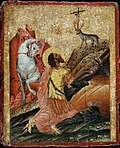 Eustathius PlakidasGreat Martyr · Roman GeneralSep 20
 Michael of ChernigovMartyr · Grand Prince of KievSep 20
 GlyceriusSaint · Archbishop of MilanSep 20
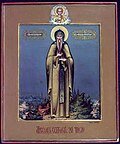 Oleg of BryanskRight-Believing · Prince of BryanskSep 20
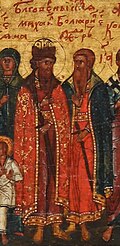 TheodoreMartyr · Boyar of ChernigovSep 20
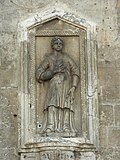 TheopistaMartyr · Martyr of RomeSep 20
- Theoctistus SmelnitskyHieromartyr · PriestSep 20
- Theodore the ConfessorConfessorSep 20
- John XenosVenerable · Wandering ascetic of CreteSep 20
- Agapius of RomeMartyrSep 20
- Alexander TetyuevHieromartyrSep 20