Hieromartyr
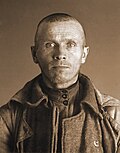
Vladimir Medvedyuk
Priest
Russian clergyman born in 1888, executed at the Butovo firing range on 3 December 1937.
- Feast
- November 20old style December 3
- Reposed
- 193720th century
- Place
- Butovo firing range
- Order
- Martyrs
Life
Holy Hieromartyr Vladimir Medvedyuk (Vladimir Faddeevich Medvedyuk) was a priest, later archpriest of the Russian Church, born on 15 July 1888 at Lukov, Siedlce province, and shot on 3 December 1937 at the Butovo firing range, near Moscow. He was numbered among the holy hieromartyrs by the Jubilee Council of Bishops of the Russian Church in 2000. He is remembered on 20 November, in the Synaxis of the New Martyrs and Confessors of Russia and in the Synaxis of the New Martyrs of Butovo, a movable commemoration.
Beginnings
He was from a Ukrainian family. His father, a railway worker, wanted his son to serve in church. After finishing, in 1910, the theological school, Vladimir was psalm-reader at the Orthodox cathedral of the city of Radom, in Poland. In the First World War he came to Moscow, where he married in 1915. The next year he was ordained deacon at the church of the Holy Martyr Irene on Vozdvizhenka, and in 1919 priest, at the church of Venerable Sabbas of Storozhi (the metochion of the Savvino-Storozhevsky monastery) on Tverskaya street. In 1921 he was appointed rector of the church of Saint Mitrophan of Voronezh and defended the church against the Renovationists' attempts to seize it, despite threats coming from Antonin (Granovsky) himself.
Fall, repentance and confession
In 1925 Father Vladimir was arrested and, under threat of reprisal, agreed to cooperate with the OGPU, after which he was released. The assignments he received from the OGPU concerned chiefly the locum tenens of the patriarchal throne, Metropolitan Peter (Polyansky). The priest carried them out, but after a time decided to break off with the OGPU and repented at confession of the sin of betrayal.
On 9 December 1929 he was summoned to the OGPU and told the investigator that he refused any further cooperation. For three days they urged him to change his decision, but he did not consent, saying that he had told everything to the priest at confession. On 11 December the arrest warrant was written, and the charge was "disclosure of information that should not be disclosed". On 3 February 1930 the Collegium of the OGPU sentenced him to three years in a corrective labour camp. He served the sentence on the construction of the White Sea and Baltic canal.
Last years
In 1932, after completing his term, he settled with his family at Zagorsk (now Sergiev Posad) and continued to serve at the church of Saint Mitrophan of Voronezh in Moscow. In 1933 the church was closed, and Medvedyuk received a place as priest at the church of the Holy Trinity in the village of Yazvishche, Volokolamsk district. In 1935 he was raised to the rank of archpriest. He was bound in friendship with protodeacon Nikolai Tsvetkov, later a hieromartyr, to whom he often turned for advice and in whose house, at Volokolamsk, he lived and served.
On 24 November 1937 Father Vladimir was arrested again and charged with "counter-revolutionary and anti-Soviet agitation". The charge rested on a denunciation that up to twenty people came to the priest daily, mostly old men and women, from different collective farms of the Volokolamsk and Novopetrovsk districts. Medvedyuk did not admit guilt. Archpriest Vladimir Medvedyuk was shot on 3 December 1937 at Butovo, by sentence of the troika of the UNKVD of the Moscow region of 29 November 1937. He was rehabilitated after death on 4 July 1991. In August 2018, in Petrovsky Park in Moscow, the great consecration took place of the church of Hieromartyr Vladimir Medvedyuk and the New Martyrs and Confessors of Russia, a baptismal church, consecrated by Bishop Paramon (Golubka) of Bronnitsy, together with Archpriest Dimitry Smirnov, rector of the church, and other clergy.
Commemorated the same day November 20
 Edmund of East AngliaPassion-Bearer · King of East AngliaNov 20
 Proclus of ConstantinopleSaint · Archbishop of ConstantinopleNov 20
 Bernward of HildesheimSaint · Bishop of HildesheimNov 20
 Gregory of DecapolisVenerable · Monk and wonderworkerNov 20
 TheoktistosConfessorNov 20
 Dasius of DurostorumMartyr · Roman soldierNov 20
 Hilarion PisaretsVenerable Martyr · HieromonkNov 20
 Simplicius of VeronaSaint · Bishop of VeronaNov 20
- Anatolius of NicaeaMartyrNov 20
- Diodorus of YuryegorskVenerable · Founder of the Demyan HermitageNov 20
- Joseph of PersiaHieromartyr · Disciple of Bishop NarsesNov 20
 Eutychius KachurVenerable Martyr · HegumenNov 20