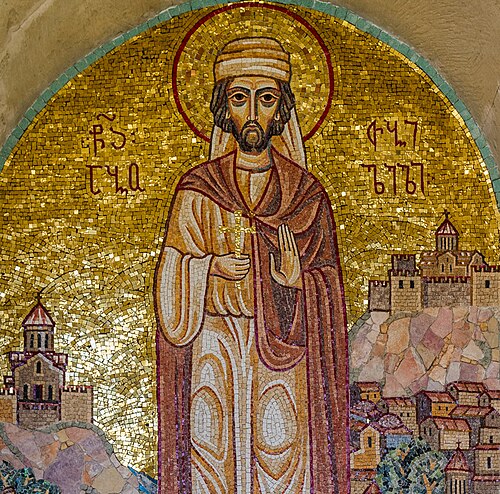
Martyr
Abo of Tiflis
Patron of Tbilisi
Arab convert to Christianity, martyr in Tbilisi and heavenly patron of the city, who died in 786.
Life
The holy martyr Abo of Tiflis was an Arab by birth, converted to Christianity, a martyr at Tbilisi and heavenly patron of the city, killed in 786. He is commemorated on 8 January in the Georgian Orthodox Church.
His life
Abo was born around 756, at Baghdad, in a Muslim family. He worked as a perfumer, making fine perfumes and ointments. At seventeen or eighteen he came to Tbilisi, following the Georgian prince Nerses, ruler of Kartli. Nerses, denounced to the caliph, had spent three years in prison; freed by a new caliph, he took Abo with him. In Kartli, Abo came to believe in Christ, not at once, but after a hard search, with heated quarrels even with Christian priests and bishops on matters of faith; the quarrels only strengthened his conviction that the truth was in Christianity. At first he was afraid to declare himself a Christian openly, since eastern Georgia was under Arab rule; he only gave up the custom of praying five times a day and began to pray in the Christian way.
Khazaria and Abkhazia
For political reasons, Prince Nerses had to seek shelter in Khazaria, north of the Caspian Sea, where the Muslims did not rule; Abo accompanied him and was baptized there. From Khazaria Nerses moved to Abkhazia, also free of Arab rule, taking Abo with him, who lived there in prayer and ascetic struggle, preparing for a future mission. In 782 the prince and his party returned to Tbilisi, and Abo, although he had been warned that it was not safe, followed him.
His witness
For almost three years Abo confessed his faith openly in the streets of Tbilisi, strengthening by his example the Christians who tried to escape Arab rule and seeking to bring to the faith the Arabs of his own people. Threats and warnings did not quench his zeal. In 785 he was denounced as a Christian to the Arab officials at Tbilisi and was arrested. The judge tried to turn him back to the faith of his ancestors, but he confessed his faith before the court, was imprisoned and was put to death, cut down with the sword, on 6 January 786. According to the Life, his body was burned and the ashes, in a sheepskin, thrown into the river Kura. At that place, it is told, pillars of light were seen.
The account of his martyrdom
His Life, the Martyrdom of Saint Abo, was written by Ioane Sabanisdze, a Georgian writer of the same time, who was a witness of what Abo did. It is one of the oldest Georgian writings. On the site where his body was burned, on the bank of the Kura, the church of Metekhi was built in the thirteenth century.
Commemorated the same day January 8
 Atticus of ConstantinopleSaint · Archbishop of ConstantinopleJan 8
 Kyros of ConstantinopleSaint · Patriarch of ConstantinopleJan 8
 Apollinaris of HierapolisSaint · Bishop of HierapolisJan 8
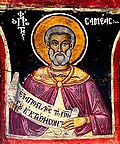 ShemaiahProphet · Prophet in the time of RehoboamJan 8
 George of ChozibaVenerable · Abbot of Choziba MonasteryJan 8
 Lucian of BeauvaisHieromartyr · Apostle of BeauvaisJan 8
 Gregory of the Kiev CavesVenerable Martyr · Wonderworker of the Kiev CavesJan 8
 Isidore of YuryevHieromartyr · Priest at TartuJan 8
 Domnica of CarthageVenerable · Virgin of CarthageJan 8
- Elias the HermitVenerable · Hermit of EgyptJan 8
- Gregory of OhridSaintJan 8
 Gregory the RecluseVenerable · Recluse of the Kiev CavesJan 8