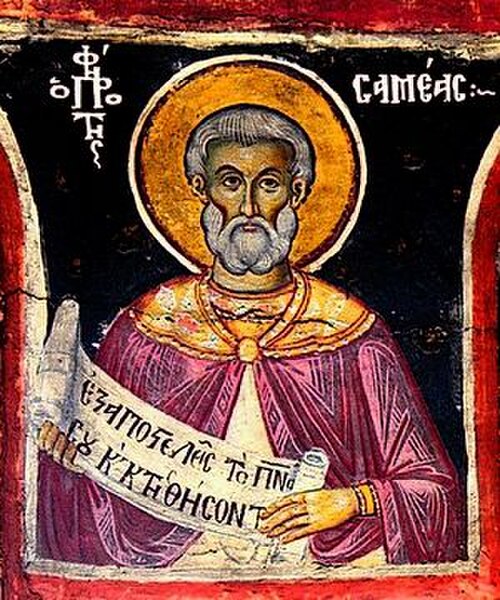
Prophet
Shemaiah
Prophet in the time of Rehoboam
Prophet in the time of King Rehoboam, who stopped the war between Judah and Israel.
Life
The Holy Prophet Shemaiah (Semeias, Samaia) was a prophet in the time of King Rehoboam, son of Solomon, the "man of God" who stopped the war between Judah and Israel. His name means "whom the Lord has heard." His feast is on 8 January and, in the Orthodox Church, also on 9 January.
The biblical account
According to Ukrainian and Russian sources, he was born at Shiloh, in the days of Solomon, lived in the days of Solomon and of his son Rehoboam and kept records of Rehoboam's reign. In the days of Rehoboam (by the dating given in some sources, 980-963 BC) the kingdom was divided: Rehoboam, Solomon's heir, had drawn the people's anger by refusing to lower the taxes laid in his father's time; the people gathered at Shechem, rebelled and separated from him. Only the tribes of Judah and Benjamin stayed on the king's side; the ten northern tribes founded a new kingdom, of Israel, and chose as king Jeroboam I, anointed by the prophet Ahijah. According to the text of Scripture, the separation was a punishment for the sins of Solomon.
Rehoboam assembled an army of a hundred and eighty thousand troops to bring the ten rebellious tribes back by force. Then the word of God came to Shemaiah, the man of God: to say to Rehoboam, son of Solomon, king of Judah, and to all the house of Judah and Benjamin and to the rest of the people: "Thus saith the Lord, Ye shall not go up, nor fight against your brethren the children of Israel: return every man to his house; for this thing is from me" (1 Kings 12:22-24). They hearkened to the word of the Lord and returned home, as the Lord had commanded. The prophet's words were obeyed and the army stood down; one commentator called his intervention "a timely reminder of the unity of the race, notwithstanding the division of the kingdom."
In the fifth year of Rehoboam's reign, because he had forsaken the Lord, Judah was struck by the invasion of the king of Egypt, Shishak (Shoshenq I). The pharaoh's numerous army took all the fortified cities of Judah and came to Jerusalem. Then the prophet Shemaiah came to Rehoboam and to the princes of Judah, who had taken refuge in the city, and said to them: "Thus saith the Lord, Ye have forsaken me, and therefore have I also left you in the hand of Shishak" (2 Chronicles 12:5). Hearing this, the king and the princes humbled themselves and said: "The Lord is righteous." Then Shemaiah received a new revelation: "They have humbled themselves; therefore I will not destroy them, but I will grant them some deliverance; and my wrath shall not be poured out upon Jerusalem by the hand of Shishak. Nevertheless they shall be his servants; that they may know my service, and the service of the kingdoms of the countries" (2 Chronicles 12:7-8). In Chronicles, he also prophesied the punishment of Rehoboam by the king of Egypt.
Commemorated the same day January 8
 Abo of TiflisMartyr · Patron of TbilisiJan 8
 Atticus of ConstantinopleSaint · Archbishop of ConstantinopleJan 8
 Kyros of ConstantinopleSaint · Patriarch of ConstantinopleJan 8
 Apollinaris of HierapolisSaint · Bishop of HierapolisJan 8
 George of ChozibaVenerable · Abbot of Choziba MonasteryJan 8
 Lucian of BeauvaisHieromartyr · Apostle of BeauvaisJan 8
 Gregory of the Kiev CavesVenerable Martyr · Wonderworker of the Kiev CavesJan 8
 Isidore of YuryevHieromartyr · Priest at TartuJan 8
 Domnica of CarthageVenerable · Virgin of CarthageJan 8
- Elias the HermitVenerable · Hermit of EgyptJan 8
- Gregory of OhridSaintJan 8
 Gregory the RecluseVenerable · Recluse of the Kiev CavesJan 8