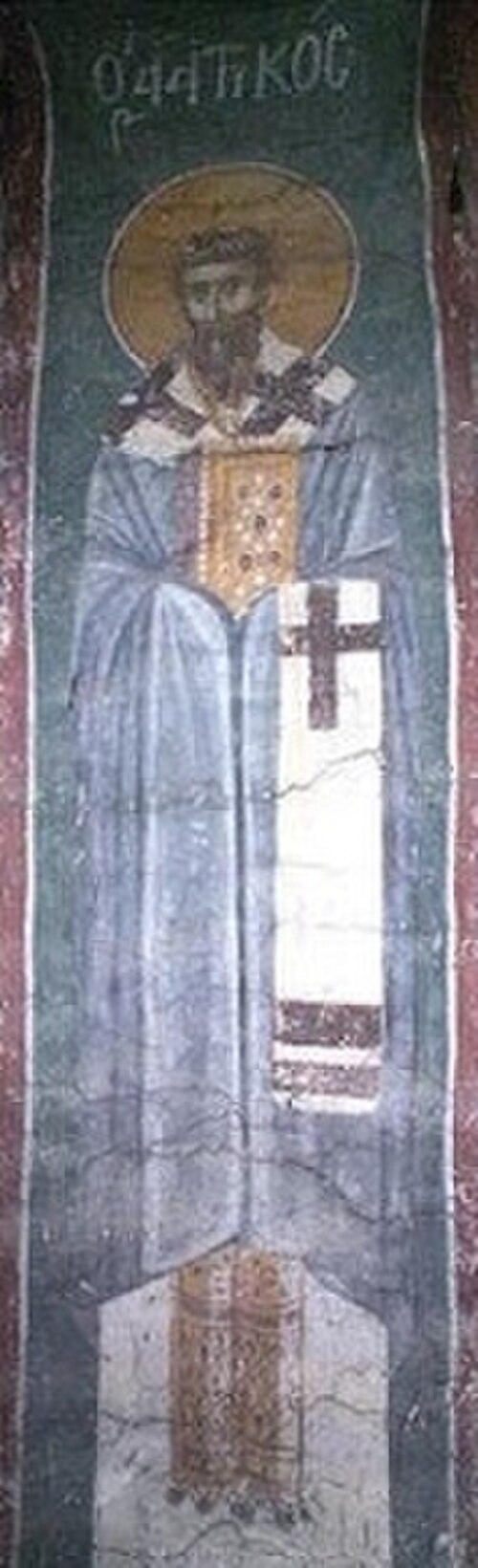
Saint
Atticus of Constantinople
Archbishop of Constantinople
Archbishop of Constantinople from March 406 until his death in 425.
Life
Saint Atticus of Constantinople, hierarch, was archbishop of Constantinople from March 406 until his repose on 10 October 425. At first he was an opponent of Saint John Chrysostom, in whose deposition he helped, but he later came to commemorate him in the diptychs. The Church commemorates him on 8 January and, according to one source, also on 11 October.
Beginnings
He was born at Sebaste, in Armenia. While still young he entered a monastic milieu linked to the Macedonians, that is, those who denied the divinity of the Holy Spirit, and so he had a limited philosophical education and an Armenian accent unpleasant to Greek ears. Later he accepted the Orthodox faith, at Constantinople he was ordained presbyter and became known for intelligence, charm and political moderation. The historian Socrates says that he at first lacked literary culture, but that he read much and worked on his own sermons.
Against John Chrysostom
Atticus was one of the bitterest adversaries of Saint John Chrysostom. If he was not, as Palladius says, the architect of the whole plot, he certainly took a leading part in it. He took part in the Synod of the Oak in 403 and was one of the witnesses against John. Chrysostom was sent into exile on 10 June 404, and his successor, the aged Arsacius of Tarsus, died on 5 November 405. After four months of intrigue, Atticus was chosen, in March 406.
His first measures were harsh: with the other eastern patriarchs, Theophilus of Alexandria and Porphyry of Antioch, he sought to crush John's supporters, and the bishops who refused communion with them were persecuted. Many of the faithful of Constantinople regarded him as a usurper and gathered for services in the open air outside the city. The death of John, on 14 September 407, did not end the division. Gradually Atticus abandoned this policy and entered John's name in the diptychs, an act dated between 412 and 417. He also urged Cyril of Alexandria to do the same. The division truly ended only after the relics of John were brought to the capital, two decades later.
Ministry
In 408 the emperor Arcadius died, leaving a son, Theodosius II, and three daughters, all children, and Atticus had a leading part in the regency and a particular influence over the princesses Pulcheria, Arcadia and Marina. His episcopate was a time of peace and prosperity for the Church and the empire: churches, monasteries and shrines were built in the capital, the city walls were enlarged in 412, and the church of Holy Wisdom, burned in 404, was rebuilt and consecrated in 415. The sources call him pious, gentle to friends, formidable to enemies, diligent and kind to people. Socrates tells that he sent to Bishop Callopius of Nicaea three hundred gold coins, to be given to those ashamed to ask and not only to those of the same faith.
He fought heresies, especially the Pelagians, which increased his popularity in the city, and he contributed to the theological interpretation of the veneration of the Mother of God. Towards the end of his life he received a delegation of Armenian clergy who sought approval for the use of the newly invented Armenian alphabet. He sought to increase the authority of the see of Constantinople and obtained from Theodosius II a decree subjecting Illyricum to it, but Pope Boniface I and the emperor Honorius objected and the decree was never carried out. He ordained at Nicaea, in Bithynia, in 425. He left four letters, preserved in the Patrologia Graeca, but his treatise on faith and virginity, addressed to the daughters of Arcadius, is lost. It is said that he foresaw his end and fell asleep on 10 October 425.
Commemorated the same day January 8
 Abo of TiflisMartyr · Patron of TbilisiJan 8
 Kyros of ConstantinopleSaint · Patriarch of ConstantinopleJan 8
 Apollinaris of HierapolisSaint · Bishop of HierapolisJan 8
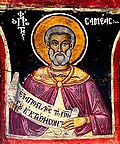 ShemaiahProphet · Prophet in the time of RehoboamJan 8
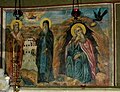 George of ChozibaVenerable · Abbot of Choziba MonasteryJan 8
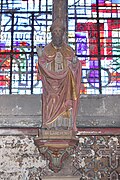 Lucian of BeauvaisHieromartyr · Apostle of BeauvaisJan 8
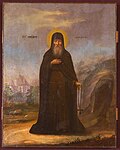 Gregory of the Kiev CavesVenerable Martyr · Wonderworker of the Kiev CavesJan 8
 Isidore of YuryevHieromartyr · Priest at TartuJan 8
 Domnica of CarthageVenerable · Virgin of CarthageJan 8
- Elias the HermitVenerable · Hermit of EgyptJan 8
- Gregory of OhridSaintJan 8
 Gregory the RecluseVenerable · Recluse of the Kiev CavesJan 8