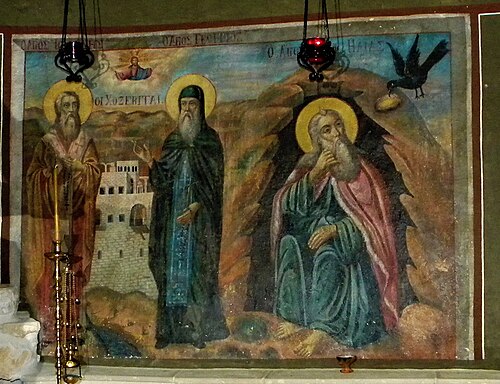
Venerable
George of Choziba
Abbot of Choziba Monastery
Cypriot monk and head of the Choziba monastery near Jerusalem, who died around 625.
- Feast
- January 8old style January 21
- Reposed
- 6257th century
- Place
- St. George's Monastery
- Order
- Venerables
Life
Saint George of Choziba (George the Chozibite, died about 625, according to some sources about 635) the venerable was a monk of Greek stock from Cyprus, an ascetic and then abbot of the monastery of Choziba in the Wadi Qelt near Jerusalem, which today bears his name. He is commemorated on 8 January (21 January in the new style).
Beginnings
He was born in Cyprus, in a Greek Orthodox family, and was orphaned early. An uncle of his, who was a monk, took him and his older brother as novices into the monastery where he lived. When they grew up, they too were tonsured. The older brother then went to the Calamon lavra, famous at that time, in Palestine. Dimitry of Rostov tells the start of George's road with some differences: the older brother, Heraclides (Heraclitus), was already living as a monk at Calamon when George, orphaned, was left alone in Cyprus. First a distant relative, a layman, took him in and wanted to give him his daughter in marriage. George, dreaming of monastic life, fled the wedding to the monastery of his uncle the abbot. When the relative, who had not given up his hopes, demanded with the help of connections that the youth be given back from the monastery, George fled in secret from Cyprus on a ship to join his brother at Calamon.
At Calamon his request to be admitted to the lavra beside his brother was rejected, perhaps because of his too young age. So George went to the monastery of Choziba, founded around 480, a century earlier, by Saint John of Choziba, a cave monastery in which the monks lived in cells cut in the rock above a mountain stream. At Choziba George won everyone's respect by his ascetic life. He made such an impression on the brethren that, still young, he was allowed to settle at Calamon. There he lived the ascetic life beside his brother until the latter's death at seventy. After that he left Calamon and returned to Choziba. In the lavra of Calamon and at Choziba, according to his biographer, he and his brother abstained from wine. From Saturday evening until Sunday afternoon he kept an all-night vigil in the coenobium of the monastery; otherwise he and the other monks lived in their cells.
His asceticism
At Choziba George surpassed all the other ascetics of the monastery in his zeal to restrict himself in everything. Where earlier he abstained from wine and cooked food, now he pounded in a mortar the leftovers of other monks and made of them dry balls, on which he fed once in two or three days. He wore a habit that he sewed himself from rags found on the rubbish heap of a neighbouring village and made his bed of the same. Constantly tormented by hunger, he worked in the monastery bakery, standing for whole days by the hot ovens in forty-degree heat, without tasting bread. He lived in a cave cell and devoted all the time free from work to prayer. The monks nicknamed George "the Iron" for his insensibility to every kind of hardship. Very old and extremely thin, he was notable for endurance and strength. The abbot ordained him hierodeacon. Local people came to him for counsel.
Nevertheless, in the Persian invasion of Shah Khosrow in 614, when the Calamon lavra (never rebuilt) and the Choziba monastery (soon restored) were destroyed and many Christians were tortured, among them brethren of Choziba, "Iron" George disappeared from the monastery in good time and so survived, which the local people took as proof of the elder's foresight. According to other accounts, he stayed at Choziba in 614. He died in deep old age in the restored monastery, surrounded by pilgrims and disciples.
Miracles, his Life and veneration
His Life, written by his disciple Antony of Choziba, a conventional hagiography but with an eyewitness account of the Persian invasion of 614 and its impact on the Palestinian monasteries, spread through the Orthodox countries. Dimitry of Rostov gives a detailed retelling. It is said that at Calamon George made a withered palm tree, which even his brother wanted to cut down, bear fruit again, and that he raised a dead infant at his prayer, in the presence of his brother. According to Dimitry, when the brothers were brought a child who had just died, Heraclides wanted to drive away the one who brought it, thinking he was leading them into temptation to do what only Christ can do. But George said: "Do not grieve and do not be angry, father, but let us call in faith on the merciful God, and if He hears us sinners and raises the infant, the father will take him from us alive as a reward for his faith; and if God does not will it, we will tell the father that, being sinners, we have not attained such boldness before God." A very ancient likeness of him is on the "fresco of the 36 saints" in a burial cave in the Lavra of Saint Sabbas the Sanctified, identified by an inscription. He seems to be the latest of the saints shown, and so the archaeologist A. E. Mader suggested that the paintings date to between his death and the Arab conquest of Jerusalem in 638.
The exact date of his canonization is not known; his veneration probably began soon after his death and continues to this day. The Choziba monastery is now called the Monastery of Saint George the Chozibite, a men's monastery of the Patriarchate of Jerusalem, often visited by Russian pilgrims.
Commemorated the same day January 8
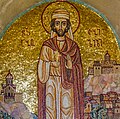 Abo of TiflisMartyr · Patron of TbilisiJan 8
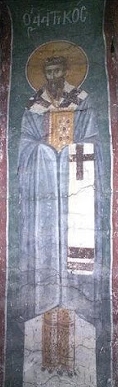 Atticus of ConstantinopleSaint · Archbishop of ConstantinopleJan 8
 Kyros of ConstantinopleSaint · Patriarch of ConstantinopleJan 8
 Apollinaris of HierapolisSaint · Bishop of HierapolisJan 8
 ShemaiahProphet · Prophet in the time of RehoboamJan 8
 Lucian of BeauvaisHieromartyr · Apostle of BeauvaisJan 8
 Gregory of the Kiev CavesVenerable Martyr · Wonderworker of the Kiev CavesJan 8
 Isidore of YuryevHieromartyr · Priest at TartuJan 8
 Domnica of CarthageVenerable · Virgin of CarthageJan 8
- Elias the HermitVenerable · Hermit of EgyptJan 8
- Gregory of OhridSaintJan 8
 Gregory the RecluseVenerable · Recluse of the Kiev CavesJan 8