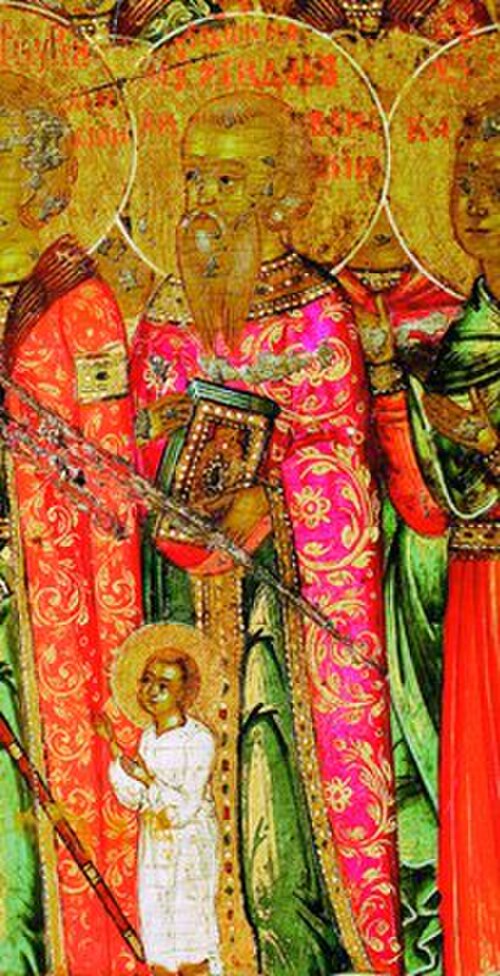
Hieromartyr
Isidore of Yuryev
Priest at Tartu
Priest of the Church of Saint Nicholas in Yuryev, killed in 1472, according to tradition for refusing Catholicism.
Life
Saint Isidore of Yuryev, hieromartyr (died 1472 at Yuryev, today Tartu), was a priest of the church of Saint Nicholas in Yuryev, killed according to tradition, together with seventy-two of his faithful, for refusing to accept Catholicism. He is commemorated on 8 January (Old Style), and in the Synaxis of the Saints of Pskov. His veneration in the whole Church was ordained by the Holy Synod in 1897.
Martyrdom
His Life was written in the sixteenth century by the priest Basil (in monastic life Barlaam). According to it, in 1472, on the feast of the Theophany, while Father Isidore of the Russian church in Yuryev (Dorpat) was blessing the water on the river Omovzha, he was seized at the order of the local Catholic bishop and thrown into prison. With him were arrested seventy-two parishioners of his church. They were urged to renounce Orthodoxy, but refused. In prison Isidore gave communion to all who were with him before they were all put to death. They were drowned in the river Omovzha, in the place where Isidore had blessed the water on Theophany.
In the spring flood the bodies of the slain were found on the bank, three versts upstream, and were buried with honour in the church of Saint Nicholas in Yuryev. According to the third redaction of the Tale of the Beginning of the Pskov Caves Monastery, the priest John, who had served with Isidore at Yuryev, fled the persecution to Pskov as early as about 1470 and later became the founder of the Pskov Caves Monastery.
The written Life and veneration
In the sixteenth century two versions of the Life appeared, a short one, probably for the Menaia, and a long one, written at the request of Saint Macarius, Metropolitan of Moscow. The service of Saint Isidore is known from copies of the seventeenth century. The relics have not survived, most probably because of the destruction of Orthodox shrines at the time of the Reformation. The Life was composed on the eve of the Livonian War and was probably meant to help establish the position of the Muscovite state in it. Veneration broke off unexpectedly in the middle of the seventeenth century, for reasons not wholly clear.
After a long oblivion, Metropolitan Eugene (Bolkhovitinov) in 1831 mentioned the martyrs of Yuryev as saints venerated at Pskov. Veneration in the whole Church was renewed at the end of the nineteenth century at the initiative of Archbishop Arseny (Bryantsev) of Riga. On 16 May 1896 the foundation of a church in their honour was laid at Valga, near Tartu. In the same year a special service was composed, and in 1897 the Holy Synod ordained the veneration of the hieromartyr Isidore of Yuryev in the whole Church.
At the beginning of the twentieth century, through the labour of Archpriest Paul Kulbusch (the future hieromartyr Platon of Reval), the church of Saint Isidore was built in Saint Petersburg for the Orthodox Estonians, and in 1898 the Russian-Estonian Orthodox brotherhood of Saint Isidore was founded. There is also a church of the saint at the Pühtitsa convent in Estonia, and at Krasnodar a chapel dedicated to him was raised. Since 2007, with the blessing of Metropolitan Cornelius of Tallinn, an order and a medal of Saint Isidore of Yuryev have been established. In 1971 the writer Yuri Vronsky wrote a tale-ballad about him, "The Yuryev Ice Hole".
Commemorated the same day January 8
 Abo of TiflisMartyr · Patron of TbilisiJan 8
 Atticus of ConstantinopleSaint · Archbishop of ConstantinopleJan 8
 Kyros of ConstantinopleSaint · Patriarch of ConstantinopleJan 8
 Apollinaris of HierapolisSaint · Bishop of HierapolisJan 8
 ShemaiahProphet · Prophet in the time of RehoboamJan 8
 George of ChozibaVenerable · Abbot of Choziba MonasteryJan 8
 Lucian of BeauvaisHieromartyr · Apostle of BeauvaisJan 8
 Gregory of the Kiev CavesVenerable Martyr · Wonderworker of the Kiev CavesJan 8
 Domnica of CarthageVenerable · Virgin of CarthageJan 8
- Elias the HermitVenerable · Hermit of EgyptJan 8
- Gregory of OhridSaintJan 8
 Gregory the RecluseVenerable · Recluse of the Kiev CavesJan 8