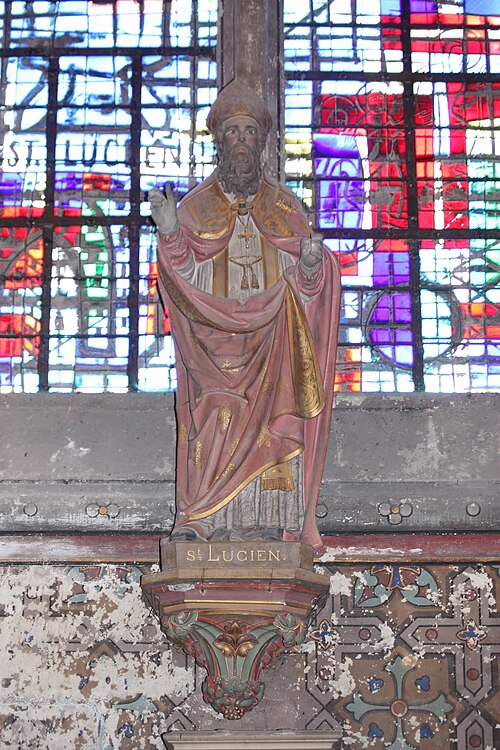
Hieromartyr
Lucian of Beauvais
Apostle of Beauvais
Called the Apostle of Beauvais, put to death for his faith in the Diocletian persecution.
Life
Saint Lucian of Beauvais, Hieromartyr, called the “Apostle of Beauvais,” was put to death for the faith in Diocletian's persecution, around the year 290. Later tradition makes him a martyr of the first century, because the church of Beauvais wished to claim apostolic origin. He is remembered on 8 January.
Bishop Odo of Beauvais, in the ninth century, is the first writer who called him the first bishop of the city. The historian Louis Duchesne considers the story of Lucian unhistorical. The details of his life are little known, and the date of his death was moved back in time to give the diocese more antiquity, a common practice in the Middle Ages. Nevertheless the foundation of the diocese of Beauvais is traditionally attributed to him.
According to tradition he came from a noble family of Rome. He was named Lucius, like his father, but when he was converted by Saint Peter himself, he took the name Lucian. As a young man he preached in Italy, then was ordained bishop by Pope Clement I (who in fact lived in another century) and sent to Gaul with Saint Denis and Rieul of Reims, among others, to preach. He was imprisoned in Parma but was freed by the Christians. He converted people at Pavia until he came to Arles, where he met Rieul again. Denis and Lucian went toward Lutetia. Denis stayed at Lutetia while Lucian went on to Beauvais, then called Caesaromagus. There he acquired fame by his labours and penance and preached against the Roman gods. He lived in a house believed to stand on the site of the present collegiate church of Saint-Nicolas, where Denis and Rieul visited him. According to Rolandus, the author of the Acts of Saint Lucian, he withdrew to a mountain near the city, living as a hermit on grass and water. According to one account he converted 30,000 people and was helped in this work by his two disciples, the priest Maximian and the deacon Julian.
The assassins Latinus, Jarius and Antor were sent by the emperor (the legend gives the contradictory name of Diocletian, though he lived in the third century) to kill him. They killed his disciples first, at Montmille, then beat Lucian with rods and at last cut off his head. The legend says that after he was beheaded Lucian took up his head, crossed the river Thérain at Miauroy and walked toward Beauvais, stopped within a quarter mile of the town and died there, showing his followers that he wished to be buried on that spot. In this part of the legend Lucian is one of the legendary cephalophores, like Denis, his companion. It is told that angels themselves attended the funeral and that, according to local tradition, vermilion-coloured rosebushes blossomed on the spot where his blood had run.
His body was buried in the cemetery of Thil. At the end of the persecutions a church was built over his tomb, called the Church of Saints Peter and Lucian, which was destroyed in the fifth century. Around 583, at the request of Dodo, bishop of Beauvais, and of Saint Evrou, King Chilperic I ordered the building of a new basilica and monastery on the same site. Dodo consecrated the church, again in the name of Saints Peter and Lucian, and Evrou was abbot. The monastery was destroyed in 845 by the Normans, then rebuilt in the twelfth century. In the Middle Ages a priory was also built at Montmille, a place of pilgrimage. In 1261 the relics of Lucian, Maximian and Julian were placed in a new reliquary by William of Grès, bishop of Beauvais, in the presence of King Louis IX and Theobald II of Navarre.
Commemorated the same day January 8
 Abo of TiflisMartyr · Patron of TbilisiJan 8
 Atticus of ConstantinopleSaint · Archbishop of ConstantinopleJan 8
 Kyros of ConstantinopleSaint · Patriarch of ConstantinopleJan 8
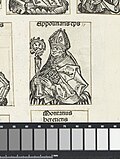 Apollinaris of HierapolisSaint · Bishop of HierapolisJan 8
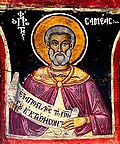 ShemaiahProphet · Prophet in the time of RehoboamJan 8
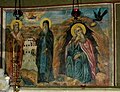 George of ChozibaVenerable · Abbot of Choziba MonasteryJan 8
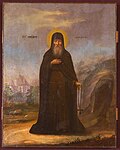 Gregory of the Kiev CavesVenerable Martyr · Wonderworker of the Kiev CavesJan 8
 Isidore of YuryevHieromartyr · Priest at TartuJan 8
 Domnica of CarthageVenerable · Virgin of CarthageJan 8
- Elias the HermitVenerable · Hermit of EgyptJan 8
- Gregory of OhridSaintJan 8
 Gregory the RecluseVenerable · Recluse of the Kiev CavesJan 8