Venerable
Adalbert of Egmond
Missionary to Frisia
Anglo-Saxon missionary from Northumbria, companion of Willibrord in Holland and Frisia; died around 710.
- Feast
- June 25old style July 8
- Reposed
- 8008th century
- Place
- Egmond
- Order
- Venerables
Life
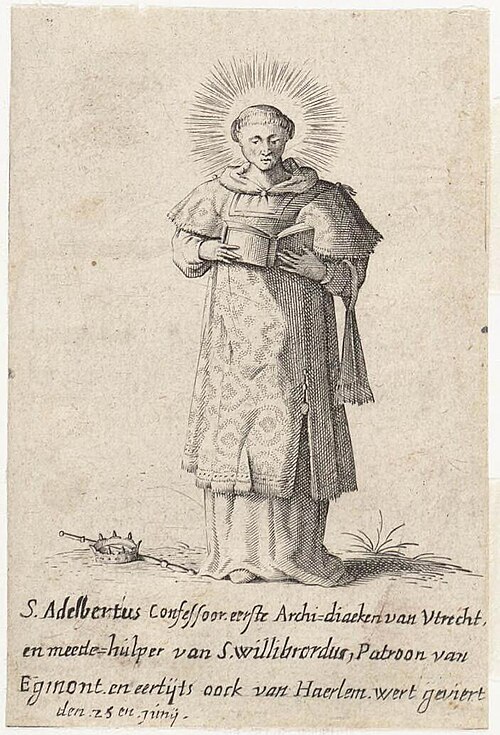
Saint Adalbert of Egmond (also called Æthelberht of Egmond) was an Anglo-Saxon missionary from Northumbria, one of the companions of Saint Willibrord in preaching the Gospel in Holland and Frisia. He died at Egmond, according to some sources around 710, according to others about 740. He is commemorated on 25 June, as a saint in the Catholic and in the Orthodox Church.
He is said to have been born in Northumbria (in Northumberland, in the Russian source), of the Northumbrian royal family, according to others of princely stock. According to some sources he studied at Rath Melsigi in Ireland with Egbert and became a monk. Around 690 he went to help Willibrord (who had also been at Rath Melsigi) in the mission field of Frisia, as a deacon. According to Alcuin's late eighth-century Life of Willibrord, Archbishop of Utrecht, they landed near Domburg. Adalbert became associated particularly with Egmond, was made archdeacon of the recently founded see of Utrecht, and died at Egmond. He was buried there, and miracles were reported at his tomb, over which a church was built. It is said he shielded the settlement of Egmond from pirates by causing a fog to rise along the coast.
His memory rests mostly on the foundation, some two hundred years later, of the Benedictine monastery of Egmond Abbey, the first in the country, by Count Dirk I of West Frisia (Holland), of which Adalbert was made patron. The Life was not commissioned until the 990s, which presumably accounts for its lack of facts. His relics were translated to the newly built abbey (initially a nunnery) for veneration. After the Reformation and the destruction of the abbey, they were preserved in Haarlem. The cult was reinstated when the abbey was re-founded in 1935, and the relics were returned there in 1984. The saint's skull, carefully restored, is preserved there too, beneath the high altar. In icons he is shown either with a crown and a sceptre at his feet, or in a dalmatic and crown, holding a sceptre.
Commemorated the same day June 25
 Prosper of AquitaineSaint · Church writerJun 25
 Salomon of BrittanyRight-Believing · King of BrittanyJun 25
 Febronia of NisibisVenerable Martyr · Nun of NisibisJun 25
 Orosia of JacaSaint · Patron of JacaJun 25
 Peter and Fevronia of MuromHoly Right-Believing Rulers · Right-believing of MuromJun 25
 Prosper of ReggioSaint · Bishop of Reggio EmiliaJun 25
 Nikon of OptinaConfessor · Last confessor of OptinaJun 25
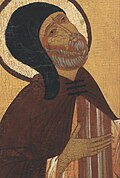 Peter of MuromRight-Believing · Prince of MuromJun 25
 John of UglichMartyr · Child martyr of UglichJun 25
 AmphibalusHieromartyrJun 25
- Fevronia of MuromRight-Believing · Princess of MuromJun 25
- Theoleptos of PhiladelphiaSaint · Metropolitan of PhiladelphiaJun 25