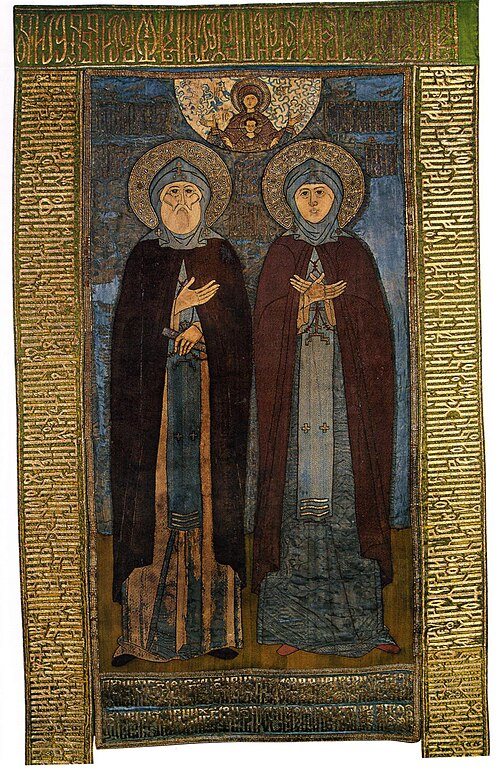
Holy Right-Believing Rulers
Peter and Fevronia of Murom
Right-believing of Murom
Rulers of Murom and husband and wife, who reposed in 1228, honored as protectors of marriage.
- Feast
- June 25old style July 8
- Reposed
- 122813th century
Life
The holy right-believing Peter and Fevronia of Murom (in monasticism David and Euphrosyne) are a married couple, rulers of Murom, venerated in the Russian Church as protectors of marriage and fidelity. They died, according to tradition, on the same day, 25 June 1228 (8 July in the new style). The two are among the best-known Russian saints and wonderworkers. The church council of 1547, under Metropolitan Macarius, canonized them as locally venerated saints. Their memory is kept on 25 June/8 July; there is another celebration established by the Holy Synod on 25 December 2012, on the Sunday before the day of the translation of their relics in 1992, and one calendar also commemorates them on 6 September.
The sources and scholars' views
There is no Life of Peter and Fevronia in the proper sense. The only source about them is a work very far from the hagiographic genre, because of the use of fairy-tale motifs and folklore (a semi-pagan secular legend, in E. E. Golubinsky's words): "The Tale of Peter and Fevronia of Murom", written by Yermolai-Erasmus at the end of the 1540s, at the order of Metropolitan Macarius, in connection with the canonization. The metropolitan did not include it in the Menaion, because of its "exceptional legendary character", and it circulated as an apocryphon. The plot rests on motifs well known in world literature and folklore: "victory over the dragon" and "the wise maiden".
The chronicles do not know a prince Peter of Murom and a wife Fevronia. Some scholars identify them with the prince of Murom David Yuryevich (died 1228), known from the chronicles, and his wife. According to another view, Peter and Fevronia are characters of folk legends. The earliest surviving copy of their Life, in the Prologue, does not name them as husband and wife but as son and mother, and the same version is found in some hymnographic sources, while another Prologue redaction of the sixteenth century, older than Yermolai-Erasmus's Tale, does not mention Fevronia at all.
The story according to the Tale
A few years before his reign, Peter is said to have killed a fiery dragon, but he was stained with its blood and fell ill with leprosy, which no one could cure. It was revealed to the prince in a dream that he could be healed by Fevronia, the daughter of a wild-honey gatherer, from the village of Laskovo in the Ryazan land. In a house in the village the messenger sent to look for a doctor saw a strange sight: a girl sat at a loom weaving linen, and before her a hare was leaping. Speaking in riddles, Fevronia tested the guest on his knowledge of "the language of wisdom". Her first parable, "it is bad when a house has no ears and a room no eyes", meant that she was an unmarried girl without a child, that she had a hare but no dog: if there had been a dog in the house, it would have sensed you approaching and barked at you, and those are the ears of the house; and if there had been a child in the room, it would have told me that you were coming in, and those are the eyes of the house. As payment for the cure, Fevronia asked that the prince marry her. He promised, was healed, but did not keep his word, because she was of the common people. But in the course of the treatment Fevronia had deliberately left one scab on the prince's body uncured, and the illness returned. Fevronia healed him again, and he was forced to marry her.
When Peter inherited the rule after his brother, the boyars did not want a princess of the common people and told him: "Either let go of the wife who by her origin insults the noble ladies, or leave Murom." The prince took Fevronia and they sailed away down the Oka in two boats. In Murom disorder began, many tried to occupy the empty throne, killings began, and the boyars asked the prince and his wife to return. They came back, and Fevronia later managed to win the love of the townspeople.
In old age they were tonsured in different monasteries with the names David and Euphrosyne, prayed God that they might die on the same day, and left an order to be laid in one coffin, prepared beforehand from a single stone with a thin partition between them. They died on the same day and at the same hour. Judging burial in one coffin unsuitable to monastic state, their bodies were placed in different monasteries, but the next day they were found together.
The date of death
The day of ecclesiastical veneration is 25 June, old style. The statement of the Laurentian Chronicle that the death of Prince David Yuryevich, identified in late sources with Peter, fell in Bright Week of 1228 (Easter was on 26 March) calls in question either this identification or the correspondence of the date of death and the date of veneration. The church's liturgical practice knows two kinds of commemoration of saints, on the day of death and on the day of the translation of relics. The Tale speaks clearly of the date of death: "... they delivered together their holy souls into the hands of God, in the month of June, on the 25th day". Yet it has been suggested that the date of 25 June, the day of the holy venerable martyr Febronia of Syria, is linked with the translation of the relics of the holy prince and princess from the decayed Boris and Gleb cathedral to the newly built cathedral of the Nativity of the Mother of God, already existing in the fifteenth century (renewed in the sixteenth), on Voevodsky Hill in Murom, where the relics lay until Soviet times. The cathedral was demolished at the end of the 1930s.
Relics and veneration
The holy couple were buried in the cathedral church of the city of Murom of the Nativity of the Mother of God, built over their relics by the vow of Tsar Ivan the Terrible in 1553. After Soviet power was established, on 10 February 1919, the reliquary was opened. In 1921 the relics were taken to the local museum and shown in an anti-religious exhibition. Since 1992 the relics have been open for veneration in the cathedral church of the Holy Trinity monastery in Murom. On 29 August 2012 particles of relics, among them those of Peter and Fevronia, were stolen from the church of Saint Catherine in Saint Petersburg. In the Russian Church there is a day specially appointed for their veneration, the Day of Peter and Fevronia. In the Moscow Patriarchate there are about ninety churches and chapels in their honour, in Russia, Ukraine, Belarus and Kazakhstan.
Since 2008 Russia has marked, on their day, the Day of Family, Love and Fidelity. Since 2009 sculptural groups "The Holy Right-believing Peter and Fevronia of Murom" have been put up in Russian cities, under the national programme "In the Family Circle", created in 2004 with the blessing of Patriarch Alexy II, with the aim of creating a positive image of family values. 89 monuments have been erected in Russia; the mass reproduction of sculptural images of Orthodox saints has no precedent in the history of Orthodoxy.
Commemorated the same day June 25
 Prosper of AquitaineSaint · Church writerJun 25
 Salomon of BrittanyRight-Believing · King of BrittanyJun 25
 Febronia of NisibisVenerable Martyr · Nun of NisibisJun 25
 Adalbert of EgmondVenerable · Missionary to FrisiaJun 25
 Orosia of JacaSaint · Patron of JacaJun 25
 Prosper of ReggioSaint · Bishop of Reggio EmiliaJun 25
 Nikon of OptinaConfessor · Last confessor of OptinaJun 25
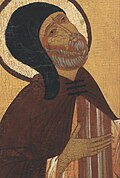 Peter of MuromRight-Believing · Prince of MuromJun 25
 John of UglichMartyr · Child martyr of UglichJun 25
 AmphibalusHieromartyrJun 25
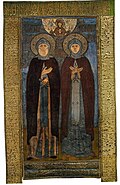 Fevronia of MuromRight-Believing · Princess of MuromJun 25
- Theoleptos of PhiladelphiaSaint · Metropolitan of PhiladelphiaJun 25