Hieromartyr
Amphibalus
Priest venerated in Britain as the one said to have converted Saint Alban; he died around the year 304.
Life
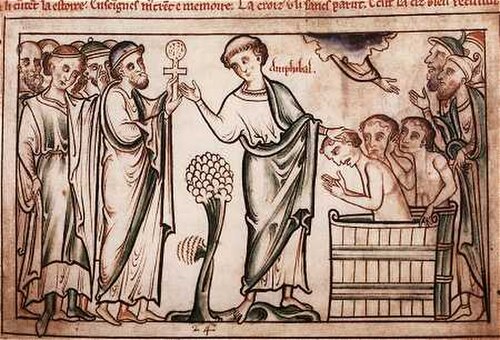
Saint Amphibalus, the Hieromartyr, is venerated in Britain as the priest who received Saint Alban of Verulamium (today St Albans) into his house and brought him to faith in Christ. In the English church tradition he held a place almost as honoured as Alban himself. He is said to have died a martyr about the year 304, in the time of Diocletian's persecution. But his name and many details of his life are the fruit of late writings, so that history and legend are mingled.
The traditional account
According to several holy accounts, among them those of Gildas, Bede, Geoffrey of Monmouth and Matthew Paris, Amphibalus was a Roman Christian priest fleeing the persecution of Emperor Diocletian. Alban sheltered him in his house in the Roman city of Verulamium. Impressed by the priest's faith and teaching, Alban began to follow him in prayer and ended by becoming a Christian. The priest was thought pious and faithful, and in Alban's house he prayed and kept watch day and night. He instructed Alban with "wholesome admonitions", moving him to abandon his former belief and follow him in the Christian faith.
When the Roman soldiers came to seize Amphibalus, Alban put on his robe and was punished in the priest's place. Alban was so inspired by his guest that he chose to sacrifice his own life to save him. After Alban's martyrdom Amphibalus is said to have returned to Caerleon, where he converted many, among them Saints Julius and Aaron, or, in the Russian account, Saints Stephen and Socrates, with whom he fled to Wales. In the end he was seized by the Romans and taken back to Verulamium, where he was killed for his faith. Where and how he died is unclear. Some sources say he was beheaded, others stabbed. A later version says Amphibalus and some companions were stoned to death a few days afterwards at Redbourn, four miles from St Albans. He is one of the four martyrs of the Church in Roman Britain, with Alban, Julius and Aaron.
The name and the doubts
Gildas, Bede and the three texts of Alban's Passion, going back to the fifth century, do not name Amphibalus. They speak of him not as a saint but simply as a priest and say nothing of his martyrdom. He gained his name and title as saint in the twelfth century, when Geoffrey of Monmouth wrote his History of the Kings of Britain. Geoffrey may have repeated a name that had come into use in his time, but he may also have misunderstood the Latin word amphibolus, meaning a cloak, which Alban wore. The Russian source says the same: it is known that Geoffrey understood inexactly the word amphibalus, referring to the garment given to Alban, and therefore the other details of his life too must be received with care.
Wilhelm Levison showed that the story of the name, which goes back to the Passion of Alban of the fifth century, is composed of borrowings from the lives of other saints and that, in his words, it "has no place in the ranks of the sincere acts of the martyrs, it is a legendary tale". Geoffrey repeated the story of Alban's martyrdom as given by Bede, adding the name of the confessor he shelters, Amphibalus. He mentions a church of Amphibalus at Winchester, where King Constantine gave his son Constans to become a monk. Geoffrey may have taken the name from Gildas, who describes Constantine, king of Dumnonia, dressed in the "amphibalo", the cloak of an abbot, to murder two royal youths in a church.
A new cult in the twelfth century
Other details about the veneration of Amphibalus come from writings that seem written to found a new cult, above all to give a setting to the finding of Amphibalus's body at Redbourn, near St Albans, in 1177 or 1178. The texts were composed at St Albans Abbey in the second half of the twelfth century by a monk, William of St Albans, in the time of Abbot Simon (1167 to 1183). He gave an elaborate version of the story of Saint Alban and gave a prominent role in it to a new martyr, Amphibalus, whose name he says he found in Geoffrey's work.
Wilhelm Levison wrote that the abbey had heavy debts and that anyone who knows the medieval use of belief and offerings will not be surprised that just then the generosity of the faithful was stirred by the discovery of the history and, above all, the relics of Saint Amphibalus. Benjamin Gordon-Taylor also holds that a principal motive for the beginning of the cult was the success of the cult of Thomas of Canterbury, murdered in 1170. The large number of people said to have been killed with Amphibalus may come from a copying error in the Martyrologium Hieronymianum, which linked to Alban, on 22 June, the large number of martyrs originally linked with Rufinus of Alexandria. The place of the finding at Redbourn was discovered near ancient Anglo-Saxon burial mounds, and the two knives found with Amphibalus are typical of an ancient pagan Anglo-Saxon burial.
Relics and veneration
According to the story, in 1178, some 800 years after the traditional date of his death, the remains were discovered at Redbourn in Hertfordshire. Saint Alban is said to have appeared in a vision to a monk named Robert, showing that he wished to make known the place of Amphibalus's remains. Robert followed the spirit of Alban and was led by the saint to the remains of Amphibalus and his companions. Healings took place at once, and the abbot ordered the site excavated. Several bodies were found, one of which seemed to fit the manner of Amphibalus's death. The body believed to be Amphibalus's was moved to St Albans and a shrine was made for the veneration of the relics.
The first shrine of Saint Amphibalus stood before the Great Rood Screen in the Norman Abbey of St Albans, near the high altar on the north side of Saint Alban's shrine. In 1323 part of the abbey roof collapsed and damaged the shrine. It was moved to the north aisle of the chancel, then, about 1350, to the centre of the retrochoir, east of Alban's shrine, with a stone tomb, paintings and a silver-gilt plate. The shrine was destroyed in the Dissolution of the Monasteries under Henry VIII, and the pieces were used to block the eastern arches. The relics were scattered. The remains of the shrine were found in the nineteenth century and reassembled in 1872 under Sir George Gilbert Scott. The stone shrine was restored in 2021 and can be seen in St Albans Cathedral. His feast was traditionally held on 22 June (the Russian sources give 24 and 25 June). Winchester Cathedral was under the patronage of Saint Amphibalus until it was dedicated to Saint Swithun about the year 971, which raises a question about the source and chronology of his much later cult.
Commemorated the same day June 25
 Prosper of AquitaineSaint · Church writerJun 25
 Salomon of BrittanyRight-Believing · King of BrittanyJun 25
 Febronia of NisibisVenerable Martyr · Nun of NisibisJun 25
 Adalbert of EgmondVenerable · Missionary to FrisiaJun 25
 Orosia of JacaSaint · Patron of JacaJun 25
 Peter and Fevronia of MuromHoly Right-Believing Rulers · Right-believing of MuromJun 25
 Prosper of ReggioSaint · Bishop of Reggio EmiliaJun 25
 Nikon of OptinaConfessor · Last confessor of OptinaJun 25
 Peter of MuromRight-Believing · Prince of MuromJun 25
 John of UglichMartyr · Child martyr of UglichJun 25
- Fevronia of MuromRight-Believing · Princess of MuromJun 25
- Theoleptos of PhiladelphiaSaint · Metropolitan of PhiladelphiaJun 25