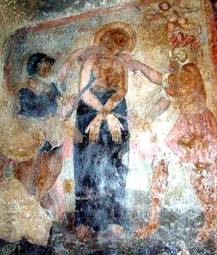
Venerable Martyr
Febronia of Nisibis
Nun of Nisibis
Nun of Nisibis who endured torment under Diocletian and did not renounce her faith.
Life
Saint Febronia the Martyr was a nun of Nisibis in Mesopotamia, now Nusaybin in Turkey, who endured cruel torments in the time of Diocletian and did not renounce the faith. The Church remembers her on 25 June. She is one of the one hundred and forty saints whose statues adorn the colonnade of Saint Peter's Square.
According to her Life she was the daughter of the senator Prosphorus of Rome, in the time of Diocletian. The prefect Anthimus wanted to marry his son Lysimachus to the beautiful daughter of Prosphorus. To escape this marriage she became a nun in the East, in Assyria, in a monastery where her aunt Brienne was abbess. After Anthimus's death, Lysimachus's care passed to his uncle Selenus. Diocletian, thinking Lysimachus a secret Christian, sent him east with his uncle to seize and kill Christians. Selenus was very harsh, while Lysimachus spared Christians wherever he could. After killing the Christians of Palmyra, Selenus came to the city of Sivapolis, near which was a convent of virgins with fifty cells, among them Febronia. Though only twenty, she was respected in the convent and the city for her meekness, wisdom and self-restraint. In the convent the rule of an earlier abbess, Platonida, was kept, that Friday be spent only in prayer and the reading of holy books. Brienne appointed Febronia to read the holy books to the nuns.
When Selenus heard of her, he ordered her brought. Febronia would not renounce Jesus Christ nor accept the marriage, and Selenus ordered Lysimachus to put her to torments: to be beaten, to have her teeth knocked out, her hands cut off, then her breasts, then her feet, and at last to be beheaded. According to tradition, on the same day God's punishment struck the tormentor: a mortal terror seized him, and striking his head on a marble pillar, he fell dead. Lysimachus ordered Febronia's body gathered and carried to the convent, where it was buried with honour, and he was baptized with many soldiers. Many healings are believed to have flowed from her relics, and she is said to have appeared on the day of her feast, standing in her usual place among the nuns. She suffered around 304, or according to other sources in 310. In 363 her relics were carried to Constantinople. Her tomb is shown in a monastery bearing her name in the village of Himo near Qamishli in northeastern Syria. In the Coptic Church she is commemorated on 25 June by the old calendar.
Commemorated the same day June 25
 Prosper of AquitaineSaint · Church writerJun 25
 Salomon of BrittanyRight-Believing · King of BrittanyJun 25
 Adalbert of EgmondVenerable · Missionary to FrisiaJun 25
 Orosia of JacaSaint · Patron of JacaJun 25
 Peter and Fevronia of MuromHoly Right-Believing Rulers · Right-believing of MuromJun 25
 Prosper of ReggioSaint · Bishop of Reggio EmiliaJun 25
 Nikon of OptinaConfessor · Last confessor of OptinaJun 25
 Peter of MuromRight-Believing · Prince of MuromJun 25
 John of UglichMartyr · Child martyr of UglichJun 25
 AmphibalusHieromartyrJun 25
- Fevronia of MuromRight-Believing · Princess of MuromJun 25
- Theoleptos of PhiladelphiaSaint · Metropolitan of PhiladelphiaJun 25