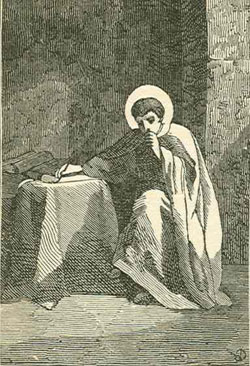
Saint
Prosper of Aquitaine
Church writer
Disciple of Augustine and Christian writer, continuator of the Chronicle of Jerome.
- Feast
- June 25old style July 8
- Reposed
- 4635th century
- Place
- Rome
Life
Prosper of Aquitaine, also called Prosper Tiro, was a Christian writer of the fifth century, disciple of Augustine and defender of the teaching on grace. He is regarded as the first continuator of the Universal Chronicle of Saint Jerome. The Catholic Church commemorates him on 25 June.
Life
He was born in Aquitaine and may have studied at Bordeaux. Around 417 he arrived at Marseille as a refugee from the Gothic invasions. In 429 he began to correspond with Saint Augustine, with his friend Hilary. In 431 he went to Rome, to seek the support of Pope Celestine I for Augustine’s teaching, against the so-called monks of Marseille. From 440, the year Leo I began his pontificate, he was attached to this pope, as secretary and adviser on questions of doctrine; according to Gennadius of Massilia, he wrote, in the pope’s name, the letters against Eutyches. The date of his death is not known; his chronicle goes down to 455, and Marcellinus mentions him under the year 463, whence it is thought he died shortly after that date. He was a layman, but threw himself with zeal into the religious disputes of his time, defending Augustine and right teaching.
Writings
Against the Pelagians he wrote, around 430, a poem of more than a thousand lines, “Adversus ingratos” (“Against the Ungrateful”). His chief work, “De gratia Dei et libero arbitrio” (432), is written against John Cassian’s “Conferences”. He urged Pope Celestine to send an open letter to the bishops of Gaul. He made an abridgment of Augustine’s commentary on the Psalms and a collection of sentences from his work, perhaps the first of its kind, as well as a rendering into verse of some of Augustine’s teachings, in 106 epigrams. His prose work “De vocatione omnium gentium” (“The Call of All Nations”), of 450, is his most original theological contribution: it tries to reconcile Augustine’s teaching on grace with God’s will that all men be saved, showing that, although not all receive the grace that saves, all receive God’s general grace. After Augustine’s death he composed three series of defences on his behalf, especially against Vincent of Lérins.
Most important for history is the “Epitoma chronicon” (379-455), which he first composed in 433 and brought up to date several times, last in 455. Down to the year 378 it is largely a retelling of Jerome’s Chronicle; for the years 425-455 it rests on his own memory and information, and is very valuable, especially for Attila in Gaul (451) and in Italy (452), and for the sack of Rome by the Vandals in 455, with which the chronicle ends. He is the author of the much-quoted saying “legem credendi lex statuat supplicandi” (later shortened to “lex orandi, lex credendi”), that is, the order of prayer establishes the order of faith. Another saying of his: “what he does not hold by arms, he holds by religion”.
Commemorated the same day June 25
 Salomon of BrittanyRight-Believing · King of BrittanyJun 25
 Febronia of NisibisVenerable Martyr · Nun of NisibisJun 25
 Adalbert of EgmondVenerable · Missionary to FrisiaJun 25
 Orosia of JacaSaint · Patron of JacaJun 25
 Peter and Fevronia of MuromHoly Right-Believing Rulers · Right-believing of MuromJun 25
 Prosper of ReggioSaint · Bishop of Reggio EmiliaJun 25
 Nikon of OptinaConfessor · Last confessor of OptinaJun 25
 Peter of MuromRight-Believing · Prince of MuromJun 25
 John of UglichMartyr · Child martyr of UglichJun 25
 AmphibalusHieromartyrJun 25
- Fevronia of MuromRight-Believing · Princess of MuromJun 25
- Theoleptos of PhiladelphiaSaint · Metropolitan of PhiladelphiaJun 25