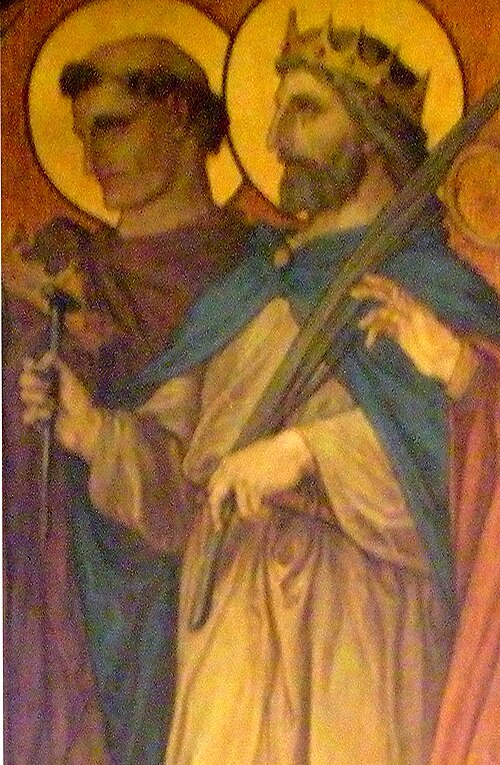
Right-Believing
Salomon of Brittany
King of Brittany
Count of Rennes and Nantes from 852 and duke of Brittany from 857, assassinated in 874.
- Feast
- June 25old style July 8
- Reposed
- 8749th century
- Place
- Langoëlan
Life
Salomon of Brittany ruled Brittany in the second half of the ninth century: count of Rennes and Nantes from 852, and duke of Brittany from 857 until his death in 874. Popular tradition in Brittany venerates him as a saint and martyr, and he is commemorated on 25 June. His life joins the deeds of a powerful ruler to a grave sin, and his later veneration rests on his violent end.
Early life
Salomon was the son of Riwallon III of Poher and the grandson of Count Erispoë I of Poher. Through his father he was a cousin of Erispoë, son of Nominoë, the first ruler of a united Brittany. After the Frankish king Charles the Bald was defeated at Jengland in 851, he made peace with Erispoë and granted him the counties of Rennes and Nantes and the land of Retz. In 852 Salomon swore an oath of loyalty to Charles and in turn received Rennes, Nantes and Retz, held as a third of Brittany. He became the most powerful nobleman at Erispoë's court.
Reign
Fearing that he would lose his possessions if Louis the Stammerer were set up as king at Le Mans, Salomon plotted with a man named Almarchus to kill his cousin Erispoë. The deed was done in 857, in a church, and Salomon took the place of the man he had killed. It was a grave guilt, and the sources do not hide it.
As ruler he used the troubles of the Frankish kingdom to enlarge his lands. In 858 he stood behind the revolt of the Neustrian nobles against Charles the Bald, and in September his envoys met Louis the German at Orléans. A synod at Savonnières near Toul in 859 told him to remember his oath of 852 and to pay tribute again. By about 862 he was the center of the revolt against Charles, and to fight Robert the Strong he hired a band of Vikings, while also lending Breton troops to Louis the Stammerer, who had risen against his own father.
In 863 Charles marched toward Brittany but halted near Entrammes and made peace: Salomon received western Anjou and took up the tribute once more. In 866 Breton and Norman forces together defeated Robert's army at Brissarthe, where Robert was killed. In 867, by the agreement at Compiègne, he was given the counties of Avranches and Coutances. In 868 Charles presented him with royal regalia, including a golden crown set with jewels, and is thought to have stood godfather to Salomon's two-year-old son Wigo. From then on Salomon called himself king, though he was never recognized as such in law; a later chronicler of Redon wrote that he bore the name only because he wore a golden coronet and purple robes granted by the emperor.
In the 860s he also tried to obtain the pallium from Pope Nicholas for the bishop of Dol, so that an archdiocese might be founded for all the Breton sees, which did not accept the metropolitan of Tours. From 870 to 873 he fought the Normans at length until they left Brittany, and in 874, together with Charles, he took the city of Angers from them.
Death and veneration
In 874 a conspiracy formed around Pascweten, count of Nantes and Salomon's son-in-law, Gurwant, count of Rennes, and Wigo, son of the count of Cornouaille. Salomon was seized and killed; the sources place his death at the end of June, and tradition keeps 25 June. The conspirators soon fell out among themselves, and civil war followed until 876.
In the popular tradition of Brittany he was counted a saint, called Saint Salomon or King Salomon, and raised to the rank of martyr. He is commemorated on 25 June.
Commemorated the same day June 25
 Prosper of AquitaineSaint · Church writerJun 25
 Febronia of NisibisVenerable Martyr · Nun of NisibisJun 25
 Adalbert of EgmondVenerable · Missionary to FrisiaJun 25
 Orosia of JacaSaint · Patron of JacaJun 25
 Peter and Fevronia of MuromHoly Right-Believing Rulers · Right-believing of MuromJun 25
 Prosper of ReggioSaint · Bishop of Reggio EmiliaJun 25
 Nikon of OptinaConfessor · Last confessor of OptinaJun 25
 Peter of MuromRight-Believing · Prince of MuromJun 25
 John of UglichMartyr · Child martyr of UglichJun 25
 AmphibalusHieromartyrJun 25
- Fevronia of MuromRight-Believing · Princess of MuromJun 25
- Theoleptos of PhiladelphiaSaint · Metropolitan of PhiladelphiaJun 25