Saint
Orosia of Jaca
Patron of Jaca
Patron saint of Jaca in the Spanish Pyrenees, the center of her veneration.
- Feast
- June 25old style July 8
- Reposed
- 8809th century
- Place
- Yebra de Basa
Life
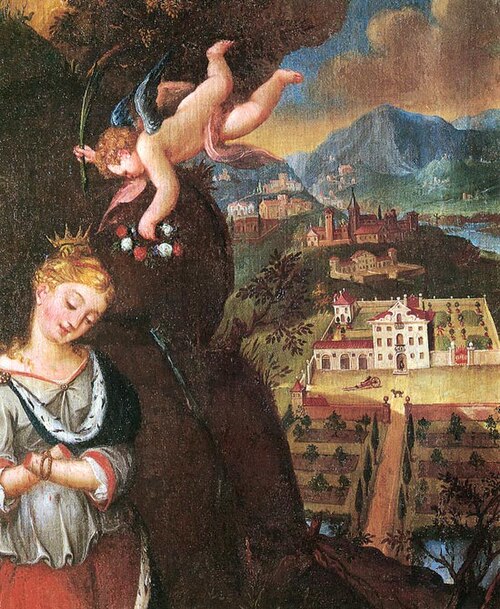
Saint Orosia (Eurosia) is the patron of the city of Jaca, in the province of Huesca in northeastern Spain, in the Pyrenees, where the centre of her veneration lies. Tradition says she was a virgin martyr, killed by the Moors in the ninth century, in 880, near the village of Yebra de Basa. Her feast is kept on 25 June, and one source also gives 1 May.
The traditions of her life
According to one tradition, she was born at Bayonne (or perhaps in Bohemia) and died in 880, killed by the Moors at Jaca. The legend says she was of noble birth and promised to a Moor in an arranged marriage. Orosia fled and hid in a cave, but the smoke from her fire gave her away. She was dragged from the cave by her hair and killed. One source adds that, rather than accept a marriage, she wished to live as a hermit on the mountain of Yebra. The medieval documents about her have been lost. In the 1950s Antonio Durán Gudiol reconstructed, from the antiphonaries of the sixteenth-century breviary of the dioceses of Huesca and Tarragona, medieval hymns that give a picture of the saint different from that of the most widespread hagiography.
According to an alternate tradition, she was born Dobroslava (in Slavic "she of good name") into the ducal family of Bohemia, in 864, was orphaned early and was taken in by Duke Bořivoj I and his wife, Saint Ludmila, who raised her as their daughter and brought her to the Christian faith. Dobroslava was baptized and received the Greek name Eurosia. Her years of peace were broken when pagan Czechs seized power and forced the ducal family into exile. Bořivoj was restored thanks to Saint Methodius. In 880 Methodius was charged by Pope John VIII to find a worthy bride for Fortún, son of the king of Pamplona, heir to the throne of Aragon and Navarre, who would be a key figure in the fight against the Moors. Eurosia, then sixteen, was considered a good choice and was brought to Spain in 880. Crossing the Pyrenees, she planned to meet her future husband at Jaca, but the country had become a war zone. A Moorish captain, Aben Lupo, wished to marry her himself and attacked the Bohemian party. Thanks to the bravery of her escort, the young bride-to-be managed to escape through the mountains, but was pursued and caught. Eurosia called on heaven and a lightning bolt struck the ground near her captors, without harming her. The Moors were frightened, but their leader, angry and terrified, ordered her put to death; according to one source her hands and feet were cut off, according to another she was beheaded. A terrible storm came with hail and thunder, and the Moors fled in terror, and from heaven a voice stronger than the storm was heard: "Let it be given to her to quell storms wherever her name is invoked." Her remains, the tradition says, were miraculously found two years later by a shepherd.
Veneration
Her veneration springs from the oral tradition of the small mountain town of Yebra de Basa. A shepherd of Yebra is said to have found her relics in the eleventh century thanks to an apparition of the Virgin Mary that showed their place. The head remained at the original simple shrine, in the parish church, where it is kept as a treasure and venerated as patron of the mountain. Sancho Ramírez, recognizing the importance of the relics, brought the body to Jaca, which he had designated the capital of his kingdom of Aragon. To draw pilgrims to his city, he shifted the traditional route of the Way of Saint James, which followed the Roman military route over the Puerto del Palo by the monastery of San Pedro de Siresa to Berdún, giving a route through Somport and Jaca, reinforced by publicized miracles at the shrine in the city, now on the direct route of the Camino de Santiago. The headless body is kept in an urn beneath the high altar of Jaca cathedral, 26 km from Yebra. There is a chapel dedicated to her in La Seo cathedral in Zaragoza. Her cult spread into Béarn and northern Italy through the campaigns of the Spanish realm, above all in Piedmont, and from the fifteenth century across Spain, also through Spanish soldiers. Her veneration was officially approved by Pope Leo XIII in 1902. The Roman Martyrology commemorates her: "At Jaca in northern Spain, Saint Eurosia, virgin and martyr."
The saint is invoked against storms, lightning and hail, and for the protection of the fruits of the earth. Many bells in Italy are dedicated to her, rung to drive away storms. It is unclear when she became patroness of the demonically possessed; until 1947, when the bishop of Jaca prohibited the practice, those afflicted were gathered in a procession following the urn with her relics, and on her feast collective exorcisms were held in two places in the Pyrenees, stopped by church authority in the second half of the twentieth century.
Commemorated the same day June 25
 Prosper of AquitaineSaint · Church writerJun 25
 Salomon of BrittanyRight-Believing · King of BrittanyJun 25
 Febronia of NisibisVenerable Martyr · Nun of NisibisJun 25
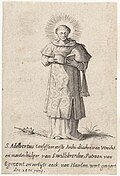 Adalbert of EgmondVenerable · Missionary to FrisiaJun 25
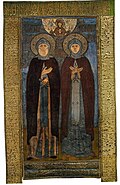 Peter and Fevronia of MuromHoly Right-Believing Rulers · Right-believing of MuromJun 25
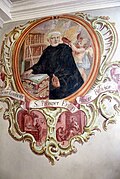 Prosper of ReggioSaint · Bishop of Reggio EmiliaJun 25
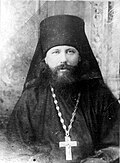 Nikon of OptinaConfessor · Last confessor of OptinaJun 25
 Peter of MuromRight-Believing · Prince of MuromJun 25
 John of UglichMartyr · Child martyr of UglichJun 25
 AmphibalusHieromartyrJun 25
- Fevronia of MuromRight-Believing · Princess of MuromJun 25
- Theoleptos of PhiladelphiaSaint · Metropolitan of PhiladelphiaJun 25