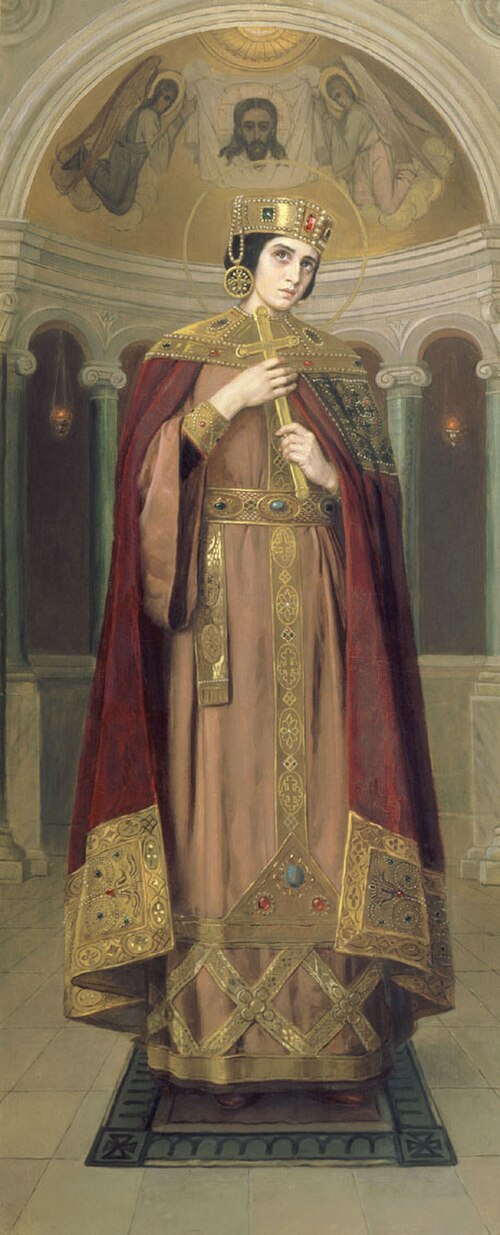
Martyr
Alexandra the Empress
Empress, martyr of Nicomedia
Martyr of the Diocletian persecution, mentioned in the account of the martyrdom of Saint George.
Life
The Holy Martyr Alexandra, called in the sources Empress Alexandra or Alexandra of Rome, was a martyr of the time of Diocletian's persecution, mentioned in the account of the martyrdom of the Holy Great Martyr George. She suffered in 303 (in other sources, in 313 or 314), at Nicomedia. Her feast is on 23 April (in some calendars, 21 April).
What the Life of Saint George says
Alexandra is known from the Life of Saint George, where she is called empress and wife of the emperor Diocletian; according to Jacobus de Voragine, who writes her name "Alexandria," she was the wife of Dacian, the Roman prefect who persecuted Saint Caprasius of Agen and Saint Maginus. While Saint George was being tortured, Alexandra, seeing his sufferings and the repeated miraculous help of God, believed in Christ. The Ukrainian account says that she saw the wounds caused by knives and nails on the wheel of torture healed by an angel, and saw George spend three days bound under a yoke and sunk to the shoulders in quicklime, and remain whole and unharmed; hearing that the sign of the cross had shattered all the statues of the gods in the temple of Apollo, she openly confessed Christ. The proconsul Magnetius wished to dissuade her. Alexandra went to the arena, bowed before George and professed her faith openly. When she wondered whether she was worthy of paradise and martyrdom without being baptized, Saint George told her: "Do not fear, for your blood will baptize you." She was denounced as a Christian and imprisoned, on her husband's orders, at Nicomedia, then sentenced to death. Her husband, enraged, is said to have exclaimed in astonishment that even she had fallen under their spell.
Her end
Alexandra quietly accepted her sentence and prayed as the guards led her to the place of execution. She asked if she could rest for a moment, and the guards allowed it. She rested by the place where Saint George had been killed, at the city wall of Nicomedia, and, leaning against the wall, died in peace (according to the most widespread account; according to another version of the Life, like Saint George, she was beheaded with the sword). The Hermeneia depicts her, in the scene of George's execution, sitting at a distance on a stone, dead, with an angel receiving her soul. Her three servants, Apollo, Isaac and Codratus, went to prison with her; the first two died of starvation, while the last was beheaded with her, on 21 April 314 (according to some sources). Her day is usually celebrated on 21 April and sometimes on 23 April, when she is commemorated with the soldier martyrs Anatolios and Protoleon and the 630 who were killed for the faith they professed while witnessing George's martyrdom. The Coptic Church venerates her on 8 or 10 April, and the Catholic Church on 20 March.
The view of historians
The wife of the emperor Diocletian was Prisca, who is known to have really been a Christian; it is possible that she received the name Alexandra after baptism. Symeon Metaphrastes, the Vatican Codex of 916 and other ancient Byzantine and Latin texts do not call her Diocletian's wife; the exception is the compilation of Theodore Daphnopates. She may have been the widow of one of the emperors before Diocletian (between 270 and 284 the Empire had fifteen rulers). The attempt to identify Alexandra with Prisca was made only in the twentieth century; in the menaion published by the Moscow Patriarchate Alexandra's death in 303 is called imaginary and her martyrdom is moved to 313, the year of Prisca's death, but this version is not supported by the ancient canonical lives and the oriental apocrypha. Jacobus de Voragine presents the story as legendary but not outright fiction; Holweck holds that it is all fictitious and that she never existed.
Veneration
The date of her commemoration is known from the tenth century and appears in the Typikon of the Great Church and the Menologion of the emperor Basil, as well as other Greek manuscripts. A short life was translated into Slavonic in the twelfth century, in the Prologue of Constantine of Mokisos. A Greek manuscript of the tenth century contains a canon of the empress Alexandra, in tone 2, by Theophanes the Branded, not included in the printed menaia. In present practice there is no separate service for her; she is mentioned at the vigil of the Holy Great Martyr George, where in the Russian menaion a separate troparion is given for her, and in the Greek service, at the sixth ode of the canon at matins, an iambic verse to Saint Alexandra. In the nineteenth century, in Russia, Alexandra became the heavenly patroness of several empresses (Alexandra Feodorovna, wife of Nicholas I, and Alexandra Feodorovna, wife of Nicholas II); at that time several churches were consecrated in her honour in Moscow.
Commemorated the same day April 23
 GeorgeGreat Martyr · The Trophy-BearerApr 23
 Alexandra FeodorovnaPassion-Bearer · Empress of RussiaApr 23
 Adalbert of PragueHieromartyr · Bishop of PragueApr 23
 Solomon I the GreatRight-Believing · King of ImeretiApr 23
 Gerard of ToulSaint · Bishop of ToulApr 23
 Marolus of MilanSaint · Archbishop of MilanApr 23
 Felix, Fortunatus and AchilleusMartyr · Martyrs of ValenceApr 23
 Therinus of ButhrotumSaintApr 23
 Athanasius the MagicianMartyrApr 23
 Lazarus the BulgarianNew MartyrApr 23
- Sophia of KleisouraVenerableApr 23
- AlcheachSaintApr 23