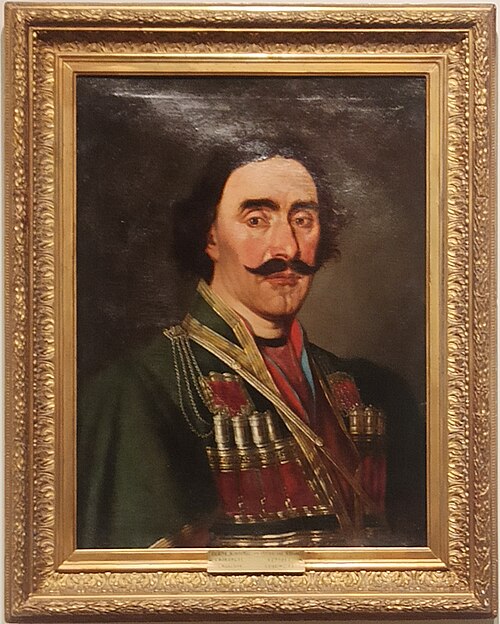
Right-Believing
Solomon I the Great
King of Imereti
King of Imereti in western Georgia from 1752 to 1766 and again from 1768 until his death in 1784.
- Feast
- April 23old style May 6
- Reposed
- 178418th century
- Place
- Kutaisi
Life
Saint Solomon I the Great was King of Imereti in western Georgia from 1752 to 1766 and again from 1768 until his repose in 1784. He is honoured as a defender of his people against Ottoman rule and the trade in human beings. The Georgian Orthodox Church canonized him on 22 December 2016 and keeps his memory on 23 April.
He was born in 1735, son of King Alexander V of Imereti and Queen Tamar, of the Abashidze family. He came to the throne at his father's death in 1752, in a land torn by feuds of the great feudal families and civil wars. At once he began stern measures against the rebel nobles and the slave trade from which they profited together with the Ottoman authorities, banning the trade in human beings in 1754. In 1752 the nobility staged a coup, but he quickly regained the crown and began reforms to strengthen the kingdom, among them a corps of men bound by oath and the end of the autonomy of the Racha duchy.
The Ottomans, who saw Imereti as within their sphere, sent an army. Solomon rallied his nobles around him and defeated it at Khresili in 1757. That same year he made an alliance with Heraclius II, who ruled eastern Georgia, and with Teimuraz II. He defeated two more Ottoman invasions and fought incursions of North Caucasian tribes instigated by the Turks. In 1765 the Ottomans took Kutaisi and set his cousin Teimuraz on the throne, but in 1767 Solomon returned and freed the land again. By the treaty of 1767 Imereti was no longer a vassal but a land under Ottoman "protection", and tribute in people was no longer demanded.
In the Russo-Turkish war of 1768 he met Heraclius II in Tbilisi in 1769. The two kings asked for five Russian regiments in return for a guarantee that Georgian interests would be protected in the final peace. The Russians sent a small force under General Totleben, but his harshness alienated the Georgians and he was recalled. Solomon took part in the siege of Şorapani in 1769 and the siege of Poti in 1770 to 1771. After the war he brought his autonomy-seeking vassals, the princes of Mingrelia and Guria, to submission, and in 1779 he crushed an Ottoman-sponsored revolt in Abkhazia. The peace of Küçük Kaynarca in 1774 fixed the Ottoman Empire's renunciation of tribute in people, freedom of Christian confession and non-interference in Imereti's affairs. Because he could stand alone against the Ottoman Empire and win the kingdom's de facto independence, Georgian historiography calls him "the Great".
He was married three times, to Tinatin Sharvashidze, to Mariam, daughter of Otia Dadiani, Prince of Mingrelia, and to Gulkan Tsulukidze. In 1778 his son Alexander rose against him, but they were reconciled. He fell asleep in April 1784 and was buried at Gelati Monastery.
Commemorated the same day April 23
 GeorgeGreat Martyr · The Trophy-BearerApr 23
 Alexandra FeodorovnaPassion-Bearer · Empress of RussiaApr 23
 Adalbert of PragueHieromartyr · Bishop of PragueApr 23
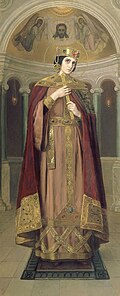 Alexandra the EmpressMartyr · Empress, martyr of NicomediaApr 23
 Gerard of ToulSaint · Bishop of ToulApr 23
 Marolus of MilanSaint · Archbishop of MilanApr 23
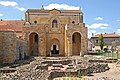 Felix, Fortunatus and AchilleusMartyr · Martyrs of ValenceApr 23
 Therinus of ButhrotumSaintApr 23
 Athanasius the MagicianMartyrApr 23
 Lazarus the BulgarianNew MartyrApr 23
- Sophia of KleisouraVenerableApr 23
- AlcheachSaintApr 23