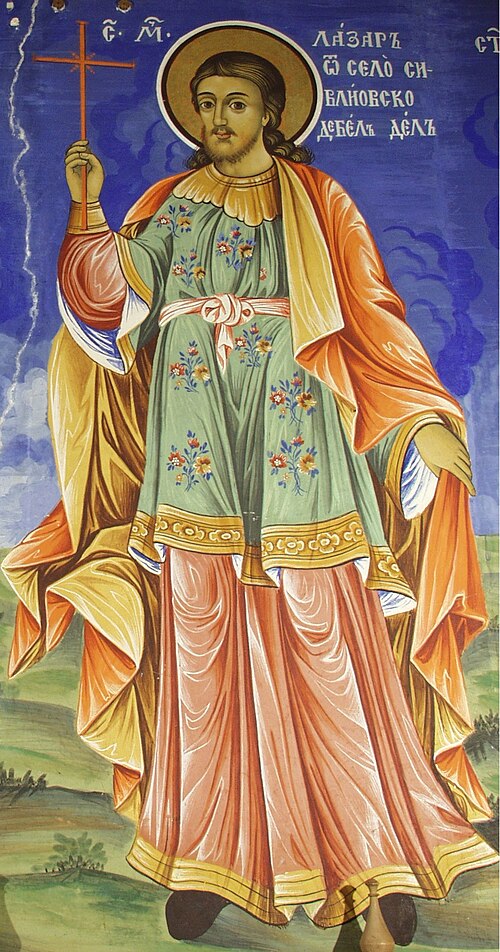
New Martyr
Lazarus the Bulgarian
New martyr of Bulgarian origin, born in 1774 and died in 1802.
Life
Holy New Martyr Lazarus the Bulgarian (Lazarus of Debel Dyal, Lazarus the New) was a young Bulgarian shepherd from Gabrovo, put to death in Asia Minor on 23 April 1802 (on Saint George's Day by the old calendar), at the age of 28. He is commemorated on 23 April.
According to the surviving tradition, he was born in 1774 in the village of Debel Dyal, 15 kilometres from Gabrovo; his father was named Nedko Enchov. His image is painted full length in the chapel of the Holy Archangels at Rila Monastery, where his place of birth is also marked. According to the nun Valentina Drumeva, he had a sad childhood, left an orphan and harassed by a stepmother; therefore he left home while still small, going south into Anatolia (Asia Minor), where he settled in the village of Soma, near Bergama (Pergamon), and became a shepherd. He was hardworking and thrifty, and at 28 already had 40 sheep. He also pastured other people's cattle.
He was a firmly believing Christian and by this drew the anger of the Turks. He perished chiefly through the machinations of a local Turkish woman and her family, supported by the agha and his men. According to his lives, she slandered him after, while he slept, his dog attacked her and tore her clothing. Her husband and other relatives demanded that he either accept Islam or die, offering him also a reward of 1000 piastres. Since he insisted on his innocence and remained faithful to Christ, they put him on trial, and the kadi acquitted him. The money-hungry lord, however, detained him on his own authority and continued to question and torture him with particular cruelty. After much hesitation he ordered him killed, because the bribe had been promised only if he persuaded him to change his religion or at least to admit guilt. He also tried to extract a ransom from his Christian friends. On the advice of the accused, they gave the agha nothing, except one who gave him a large sum precisely to put him to death, again at Lazarus' request.
Lazarus himself is said to have insisted on being put to death in the name of Christ, who is said to have appeared to him in his cell and healed him. Many Christians gathered to pray for him, and the Turks, disturbed by his courage and will, did not dare to put the noose on his neck. He put it on himself, after praying fervently to Saint George, whose memory the Christians were keeping that day. According to the Bulgarian source, he was hanged; the Serbian source says only that he was killed. He was buried after his body hung long on the gallows, but remained incorrupt for days. Later a fragrance began to be sensed from his grave, and his relics were moved to the altar of the village church. According to hagiographic data, many miracles took place at his relics, even immediately after his death. The Bulgarian source says that a life and a service composed in his honour, which were in the library of Neophyte of Rila, have been lost.
Commemorated the same day April 23
 GeorgeGreat Martyr · The Trophy-BearerApr 23
 Alexandra FeodorovnaPassion-Bearer · Empress of RussiaApr 23
 Adalbert of PragueHieromartyr · Bishop of PragueApr 23
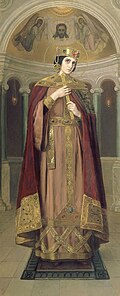 Alexandra the EmpressMartyr · Empress, martyr of NicomediaApr 23
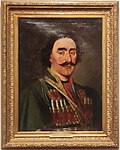 Solomon I the GreatRight-Believing · King of ImeretiApr 23
 Gerard of ToulSaint · Bishop of ToulApr 23
 Marolus of MilanSaint · Archbishop of MilanApr 23
 Felix, Fortunatus and AchilleusMartyr · Martyrs of ValenceApr 23
 Therinus of ButhrotumSaintApr 23
 Athanasius the MagicianMartyrApr 23
- Sophia of KleisouraVenerableApr 23
- AlcheachSaintApr 23