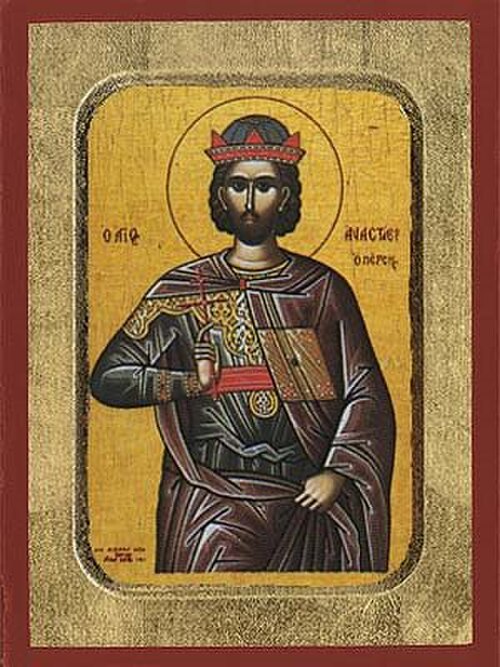
Venerable Martyr
Anastasius the Persian
Zoroastrian Persian soldier who became a Christian and a monk, and was martyred in 628.
- Feast
- January 22old style February 4
- Reposed
- 6287th century
- Place
- Resafa
- Order
- Martyrs
Life
The venerable martyr Anastasius the Persian was a Persian soldier, a Zoroastrian, who became a Christian and a monk and was killed for the faith in 628. He is commemorated on 22 January, and on 24 January the translation of his relics.
His life
Anastasius, called before Magundat, was born in the city of Ray, the son of a magus named Bavi. He served in the army of King Khosrow II and took part in the capture of the Holy Cross at Jerusalem, which was carried to the Persian capital Ctesiphon. The event led him to inquire about the Christian faith. Then he received the faith, left the army, became a Christian and later a monk at Jerusalem. He was baptized by Modestus, receiving the name Anastasius, in honour of the resurrection of the Lord (in Greek, anástasis). According to tradition he was tonsured at the monastery that bears his name, where he stayed seven years.
Martyrdom
After seven years of monastic life he went to Caesarea, then under Persian rule. There he interrupted and mocked the Zoroastrian priests about their religion and was arrested by the local marzban. He was imprisoned and cruelly tortured to make him renounce the faith, then taken near the Euphrates, to a place called Barsaloe, where the torments continued, while the highest honours in the service of King Khosrow as a magus were promised him if he would renounce Christianity. In the end, because he did not renounce, he was strangled and beheaded, together with seventy others, on 22 January 628.
The relics
His body was thrown to the dogs, but they did not touch it. The Christians ransomed it for a great sum. It was carried from the place of martyrdom to Palestine, then to Constantinople and finally to Rome, where the relics were venerated at the monastery of Tre Fontane. His Life, written in Greek, was translated into Latin, perhaps by Archbishop Theodore of Canterbury, and Bede judged the result poor and reworked it.
Commemorated the same day January 22
 TimothyHieromartyr · Bishop of EphesusJan 22
 Irene of RomeSaint · Wife of St. CastulusJan 22
 Antiochus the MonkVenerable · Monk and writer of PalestineJan 22
 Gaudentius of NovaraSaint · Bishop of NovaraJan 22
- BlesillaVenerable · Disciple of Saint JeromeJan 22
 Anastasius of the Kiev CavesVenerable Martyr · Deacon of the Kiev Caves LavraJan 22
 Macarius of BelyovVenerable · Founder of Makaryev MonasteryJan 22
 Manuel of AdrianopleHieromartyr · Bishop of AdrianopleJan 22
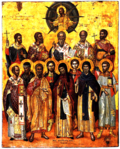 Joseph SamakosVenerableJan 22
- Vissarion of the AgathonosVenerable · Monk of Agathonos MonasteryJan 22
- AmhalghaidhSaintJan 22
- Anastasius the DeaconVenerable Martyr · Deacon of the Kiev CavesJan 22