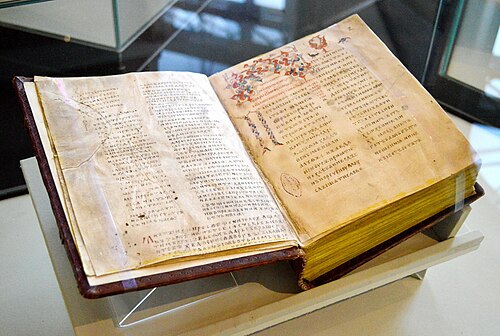
Venerable
Antiochus the Monk
Monk and writer of Palestine
Monk and writer of the 7th century, born near Ancyra, who lived in Palestine.
- Feast
- January 22old style February 4
- Reposed
- 7007th century
- Place
- Byzantine Empire
- Order
- Venerables
Life
Venerable Antiochus the Sabaite (Antiochus of Palestine, Antiochus the Monk, Antiochus Pandectes) was a monk and writer of the seventh century, born near Ancyra (today Ankara), who lived in Palestine, at the monastery of Saint Sabbas the Sanctified, and saw the Persian invasion of 614. He left the "Pandects of Holy Scripture", a collection of moral teachings for monks, and is the author of a prayer still read in the evening prayers and at Great Compline. He is commemorated on 24 December (6 January by the new calendar). The years of his life are uncertain: the sources place him between the end of the sixth century and the first half of the next, and give his death around 635.
His life
He was born, it is believed, near Ancyra (today Ankara), in Galatia, by the Russian source in the village of Medosaga, at the end of the sixth century. He lived first in solitude, then became a monk at the Lavra of Saint Sabbas the Sanctified, in the Kidron valley near Jerusalem, a lavra in which some sources say he became abbot or archimandrite. Others show him as a simple monk. As witness of the Persian-Byzantine war, he saw how in 614 the Persian general Shahrbaraz besieged Jerusalem for twenty days and took it. It is said up to ninety thousand people died, and the survivors were led into captivity in Persia and the city was set on fire. Then, in the massacre by Bedouins in the monastery, forty-four monks perished, Antiochus's companions. According to the Greek source, he escaped with other ascetics, returned to bury the dead, but the rumour of a new Persian attack made them take refuge in a deserted monastery near Jerusalem. After two years he returned for good to the monastery of Saint Sabbas.
In 619, five years after the conquest of the Holy Land by Chosroes, Ancyra was taken and destroyed by the Persians, and the monks of the neighbouring monastery of Attaline were forced to leave and wander from place to place. Unable to carry many books, Abbot Eustathius asked his friend Antiochus to compile an abridgment of Holy Scripture, easy to carry, and a short account of the martyrdom of the forty-four monks of Saint Sabbas. Some scholars have conjectured that Antiochus was the same as the Sabaite monk Strategios, author of an account of the Persian conquest of Jerusalem. This has not been proved.
The Pandects
In answer to the request, around 620 (between the conquest of Palestine by Chosroes and its reconquest by Emperor Heraclius, in 628) he wrote the "Pandects of Holy Scripture", in 130 chapters (which the Latin translator took for as many homilies). It is a collection of moral sentences, drawn from Scripture and early church writers, mainly on monastic life. The introductory chapter tells of the martyrdom of the monks mentioned, and the last contains a list of heretics, from Simon Magus to the Monophysite followers of Severus of Antioch. He does not limit himself to Scripture but also uses patristic teachings, of Ignatius of Antioch, Polycarp of Smyrna, Irenaeus, Clement of Alexandria, the Shepherd of Hermas, the Evagrian writing of Nilus and Dionysius the Areopagite. The book is of special value for its extracts of lost works: the author had an interest, then rare, in early Christian literature. Later it was reworked and took the form of monastic catecheses. It is in essence a code of monastic morals and conduct. It begins with the foundation of the virtues, which is faith, followed by hope, speaks in mixed fashion of virtues and passions, of how ascetics are to face the passions and gain peace of soul, of monastic and social duties, of those set in priestly leadership, and ends with questions of salvation and eschatology. It attracted the attention and love of monks and had great influence on monastic morals. The Greek and Latin text is in Migne's Patrologia Graeca (vol. 89).
Antiochus also wrote a short "Narrative" on the killing of the monks of the Lavra of Saint Sabbas and an "Exomologesis" or prayer in which he tells of the misfortunes fallen on Jerusalem in the time of the Persian invasion and asks divine mercy to heal the Holy City of its many ills. Part of it is the second prayer "And grant us, Master, for sleep..." read at the evening prayers and at Great Compline (the "second prayer to our Lord Jesus Christ, of Antiochus the monk Pandectes"). Antiochus is said to have died about the year 635.
Commemorated the same day January 22
 TimothyHieromartyr · Bishop of EphesusJan 22
 Anastasius the PersianVenerable MartyrJan 22
 Irene of RomeSaint · Wife of St. CastulusJan 22
 Gaudentius of NovaraSaint · Bishop of NovaraJan 22
- BlesillaVenerable · Disciple of Saint JeromeJan 22
 Anastasius of the Kiev CavesVenerable Martyr · Deacon of the Kiev Caves LavraJan 22
 Macarius of BelyovVenerable · Founder of Makaryev MonasteryJan 22
 Manuel of AdrianopleHieromartyr · Bishop of AdrianopleJan 22
 Joseph SamakosVenerableJan 22
- Vissarion of the AgathonosVenerable · Monk of Agathonos MonasteryJan 22
- AmhalghaidhSaintJan 22
- Anastasius the DeaconVenerable Martyr · Deacon of the Kiev CavesJan 22