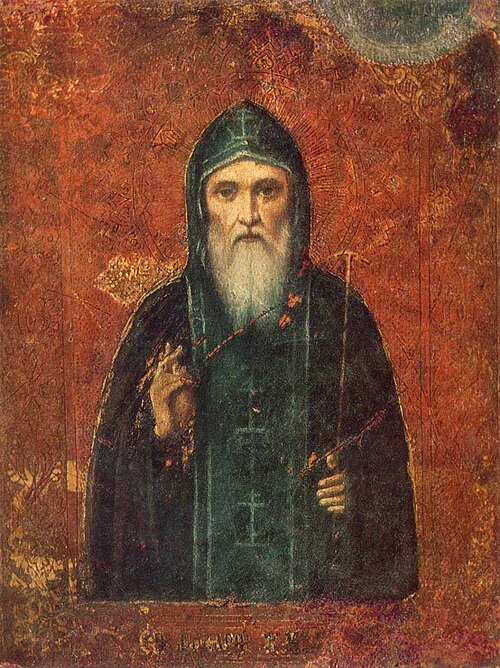
Venerable
Macarius of Belyov
Founder of Makaryev Monastery
Hieroschemamonk, founder of the Entry into the Temple Makaryev Monastery at Belyov; lived from 1539 to 1623.
- Feast
- January 22old style February 4
- Reposed
- 162317th century
- Order
- Venerables
Life
Venerable Macarius of Zhabyn (Macarius of Belyov, 1539 to 1623) was a hieroschemamonk, renewer of the Zhabyn Hermitage and founder of the Entry into the Temple Makaryev monastery at Belyov. He is commemorated (Old Style) on 22 January, 22 September and in the Synaxis of the Saints of Tula. According to the source, he was canonized at the end of the seventeenth century; his relics were found in 1816 and are in the hermitage he founded.
Life
He was born in 1539. Of his life before monasticism, as of the beginning of his monastic labours, no written reports survive. Tradition says that from youth he received monasticism and, ordained priest, not only laboured without sloth for God with all his soul, but became a father and guide to many. It can be said, with some probability, that, though he began his struggle in another monastery, he belonged to the brotherhood of the Zhabyn Hermitage even before its destruction, for in all the written accounts that have come down to us he is mentioned only as an ascetic of Zhabyn.
In 1615 the Zhabyn Hermitage was destroyed by the Polish army of Lisowski and ruins remained. Its revival owes to Saint Macarius, who, after the invaders left, returned to the ashes of the monastery and began its restoration. According to the synodikon, he "built the monastery, gathered the brotherhood", that is, after the restoration he was its first abbot. To the brotherhood he was not only a wise guide but a beloved abba, who built them up by word and by the example of a life of patient struggle. The synodikon speaks of his labours: "enduring in monastic body, he suffered frost and heat, hunger and thirst".
The strength of his faith and his love of neighbour are shown by an incident. When, in 1615, after the departure of Lisowski's army, he returned to the ashes of the monastery, he found near it a wounded Polish soldier, left behind by his own. Weak from his wounds, the Pole asked for water. Saint Macarius, hoping in God's mercy, prayed and struck the ground with his staff, and at once a spring burst forth which quenched the wounded man's thirst. The spring came to be called the well of Zhabynets. Not long before his blessed end he received the schema and laboured at the well of Zhabynets, in intensified fasting and prayer. He reposed in 1623, at eighty-four. At his grave many healings took place.
Commemorated the same day January 22
 TimothyHieromartyr · Bishop of EphesusJan 22
 Anastasius the PersianVenerable MartyrJan 22
 Irene of RomeSaint · Wife of St. CastulusJan 22
 Antiochus the MonkVenerable · Monk and writer of PalestineJan 22
 Gaudentius of NovaraSaint · Bishop of NovaraJan 22
- BlesillaVenerable · Disciple of Saint JeromeJan 22
 Anastasius of the Kiev CavesVenerable Martyr · Deacon of the Kiev Caves LavraJan 22
 Manuel of AdrianopleHieromartyr · Bishop of AdrianopleJan 22
 Joseph SamakosVenerableJan 22
- Vissarion of the AgathonosVenerable · Monk of Agathonos MonasteryJan 22
- AmhalghaidhSaintJan 22
- Anastasius the DeaconVenerable Martyr · Deacon of the Kiev CavesJan 22