Hieromartyr
Manuel of Adrianople
Bishop of Adrianople
Bishop of Adrianople, put to death by the Bulgars during the wars of the early ninth century.
- Feast
- January 22old style February 4
- Era
- unknown
- Order
- Martyrs
Life
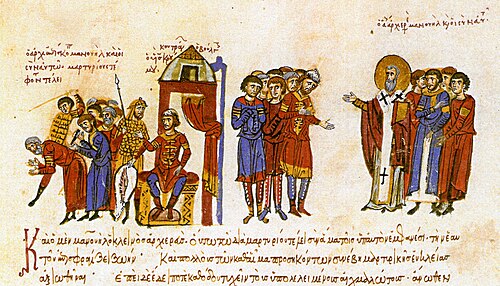
Holy Hieromartyr Manuel was bishop of Adrianople, a Byzantine city, put to death by the Bulgars in the year 815, during the wars of the early ninth century. He is remembered on 22 January. In the Middle Ages he and those who suffered with him were commemorated together in the Patriarchate of Constantinople on 22 and 23 January.
The bishop
Manuel is known from several early medieval sources: the writings of Theophanes Continuatus and of John Skylitzes, the Synaxarion of the Church of Constantinople, the Menologion of the emperor Basil II the Bulgar-slayer, the Menaion of Joseph the Hymnographer and other hagiographical writings. No information has been preserved about his origin and early years. His first mention is from the year 787, when he was already at the head of the Metropolis of Adrianople. Since several bishops were subject to him, in some sources he is given the rank of archbishop, but in the sources of his own time and in the writings of medieval authors he is called only bishop. It is not known when he ascended the throne. Before him was Joseph, and after him Gregory, of whom nothing is known but the names.
According to the acts of the Second Council of Nicaea, in the autumn of 787, Manuel took part in this council, made up of 367 bishops (mostly from the Christian dioceses of the East) and the envoys of the pope. He was present at eight of the sessions. At the second he spoke for the veneration of icons in the form set out in the letter of Pope Hadrian I and condemned iconoclasm. At the fourth session he signed the document of quotations from the writings of the Holy Fathers in support of the veneration of icons, and at the seventh he confirmed with his signature the Creed adopted by the council.
Captivity and martyrdom
His next mention in Byzantine sources is from 813. Then, after the Bulgars captured the city, he was carried off into captivity with other inhabitants of Adrianople, among them the future emperor Basil I the Macedonian, still a child, with his parents. In the Life of Basil the Macedonian in the work of Theophanes Continuatus it is said that in Bulgaria Manuel and his companions in misfortune "turned many Bulgars to the true faith of Christ (this people had not yet been brought to faith) and sowed everywhere the seeds of Christian teaching, turning the Scythians from barbarian errors and bringing them to the light of the knowledge of God".
According to the testimony of Byzantine authors, soon after the sudden death of Khan Krum, on 13 April 814, power over the Bulgars passed to a ruler who fiercely hated the Byzantines for their Christian faith. Who he was, Dicevg or Omurtag, is not known for certain: the Byzantines held both responsible for the persecution of the Christians, accusing them of the same deeds. Modern historians mostly incline to consider Dicevg the organiser of the repressions. In the Synaxarion of the Church of Constantinople and other hagiographical sources it is said that at the beginning of 815 the ruler of the Bulgars, Dicevg, ordered the captive Christians to eat meat in Great Lent, threatening those who disobeyed with death. Most of the Byzantines, to save their lives, were forced to break the canons of their faith. But a group of several hundred Christians, with Manuel at their head, refused to carry out the command. For this they were all cruelly put to death: together with Manuel, 377 Byzantines were killed. Dimitry of Rostov described the martyr death of the bishop thus: Dicevg ordered Bishop Manuel of Adrianople to be sawn in two and his arms cut off at the shoulders, and then his holy remains were thrown to the dogs. In the writings of Theophanes Continuatus and Skylitzes it is said, however, that the khan was then Omurtag and that the cause of the killings was the conversion by Manuel and his companions of the Bulgars and Slavs living near their places of captivity.
Later those who died with Manuel, as well as many others killed by the Bulgars in the years 813 to 815, were numbered among the martyrs, and the bishop of Adrianople and a few priests among the hieromartyrs.
Commemorated the same day January 22
 TimothyHieromartyr · Bishop of EphesusJan 22
 Anastasius the PersianVenerable MartyrJan 22
 Irene of RomeSaint · Wife of St. CastulusJan 22
 Antiochus the MonkVenerable · Monk and writer of PalestineJan 22
 Gaudentius of NovaraSaint · Bishop of NovaraJan 22
- BlesillaVenerable · Disciple of Saint JeromeJan 22
 Anastasius of the Kiev CavesVenerable Martyr · Deacon of the Kiev Caves LavraJan 22
 Macarius of BelyovVenerable · Founder of Makaryev MonasteryJan 22
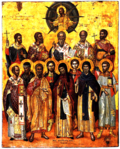 Joseph SamakosVenerableJan 22
- Vissarion of the AgathonosVenerable · Monk of Agathonos MonasteryJan 22
- AmhalghaidhSaintJan 22
- Anastasius the DeaconVenerable Martyr · Deacon of the Kiev CavesJan 22