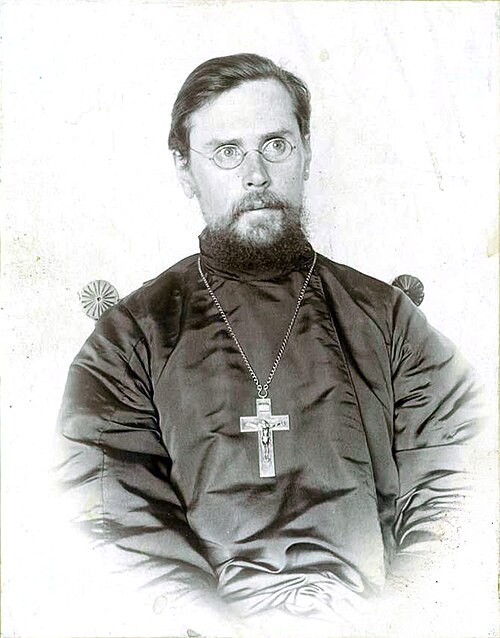
Saint
Anatoly Kamensky
Archbishop of Irkutsk
Archbishop of Irkutsk, a deacon's son and member of the Fourth State Duma, who died in 1925 in Omsk.
- Feast
- July 29old style August 11
- Reposed
- 192520th century
- Place
- Omsk
Life
Anatoly Kamensky (in the world Alexei Vasilievich Kamensky, 1863-1925) was Archbishop of Irkutsk, formerly a missionary in Alaska, Bishop of Elisavetgrad and then of Tomsk, a deputy in the Fourth State Duma and a man of the Russian political right. He was arrested in 1922 for refusing to give church valuables to the State, was sentenced to death, the sentence being commuted to ten years of imprisonment, and then died on 20 September 1925 at Omsk. His canonization, as a hieromartyr, was carried out in 1981 by the Russian Orthodox Church Outside Russia, without a proper day of commemoration. In the sources available no act of the Russian Orthodox Church inside the country appears.
Formation and mission in America
He was born in the village of Staro-Mertvishchevo, Bugulma district, Samara province, in the family of a deacon. He graduated from the church school and the Samara seminary (1886), was a supervisor of the pupils, on 6 August 1888 was ordained priest for the church of the Archangel Michael at Khilkovo and, widowed in 1889, was a district missionary. In 1891 he entered the Saint Petersburg Theological Academy and graduated in 1895 as candidate of theology. On 26 August 1895 he was tonsured a monk by Bishop Nicander and appointed rector of the Archangel Michael Cathedral at Sitka in Alaska, supervisor of the missionary school and dean of the churches in the district. In 1897 he was raised to archimandrite, in 1898 he was assigned to the bishop's house in San Francisco, and from 1899 he was teacher and head of the missionary school in Minneapolis. In 1903 he returned to Russia and was rector of the Odessa seminary.
Bishop and deputy
On 10 December 1906 he was consecrated Bishop of Elisavetgrad, second (from 1913 first) vicar of the Kherson diocese. From 1906 he was abbot of the Dormition Monastery in Odessa and a member of the Union of the Russian People. In 1912 he was elected a deputy of the Fourth State Duma, on the list of the right, and was deputy chairman of the Main Council of the Union of the Russian People. He received several imperial orders. On 30 July 1914 he was named Bishop of Tomsk and Altai. He gave up his status as a Duma member and gave his salary to the Alexeyevsky hospital. He reached Tomsk on 8 January 1916 and started missionary courses at monasteries and Sunday schools. After the February Revolution part of the clergy asked the Synod to replace him, but the complaint had no result. He was a member of the Local Council of 1917-1918 and in 1919 one of the founders of the Brotherhood of the Holy Cross, to fight Bolshevism. He withdrew with Kolchak's troops toward the Far East and stayed at Irkutsk. From 12 July 1920 he was Archbishop of Irkutsk and Verkholensk.
Arrest and end
In the famine of 1921-1922 the campaign for confiscating church valuables began. A commander of the 5th Army asked him in a newspaper for the gold held in sacristies. After three days he answered that he had no authority to dispose of the Church's gold and left it to the church councils and the faithful, adding that the Church is ready to help the starving, but "to you we will not give gold", since the laity do not trust you. Assemblies of the faithful were held and decided not to give the Bolsheviks the golden vessels. For this reason he was arrested, in May 1922. In July he was sentenced to death, the sentence being changed to ten years of imprisonment. He was in solitary confinement at Irkutsk and in 1924 exiled to Moscow. On 1 February 1924 he was retired. The last months he lived at Omsk beside Archbishop Victor, with whom he often served. He died on 20 September 1925, in the altar of the Brotherhood church, during the vigil, and was buried at the Cossack cemetery, then moved to the Staro-Severny cemetery.
Commemorated the same day July 29
 MarthaSaint · Sister of LazarusJul 29
 Olaf of NorwayRight-Believing · King of NorwayJul 29
 Lupus of TroyesSaint · Bishop of TroyesJul 29
 Constantine I of ConstantinopleSaint · Patriarch of ConstantinopleJul 29
- Constantine III of ConstantinopleSaint · Patriarch of ConstantinopleJul 29
 Serapia of RomeMartyr · Martyr of RomeJul 29
 Eustathius of MtskhetaMartyr · Persian convert, martyr in GeorgiaJul 29
 Callinicus of GangraMartyrJul 29
 Constantine of KosinoVenerable · Abbot of Kosino MonasteryJul 29
 Cosmas of KosinoVenerableJul 29
 Daniel of CherkasyMartyrJul 29
 Bessarion of SmolyanNew MartyrJul 29