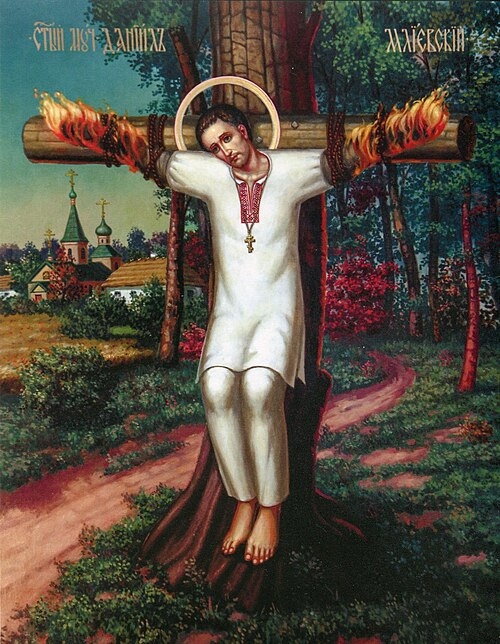
Martyr
Daniel of Cherkasy
Saint from the Cherkasy region of Ukraine, who died in 1766 at Vilshana.
Life
Daniel of Cherkasy (Daniel of Mliiv, in the world Danylo Kushnir) was the churchwarden (steward) of the Dormition church in the village of Mliiv, in the Cherkasy region of Ukraine, put to death on 29 July 1766 near Vilshana, in the time of religious conflicts before the Koliivshchyna uprising. He was canonized by the Ukrainian Autocephalous Orthodox Church of the first revival (UAOC), a body that was not recognized by the canonical Orthodox Churches of the time. According to the Ukrainian source, he is also venerated as a holy martyr by the Ukrainian Orthodox Church (Moscow Patriarchate), the Russian Orthodox Church and the Orthodox Church of Ukraine. His day is 29 July. The text of our source breaks off at the beginning of the chapter on canonization.
The church version
Danylo Kushnir lived in the middle of the eighteenth century, when the Right Bank of the Dnieper was part of the Polish-Lithuanian Commonwealth. Trying to subject all spheres of Ukrainians' life to the crown, the rulers introduced Catholicism by force. So in 1766 at Vilshana a commission gathered which, with the help of the army, dealt fiercely with Orthodox priests and laity. Many were taken to torment, even put to death, and churches were handed by force of arms to Catholics.
In the village of Mliiv there were then two Orthodox churches, of the Trinity and of the Dormition. As priests there served the brothers Basil and Theodore Gdyshytsky, sons of the Catholic archpriest Athanasius, and, following their father, they too went over to the Catholics. The village community chose new priests: for the Trinity church the cantor Gregory Shylenko, for the Dormition church Gregory Khominsky. But the Gdyshytskys would not yield, and a struggle blazed up. The church vessels and vestments were taken into keeping by Danylo Kushnir, who was churchwarden of the Dormition church and had authority, trust and respect among his fellow villagers. The Gdyshytskys said he had stolen them and wrote a denunciation to the governor of Smila, Venta. He ordered him put in chains and imprisoned in the dungeon of Smila castle. This was the end of March 1766. The peasants tried to free their warden, even offering the archpriest Gdyshytsky a ransom. But he insisted that Danylo Kushnir accept Greek Catholicism; only on this condition was he ready to withdraw his slanders. The warden refused firmly. He urged the peasants to hold as firmly as possible to the Orthodox faith inherited from their ancestors, for which he himself was ready to endure all trials. Then Gdyshytsky obtained from the governor an order to put Kushnir to death.
On Saturday, 29 July, he was sent to the Polish military camp near Vilshana, for a public execution. To frighten the people, the population of the surrounding villages was gathered: to see what swift punishment awaited them if they remained disobedient. Kushnir's hands were wrapped in hemp soaked in pitch and set alight. But the executioners did not heed his plea for mercy; on the contrary, the brave man urged the people on no account to believe the Uniates. Even the Polish soldiers felt compassion for the martyr and began to say that the tortures were enough. But Gdyshytsky remained unyielding and ordered his head cut off. Danylo Kushnir turned only to the Most High: "My God, receive my spirit". As he bound the martyr's eyes, the executioner said: "Do not fear, God is with you". "I do not fear, do what you were told". The martyr's body was burned by the Poles. The remains were buried by the locals in a small ditch. At the end of September the head, set on a stake, was stolen and taken to the episcopal Ascension monastery at Pereyaslav, where it was buried.
Historical realities
The Ukrainian source adds a second version, that of historians. The Dormition church of Mliiv, in 1766, was part of the Braila metropolis of the Patriarchate of Constantinople. Saint Daniel of Mliiv, with the community of the Dormition church, resisted the transfer of the church both to the Union and to the Russian synodal church. The sons of the Uniate priest Athanasius Gdyshytsky wanted to become rectors of these churches and for this even passed from the Union to Orthodoxy (at the time of the conflict the Gdyshytsky brothers were Orthodox, though in the course of their lives they passed several times from the Union to Orthodoxy and back). But they inclined toward the Moscow church and intended to transfer these churches to the jurisdiction of the bishop of the left bank. The village did not want this at all, and so chose as priests the cantor Gregory Shylenko for the Trinity church and Gregory Khominsky for the Dormition church, who were to be ordained in the Patriarchate of Constantinople.
The warden of the Dormition church, Danylo Kushnir, foreseeing that the priest Basil Gdyshytsky would try to seize the church, took out with the community the church vessels and removed the tabernacle from the altar table. The priest Basil Gdyshytsky used this and wrote a denunciation to the local authorities, accusing the warden of blasphemy. The representatives of the local government, still of the Polish-Lithuanian Commonwealth, arrested him and put him on trial. Soon Bishop Gervasius forgave the Gdyshytskys all their sins and at the same time launched the myth of the martyr's killing by the Uniates. In fact the holy martyr Danylo Kushnir was a believer of the Patriarchate of Constantinople and equally resisted the forced transfer of his parish both to the Union and to the Russian church.
Danylo's head was stolen and taken to Pereyaslav. Bishop Gervasius left a detailed description of the funeral procession, held on 4 October 1766 with the townspeople, to the ringing of the bells of all the churches of the city, from the Protection church to the Ascension cathedral. In the latter, at the place determined by Gervasius, the head was finally buried in one of the niches inside, to the right of the main entrance. It may be supposed that the saint's relics are there today, since no data are known of a rebuilding of the church walls during repairs and restorations. In January 1768 Melchizedek, commissioned by the Pereyaslav consistory, went to Warsaw to file a suit about the persecution of the Orthodox before the opening of the diet. It was drawn up, probably in the same month, in the form of a "Manifesto" with the signatures of the nobles and "inhabitants" of the Dnieper region. Among other things, the "Manifesto" gives a description of the arrest and execution of Danylo Kushnir. Melchizedek entered the "Manifesto" in the town court and also gave its text to the Russian ambassador in Warsaw, Nikolai Repnin, and to Archbishop George Konissky of Belarus.
Canonization
After the execution of Danylo Kushnir, his veneration as a holy martyr for Christ and the Church spread very quickly among the people. The text of our source breaks off here, at his remains carried from Vilshana, so we cannot say more about the canonization.
Commemorated the same day July 29
 MarthaSaint · Sister of LazarusJul 29
 Olaf of NorwayRight-Believing · King of NorwayJul 29
 Lupus of TroyesSaint · Bishop of TroyesJul 29
 Constantine I of ConstantinopleSaint · Patriarch of ConstantinopleJul 29
- Constantine III of ConstantinopleSaint · Patriarch of ConstantinopleJul 29
 Serapia of RomeMartyr · Martyr of RomeJul 29
 Eustathius of MtskhetaMartyr · Persian convert, martyr in GeorgiaJul 29
 Callinicus of GangraMartyrJul 29
 Constantine of KosinoVenerable · Abbot of Kosino MonasteryJul 29
 Cosmas of KosinoVenerableJul 29
 Anatoly KamenskySaint · Archbishop of IrkutskJul 29
 Bessarion of SmolyanNew MartyrJul 29