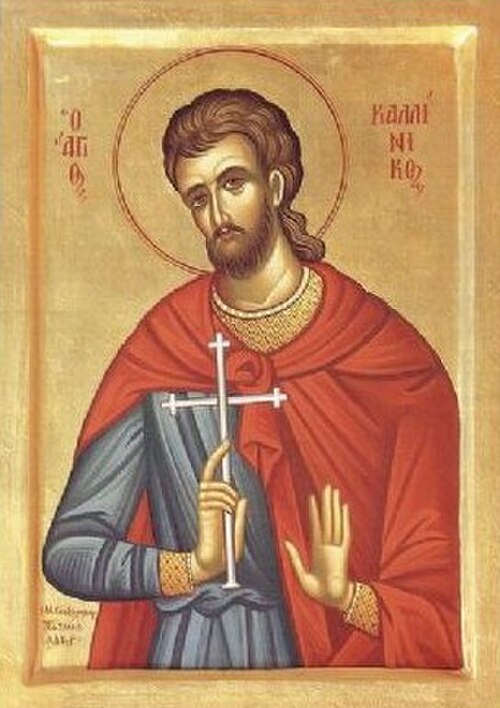
Martyr
Callinicus of Gangra
Life
Saint Callinicus the Great Martyr of Gangra (in Paphlagonia) was a Christian preacher of the second or third century, burned alive at Gangra after being first tortured at Ancyra in Galatia. His Life, preserved in the Greek Synaxaria, tells of a fearless confession, a miracle of water on the road to the place of martyrdom and a death in the furnace, met with prayer. The Church commemorates him on 29 July (11 August by the new calendar).
Life and preaching
According to tradition, Callinicus was born into a well-off family, by some sources in Cilicia, and was learned and a great orator. While still young he was catechized in the Christian faith and, full of faith and devotion to the Word of God, began to preach it, starting from the city of Gangra. In a very short time a large part of the inhabitants were baptized. He then continued his teaching in neighbouring cities and reached Ancyra, the populous city of Galatia.
A Bulgarian source adds that, having reached mature age, Callinicus was troubled by the large number of pagans around him and resolved to work for their conversion and for weakening the influence of idolatry, making several journeys and preaching, it is supposed chiefly in Phrygia, with great success. He remained a long time at Ancyra, preached much and baptized many. But among the inhabitants were some who opposed him resolutely and denounced him to the city's governor.
The trial at Ancyra
When the governor of the city, Sacerdon, learned that someone was stirring up the crowds against the gods of the ancestors and disturbing religious order, he ordered his arrest. According to the Bulgarian source, Sacerdon was of princely stock, perhaps of Persian or Parthian origin, and was known as a persecutor of Christians and a fierce adherent of pagan cults. Callinicus was brought before him as "the foreigner Callinicus", because he belonged to the authorities of the neighbouring city of Gangra, from where he was later sent to execution.
The prince asked him angrily how he, a stranger, had dared to corrupt the people, teaching them to leave the gods who made the world and whom the emperor honours. Callinicus answered from Holy Scripture, saying that whoever turns a sinner from the error of his way will save a soul from death, and offered to baptize him. Sacerdon refused, threatened to torture him and said he wanted to see whether his God would come to deliver him. Callinicus answered, says the Life, that any torment for his God was as welcome to him as bread to the hungry, and asked him not to delay. The governor ordered him beaten with whips and torn with iron instruments, but Callinicus bore them bravely, asking for more, as contests of faith.
The road to Gangra
Not permitted, according to the Serbian source, to torture or kill him further at Ancyra, because many people believed in Christ on seeing his torment, the governor ordered his feet shod in iron sandals with nails inside and that he be taken to Gangra, to be killed there, so that those there, who were his disciples, would be corrected. The mounted soldiers took him bound, dragged with a rope. It was summer, the sun burned and the road was waterless. Soon the soldiers began to thirst, and the horses too, until they fell ready to die. Seeing Callinicus standing on his feet with no sense of thirst, they began to beg him to save them, saying: "Saint, do not remember the wrongs we did you, have pity and save us from the heat, we have no other hope".
Then Callinicus, praying with faith that God would help the soldiers, made a spring of water gush from the dry ground. The Serbian source says he brought water from a rock. After the miracle the soldiers, coming to themselves, did not know what to do, but fearing the consequences of not carrying out the order, they put the martyr on a horse and went on toward Gangra, thinking on the way what to do. Arriving outside the walls of the city they stopped to confer, unable to decide. Then Callinicus advised them to carry out the order, so that they too would not receive the death penalty, and also for himself, who was ready to pass from temporary death to immortal life.
Martyrdom
The soldiers went on and, near the gate of the walls of Gangra, where there was a furnace, they lit a great fire into which they threw Callinicus, who was glorifying God. According to the Serbian source, before entering the fire he prayed: "I thank Thee, heavenly Father, that Thou hast made me worthy of this hour, in which I die for Thy holy name". By Christian tradition, when the fire died down they found his body dead but whole and unharmed by the fire. He suffered for faith in Jesus Christ, according to the Serbian source, about the year 250. His hymns, the apolytikion, kontakion and megalynarion, are sung at the service of 29 July.
Commemorated the same day July 29
 MarthaSaint · Sister of LazarusJul 29
 Olaf of NorwayRight-Believing · King of NorwayJul 29
 Lupus of TroyesSaint · Bishop of TroyesJul 29
 Constantine I of ConstantinopleSaint · Patriarch of ConstantinopleJul 29
- Constantine III of ConstantinopleSaint · Patriarch of ConstantinopleJul 29
 Serapia of RomeMartyr · Martyr of RomeJul 29
 Eustathius of MtskhetaMartyr · Persian convert, martyr in GeorgiaJul 29
 Constantine of KosinoVenerable · Abbot of Kosino MonasteryJul 29
 Cosmas of KosinoVenerableJul 29
 Anatoly KamenskySaint · Archbishop of IrkutskJul 29
 Daniel of CherkasyMartyrJul 29
 Bessarion of SmolyanNew MartyrJul 29