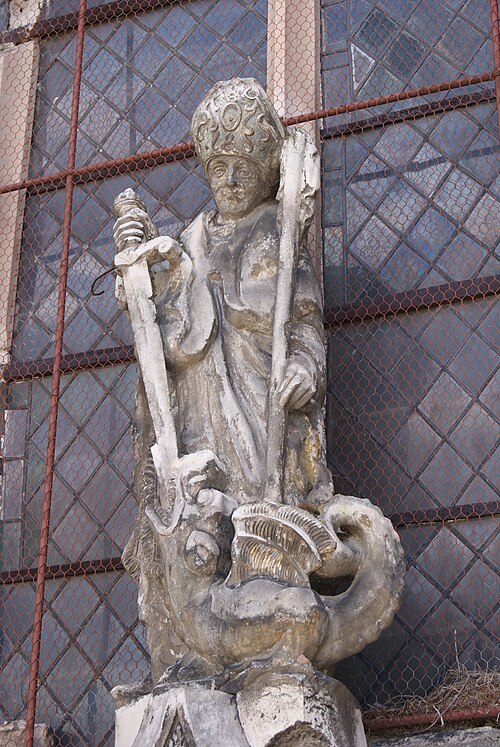
Saint
Lupus of Troyes
Bishop of Troyes
Bishop of Troyes, sent with Germanus of Auxerre to Britain against Pelagianism in about 426.
Life
Saint Lupus was bishop of Troyes in Gaul for over fifty years in the fifth century. The Church remembers him as a bishop of austere life, sent with Saint Germanus of Auxerre to strengthen the right faith in Britain against Pelagianism, and as a defender of his city.
He was born at Toul around 395, the son of the wealthy nobleman Epirocus. Orphaned young, he was raised by his uncle Alistocus. He married Pimeniola, sister of Saint Hilary of Arles, held estates in Maxima Sequanorum and worked as a lawyer. After six years of marriage the couple parted by mutual agreement. Lupus sold his property, gave the money to the poor and entered the monastery of Lérins, led by Saint Honoratus, where he stayed about a year. When Honoratus was named bishop of Arles in 427, Lupus withdrew to Mâcon, where he came to the notice of Germanus of Auxerre, who made him bishop of Troyes. Lupus took the office with reluctance, at first declining it. The Council of Arles sent him, in the autumn of 429 according to some sources, with Germanus, at the request of the British bishops, against Pelagianism; they returned to Gaul after Easter in the spring of 430. In Wales he is remembered as Bleiddian, and at Llanblethian in the Vale of Glamorgan he is still venerated.
He shepherded his flock for fifty-two years and fell asleep at Troyes in 479, held as a model of austere life. Sidonius Apollinaris called him the father of fathers and bishop of bishops. He was a friend of Bishop Euphronius of Autun.
Tradition says that in 451 he saved his city from the Huns. In the story, after many days of prayer, he went out in episcopal vestments at the head of a procession of clergy to meet Attila, who, impressed, spared the city. After the battle of Châlons Attila is said to have asked him to accompany him, believing his presence would protect his army; the Romans accused him of helping the Huns escape, and Lupus had to withdraw for a time to the mountains as a hermit. Many scholars doubt this episode, which is similar to the story told of Saint Genevieve. The historical kernel may be that Troyes was spared and its people saw this as a miraculous deliverance. He was buried near Troyes; later a monastery was built over his grave. His feast is on 29 July.
Commemorated the same day July 29
 MarthaSaint · Sister of LazarusJul 29
 Olaf of NorwayRight-Believing · King of NorwayJul 29
 Constantine I of ConstantinopleSaint · Patriarch of ConstantinopleJul 29
- Constantine III of ConstantinopleSaint · Patriarch of ConstantinopleJul 29
 Serapia of RomeMartyr · Martyr of RomeJul 29
 Eustathius of MtskhetaMartyr · Persian convert, martyr in GeorgiaJul 29
 Callinicus of GangraMartyrJul 29
 Constantine of KosinoVenerable · Abbot of Kosino MonasteryJul 29
 Cosmas of KosinoVenerableJul 29
 Anatoly KamenskySaint · Archbishop of IrkutskJul 29
 Daniel of CherkasyMartyrJul 29
 Bessarion of SmolyanNew MartyrJul 29