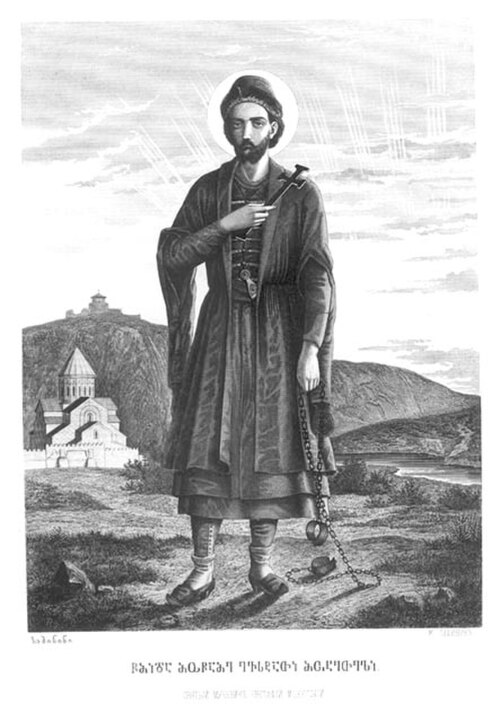
Martyr
Eustathius of Mtskheta
Persian convert, martyr in Georgia
Persian Christian, a former Zoroastrian, executed around 550 by Sasanian authorities in Caucasian Iberia.
Life
Holy Martyr Eustathius of Mtskheta was a Persian Christian, a former Zoroastrian, killed around 550 by the Sasanian authorities in Caucasian Iberia (Kartli, in eastern Georgia). His story is told in the anonymous sixth-century Georgian hagiographic work The Passion of Eustathius of Mtskheta. His commemoration is on 29 July by the old calendar (11 August by the new).
The Passion of Eustathius is one of the earliest surviving works of Georgian literature, written by an anonymous author toward the end of the sixth century, within thirty years of his death. The manner of writing and its theological vocabulary support this dating, although the earliest surviving manuscript is from around the year 1000. The text contains the earliest Georgian formulation of the Ten Commandments, an account of the life of Jesus that recalls Tatian's Diatessaron, and traces of the Apology of Aristides. It was first published by Mikhail Sabinin in 1882.
According to the hagiographer, Eustathius was an Iranian cobbler, originally named Gvirobandak, the son of a high-ranking Zoroastrian priest (magus) from Ganzak. The Serbian source says he was from the village of Arbuketa. Having converted to Christianity, he fled persecution and came to Georgia (Iberia), then under Iranian military authority, in 541. The Serbian source says he came to Mtskheta in his thirtieth year and, seeing how the Christians lived and believed, received baptism. He settled in the Christian town of Mtskheta and married a Christian woman.
The local guild of Iranian cobblers denounced him, together with seven other converts, to the marzban Arvand Gushnasp, to be judged. Arvand punished the apostates by having their noses pierced and imprisoned them under sentence of death. After six months, Arvand released them, as a farewell gesture to the local population, when he was recalled from Georgia by King Khosrau I. Four years later, under the new marzban Vezhan Buzmihr, Eustathius was arrested again, but reaffirmed his faith before the court in a speech of about three thousand words, which makes up nearly half of the Passion. In the end the marzban, though reluctant, ordered his execution by beheading at Tbilisi. His relics were taken to Mtskheta and buried in the principal church. The Serbian source says that he was killed in 589, a date which does not fit the others, and that, according to tradition, many of the faithful were healed of illnesses at his grave.
Commemorated the same day July 29
 MarthaSaint · Sister of LazarusJul 29
 Olaf of NorwayRight-Believing · King of NorwayJul 29
 Lupus of TroyesSaint · Bishop of TroyesJul 29
 Constantine I of ConstantinopleSaint · Patriarch of ConstantinopleJul 29
- Constantine III of ConstantinopleSaint · Patriarch of ConstantinopleJul 29
 Serapia of RomeMartyr · Martyr of RomeJul 29
 Callinicus of GangraMartyrJul 29
 Constantine of KosinoVenerable · Abbot of Kosino MonasteryJul 29
 Cosmas of KosinoVenerableJul 29
 Anatoly KamenskySaint · Archbishop of IrkutskJul 29
 Daniel of CherkasyMartyrJul 29
 Bessarion of SmolyanNew MartyrJul 29