Martyr
Serapia of Rome
Martyr of Rome
Born at Antioch to Christian parents, she fled to Italy from Hadrian's persecution and died a martyr in Rome.
Life
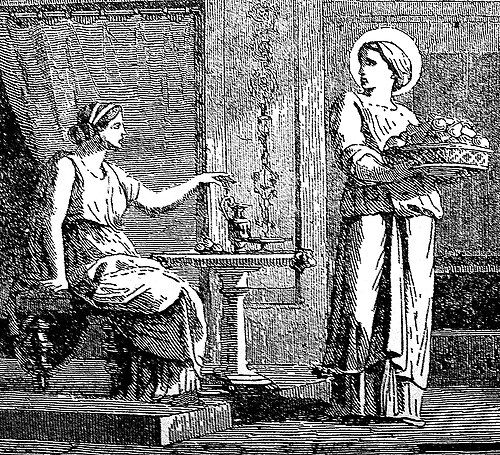
The holy martyr Serapia (Seraphia, Seraphima) was a young woman of Antioch in Syria, a slave by her own choice and a martyr at Rome in the time of the Emperor Hadrian, around the end of 119 (according to some sources between 117 and 138). She is commemorated on 29 July, and in some sources also on 3 September.
She was born at Antioch, at the end of the first century, to Christian parents, who fled the persecution of Hadrian and settled in Italy. After her parents died, many sought her hand, but she resolved to give herself to God alone. She sold her property and gave the money to the poor, then sold herself into slavery and entered the service of a noble Roman woman, Sabina. Serapia's piety, diligence and charity won the heart of her mistress, who accepted the Christian faith. Sabina then withdrew with a few devout friends to one of her country estates near Vindena in Umbria, where they devoted themselves to prayer and works of charity.
In the time of Hadrian, Serapia was commanded to do homage to the gods of Rome. She refused and was handed over to two men to defile her, but they fell unconscious; according to the Serbian source, an angel with a sword in his hand appeared to them, and next day, at the judge's request, she woke them by prayer. The judge, called Virilus (or Derillus), attributed all this to sorcery. They tried to burn her with torches but could not, and according to the Serbian tradition, while she was being beaten with sticks, a piece of a stick flew off and struck Virilus in the eye, blinding him. In the end she was beaten with rods and beheaded with the sword.
Sabina buried her body in their family tomb near the Vindician field. Not long afterwards Sabina met the same fate. The basilica of Santa Sabina on the Aventine Hill originally bore the dedication of both saints. Serapia is honoured especially on 3 September, the day on which their common tomb was completed, adorned and consecrated as a place of prayer. Her relics are said to heal the sick.
In icons she is shown holding a book or a tablet, sometimes together with Saint Sabina. Around 1639 Claude Lorrain painted for King Philip IV of Spain "Landscape with the Burial of Saint Serapia", which now hangs in the Prado Museum.
Commemorated the same day July 29
 MarthaSaint · Sister of LazarusJul 29
 Olaf of NorwayRight-Believing · King of NorwayJul 29
 Lupus of TroyesSaint · Bishop of TroyesJul 29
 Constantine I of ConstantinopleSaint · Patriarch of ConstantinopleJul 29
- Constantine III of ConstantinopleSaint · Patriarch of ConstantinopleJul 29
 Eustathius of MtskhetaMartyr · Persian convert, martyr in GeorgiaJul 29
 Callinicus of GangraMartyrJul 29
 Constantine of KosinoVenerable · Abbot of Kosino MonasteryJul 29
 Cosmas of KosinoVenerableJul 29
 Anatoly KamenskySaint · Archbishop of IrkutskJul 29
 Daniel of CherkasyMartyrJul 29
 Bessarion of SmolyanNew MartyrJul 29