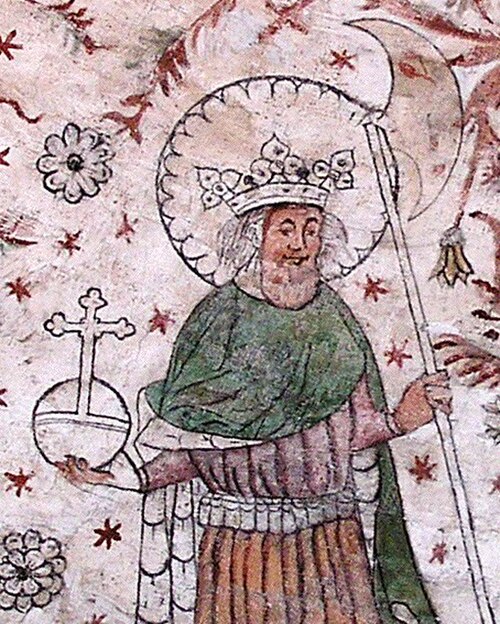
Right-Believing
Olaf of Norway
King of Norway
King of Norway from 1015 to 1028, who spread Christianity, killed at the battle of Stiklestad in 1030.
- Feast
- July 29old style August 11
- Reposed
- 103011th century
- Place
- Stiklestad
Life
Olaf of Norway, called Olaf Haraldsson, Olaf the Holy or, in his lifetime, Olaf the Stout, was king of Norway from 1015 to 1028 and fell in the battle of Stiklestad on 29 July 1030. His name is tied to the christianization of Norway, and his veneration as a saint helped Christianity take root in Scandinavia. He died before the great schism of 1054, and the Roman Catholic Church has honoured him for centuries as the patron of Norway. Orthodox calendars, among them the Romanian and the Russian, keep his memory on 29 July (11 August on the new style) as a holy king and martyr.
Youth
He was born around 995 in the district of Ringerike, the son of Harald Grenske, a petty king in Vestfold, and of Åsta Gudbrandsdatter. His father died while his mother was still pregnant with him, and his mother married Sigurd Syr, by whom she had several children, among them the future Harald Hardrada. According to the sagas he was a great-great-grandson of Harald Fairhair, the first king of Norway.
While still young, between 1007 and 1013, he made Viking expeditions along the shores of the Baltic, in Sweden, Estonia and Finland, then in Denmark and England, first with the Danes and then with the Anglo-Saxons. On the way home he wintered with Duke Richard II of Normandy and received Baptism at Rouen in 1013, according to the most common account. Other Russian sources give Novgorod or Kiev as the place.
The king
In 1015 he returned to Norway and proclaimed himself king, with the support of five petty kings of the uplands. In 1016, at the battle of Nesjar, he defeated Earl Sweyn, the de facto ruler of the land. Within a few years he held more power than any of his predecessors, ended the petty kings of the south, subdued the nobility and made peace with Sweden. In 1019 he married Astrid, the daughter of the Swedish king Olof, and had a daughter, Wulfhild.
His most important work was to spread Christianity. He brought bishops from England into the land, among them Grimketel, four in all according to the Romanian tradition, set up a wider church organization than before, and tried to enforce the faith in the inland districts, where paganism was strongest. The chroniclers tell that in a valley he struck down a wooden image of Thor before the frightened locals. Mice and snakes came out of the statue, but no thunder rolled and no lightning struck him. Many believe that in 1024 he set down the Christian law of the land, but the Kuli stone on which this opinion rests is hard to interpret.
Historians today add that his role may have been exaggerated by legend, since the coasts of Norway were much influenced by Christianity before him, and that his reign was harsh. He is said to have been inclined to violence and to have treated his enemies roughly, and some church rules were ascribed to him later. Still, it remains true that he worked steadily to strengthen the Church in the land.
Exile and Stiklestad
His reign was full of wars, above all with Sweden and Denmark, and in 1026 he fought at Helgeå. The opposition of some chieftains and the power of King Cnut the Great of Denmark forced him into exile in 1028. He took refuge at the court of Grand Prince Yaroslav the Wise, in Kievan Rus', with his son Magnus. On the way, in Sweden, according to a local legend, he baptized many people.
In 1030, seizing the chance when Cnut's earl was lost at sea, he crossed the mountains of Jämtland with the help of the Swedish king Anund, to retake Nidaros. On 29 July 1030, at Stiklestad, he fell in battle against an army that included some of his own subjects from central and northern Norway. According to the Romanian account, he fell under the axe blow of a pagan rebel, uttering the prayer "Lord, save". The saga says that on the day of the battle the sun was darkened. The axe became the symbol of his martyrdom and stands today in the coat of arms of Norway.
Glorification
His body was buried on the river bank, in the sand. After a year, on 3 August 1031, Bishop Grimketel lifted the body and moved it to Nidaros, today Trondheim, where he ordered it venerated as a saint. At that time, by the custom of the age, bishops and people recognised a man as a saint without a procedure at Rome, and a formal papal canonization came much later. Pope Alexander III confirmed the veneration in 1164, and in the cathedral of Nidaros, raised over the grave, his shrine stood, the most important place of pilgrimage in the North until the Reformation. The poem Geisli tells of his miracles, among them the healing of a blind man who touched his eyes with hands stained by the saint's blood. The title Rex Perpetuus Norvegiae, eternal king of Norway, dates from the thirteenth century.
His illegitimate son Magnus the Good became king after Cnut died, and promoted the cult of his father. Churches in his name rose in Denmark, in England, where he is called Olave, and in Russia, at Novgorod and Staraya Ladoga. The exact site of his grave in Nidaros has been unknown since 1568, after the Lutheran iconoclasm of 1536 and 1537.
Veneration today
The Orthodox veneration of the saint was kept in the Eastern calendars, and in recent times it has been renewed in Norway: in 2003 an Orthodox chapel in his name was consecrated at Folldal, and in 2014, a thousand years after his baptism, one at his resting place at Stiklestad. In 2016 archaeologists found in Trondheim the foundation of the church of Saint Clement, which is thought to have housed his shrine. His day, Olsok, is still a celebration in Norway, and the Order of Saint Olav bears his name.
Commemorated the same day July 29
 MarthaSaint · Sister of LazarusJul 29
 Lupus of TroyesSaint · Bishop of TroyesJul 29
 Constantine I of ConstantinopleSaint · Patriarch of ConstantinopleJul 29
- Constantine III of ConstantinopleSaint · Patriarch of ConstantinopleJul 29
 Serapia of RomeMartyr · Martyr of RomeJul 29
 Eustathius of MtskhetaMartyr · Persian convert, martyr in GeorgiaJul 29
 Callinicus of GangraMartyrJul 29
 Constantine of KosinoVenerable · Abbot of Kosino MonasteryJul 29
 Cosmas of KosinoVenerableJul 29
 Anatoly KamenskySaint · Archbishop of IrkutskJul 29
 Daniel of CherkasyMartyrJul 29
 Bessarion of SmolyanNew MartyrJul 29