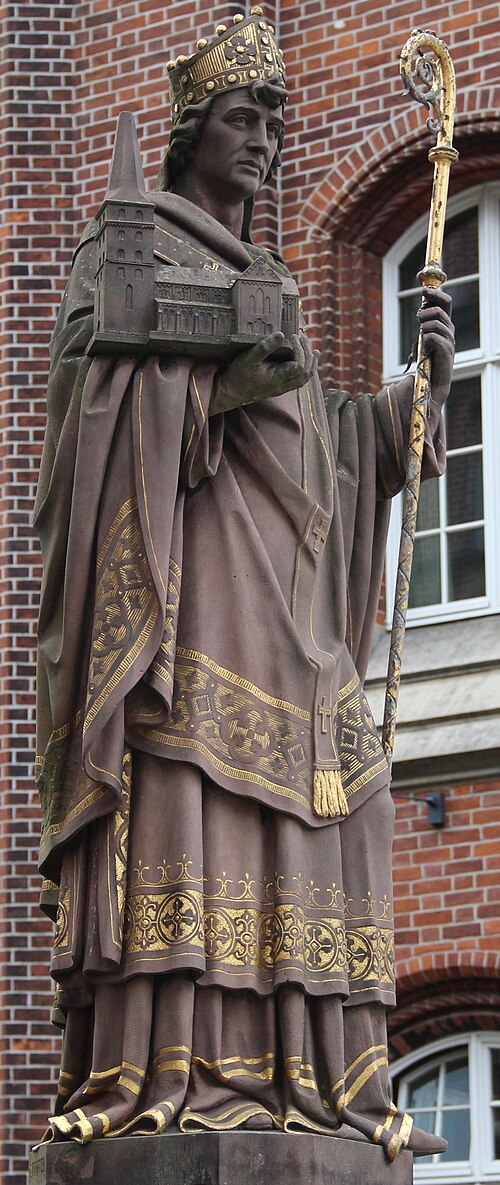
Saint
Ansgar
Archbishop of Hamburg-Bremen
Missionary to Denmark and Sweden, called the Apostle of the North, who became archbishop of Hamburg-Bremen.
- Feast
- February 3old style February 16
- Reposed
- 8659th century
- Place
- Bremen
- Order
- Hierarchs
Life
Saint Ansgar was a missionary to Denmark and Sweden, called the Apostle of the North, and the first archbishop of Hamburg-Bremen. The Church commemorates him on 3 February.
Childhood and youth
He was born on 8 September 801, into a noble Frankish family, near Amiens, in Picardy. After the early death of his mother he was raised in the Benedictine monastery of Corbie. Rimbert, his pupil, successor and biographer, tells in the Life of Ansgar that in childhood he saw in a vision his mother in the company of the Mother of God. From that time he put aside his carelessness about spiritual things and took life seriously, and Rimbert considered this vision, the first of many, the chief motive of his life. In 822 he was sent, with other monks, to found the monastery of Corvey, in Westphalia, where he was a teacher and preacher.
The missions
With a group of monks he went to Jutland with King Harald Klak, who had received Baptism in exile. After Harald's downfall, in 827, and the death of his companion Autbert, the school for the sons of courtiers was closed, and Ansgar returned to Germany. In 829, when the Swedish king Björn asked for missionaries, the emperor Louis the Pious sent Ansgar, with the monk Witmar. He preached and made converts, above all in the six months spent at Birka, on Lake Mälaren, where a wealthy widow, Frideborg, gave him hospitality. With her and the king's steward, Hergeir, he formed a small Christian congregation.
The archbishop
In 831 he returned to the court of Louis at Worms and was appointed archbishop of Hamburg-Bremen, a new archbishopric, with the right to send missions into all the northern lands and to consecrate bishops for them. He was consecrated bishop in November 831, with the approval of Pope Gregory IV, received the pallium at Rome and was named legate for the North. The king of the Swedes decided to cast lots on whether to receive the Christian missionaries, and Ansgar committed the cause to God, and the lot was favourable. At Hamburg he founded a monastery and a school, which however bore little fruit.
Trials
After the death of Louis the Pious, in 840, Ansgar lost the abbey of Turholt, given to support his work. In 845 the Danes raided Hamburg, and all the treasures and books of the church were destroyed. Ansgar was left with neither see nor revenue, and many helpers deserted him. In 847 he was named to the vacant diocese of Bremen, where he moved in 848. The union of the sees of Bremen and Hamburg was approved by Pope Nicholas I only in 864. Throughout this time he kept working for the mission in the North. He won the friendship of the Danish kings Horik the Elder and Horik II, obtained permission to build a church at Sleswick and recognition of Christianity as a tolerated religion. Between 848 and 850 he spent two years in Sweden, averting a threatened return to paganism, and in 854 he returned there, in the time of King Olof.
Repose
Ansgar died at Bremen on 3 February 865 and was buried there. Rimbert, his successor in the see, says he wore a rough hair shirt and lived on bread and water. He is honoured as a saint in the Roman Catholic Church, and in the Orthodox Church as a local saint of the diocese of Berlin and Germany.
Commemorated the same day February 3
 Anna the ProphetessProphet · Prophetess of the TempleFeb 3
 Simeon the God-receiverRighteous · The Righteous of the TempleFeb 3
 Nicholas of JapanEqual-to-the-Apostles · Archbishop of JapanFeb 3
 Laurence of CanterburySaint · Archbishop of CanterburyFeb 3
 WerburghVenerable · Abbess, patron of ChesterFeb 3
 Ignatius of MariupolSaint · Metropolitan of Gothia and KaffaFeb 3
 HadelinVenerable · Missionary monk in BelgiumFeb 3
 Roman of UglichRight-Believing · Prince of UglichFeb 3
 Simeon of TverSaint · First bishop of TverFeb 3
 Oliver of AnconaVenerableFeb 3
 Alexius of NovgorodSaint · Archbishop of NovgorodFeb 3
- Celerinus of CarthageConfessor · Deacon of CarthageFeb 3