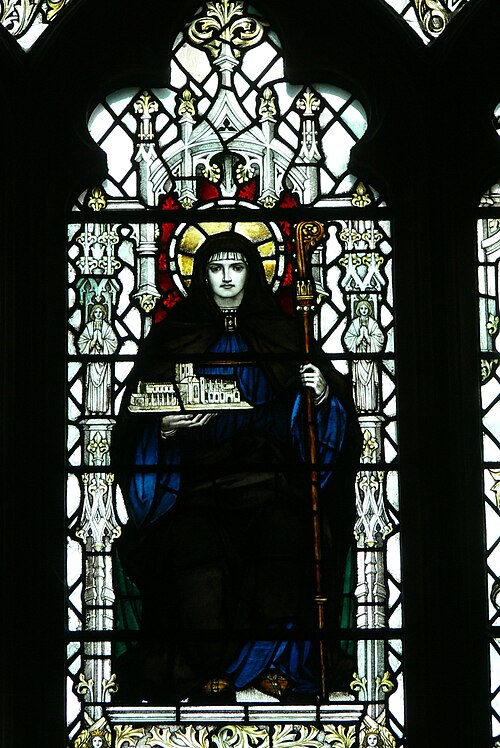
Venerable
Werburgh
Abbess, patron of Chester
Anglo-Saxon princess who became an abbess and is the patron of Chester; she is remembered on 3 February.
- Feast
- February 3old style February 16
- Reposed
- 6997th century
- Place
- Stoke-on-Trent
- Order
- Venerables
Life
Saint Werburgh was an Anglo-Saxon princess who became abbess of Ely and is the patron of the city of Chester. Her name means "true city". The Church remembers her on 3 February.
She was born around 650 at Stone, now in Staffordshire, daughter of King Wulfhere of Mercia and Queen Ermenilda, daughter of the king of Kent. Wulfhere was the Christian son of the pagan king Penda. With her father's consent she entered the abbey of Ely, founded by her great-aunt Saint Etheldreda (Audrey), its first abbess and former queen of Northumbria. She was trained at home by Saint Chad, later bishop of Lichfield, and by her mother, and in the cloister by her aunt and grandmother, Saints Etheldreda and Seaxburh. She was a nun nearly all her life, for a time at Weedon Bec in Northamptonshire, and took part in the reform of convents across England. In the end she became the fourth abbess of Ely, after her mother Ermenilda, her grandmother Seaxburh and her great-aunt Etheldreda. She fell asleep on 3 February in 699 or 700 and was buried at Hanbury in Staffordshire.
After her death her brother Coenred, who had become king of Mercia, decided in 708 to move her remains to a more prominent place in the church. When the tomb was opened her body was found intact, a sign of divine favour. A year later Coenred gave up the throne and became a monk in Rome. The best-known story of Werburgh, told by Goscelin, is that of a dead goose, eaten, which she brought back to life. A stained glass window in the church of Saints Peter and Paul at Weedon Bec recalls another tradition, in which she banished the geese from the village.
The shrine remained at Hanbury until the threat of Danish raids in the late ninth century brought her relics into the walled city of Chester, to the church of Saints Peter and Paul, where the cathedral now stands. In 975 the church was rededicated to Saint Werburgh and Saint Oswald of Northumbria, and in the eleventh century a monastery was attached to it. By 1057 the church had been rebuilt and endowed by Leofric, Earl of Mercia, and Werburgh was regarded as the city's protector. A miracle attributed to her is the unexpected withdrawal of the Welsh king Gruffudd ap Llywelyn from besieging the city. In 1093 Hugh d'Avranches gave the abbey property and established a Benedictine monastery with monks from Bec. In the Middle Ages a badge of a gaggle of geese marked those who had made pilgrimage to her shrine. At the dissolution of the abbey in 1540 Chester Cathedral was born, dedicated to Christ and the Blessed Virgin Mary. The rich fourteenth-century shrine was broken up, and her relics were lost. Parts of the shrine's stonework were reassembled in 1876 and stand in the cathedral's Lady Chapel. At least ten churches in England, in Dublin, Derby, Stoke-on-Trent and Spondon, bear her name.
Commemorated the same day February 3
 Anna the ProphetessProphet · Prophetess of the TempleFeb 3
 AnsgarSaint · Archbishop of Hamburg-BremenFeb 3
 Simeon the God-receiverRighteous · The Righteous of the TempleFeb 3
 Nicholas of JapanEqual-to-the-Apostles · Archbishop of JapanFeb 3
 Laurence of CanterburySaint · Archbishop of CanterburyFeb 3
 Ignatius of MariupolSaint · Metropolitan of Gothia and KaffaFeb 3
 HadelinVenerable · Missionary monk in BelgiumFeb 3
 Roman of UglichRight-Believing · Prince of UglichFeb 3
 Simeon of TverSaint · First bishop of TverFeb 3
 Oliver of AnconaVenerableFeb 3
 Alexius of NovgorodSaint · Archbishop of NovgorodFeb 3
- Celerinus of CarthageConfessor · Deacon of CarthageFeb 3